Modern navigation is a true wonder. Satellite mapping and imagery, GPS, digital charts, crowd-sourced sonar bathymetry, and the shareability of the internet, all make even detailed local knowledge available to anyone. Even with all that, though, reality still imposes limits.
Doug spends many winter nights carefully plotting courses and stopovers using all available tools for the coming season. But even the best information can become stale and outdated before you have a chance to use it. A single storm can change the location of channels and shift shoals overnight. This is especially true in the shallow waters of the southern coast, where sandbars swept by strong tides can snake offshore for 10 miles, and inlets will open and close suddenly in really big storms.
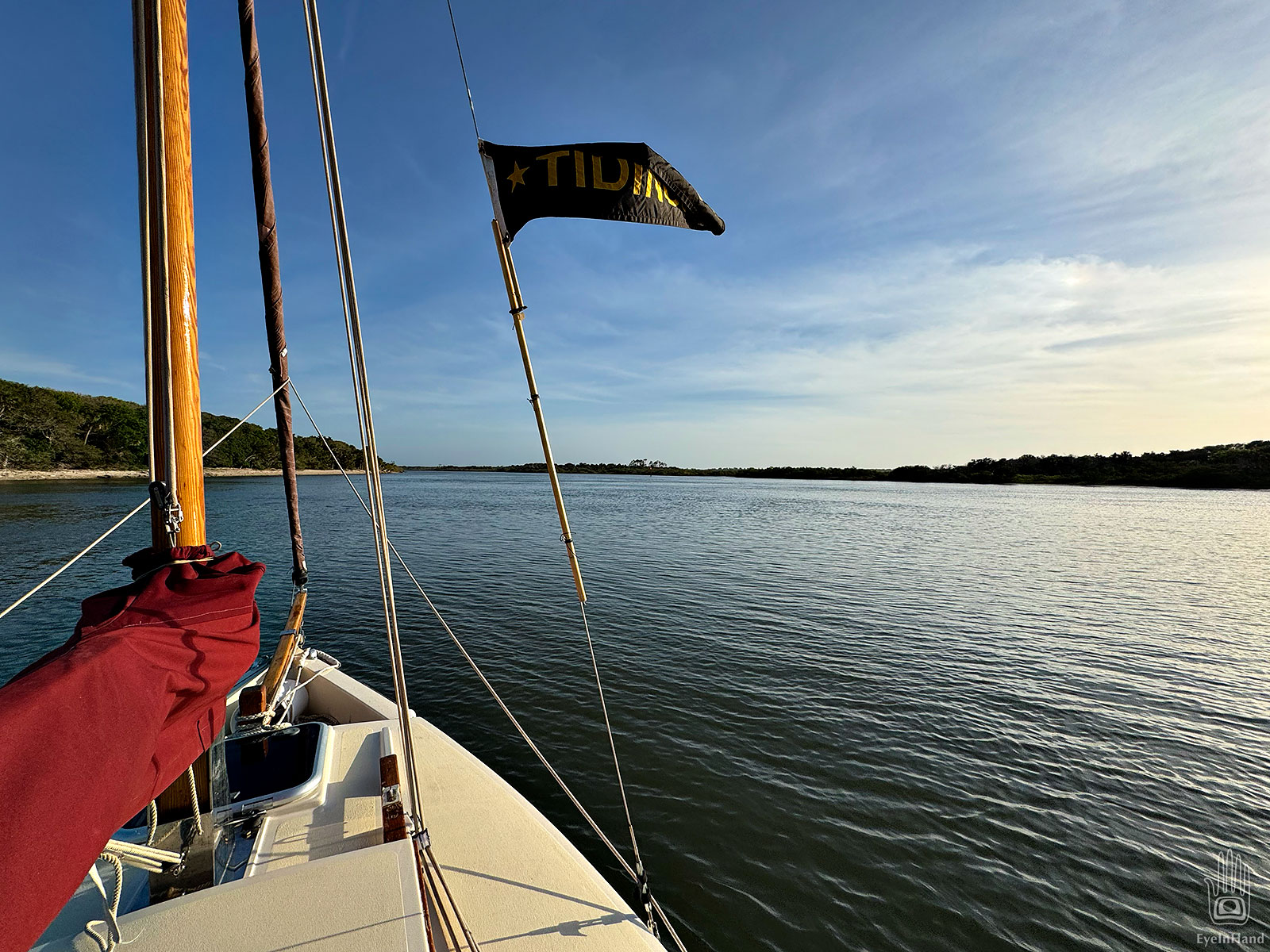
Pellicer Creek beyond the sandbar
The spot chosen to anchor for the night is a side creek just outside the ditch, just inside the Princess Place Preserve, where a string of small islands separate the ICW from a broad expanse of open water called Pellicer Creek.
Notes in the chart book from other boaters recommend it as a good anchorage, with 6 feet of water outside the channel. Tidings only draws 2 feet with the board up. Easy peezy. But just to be safe, Doug lowers the motor to idle, reducing our speed to around 1 knot. He has me steer between two islands for the open water while he watches the depthfinder.
Just after daybreak. It’s almost time to shove off and I have to find a hat. It’s technically still Spring, but the sun here is blazing hot, relentless, and I don’t have a good hat. Couldn’t figure out how to pack one in the carryon for the flight. This is my quest, to be completed before breakfast. I have thirty minutes. I will fail.
Stowage on Tidings is super tight. No room for suitcases, just one collapsable duffel. Everything I can bring for the next three weeks has to fit in a ten gallon cooler box. (And a doctor bag of tech gear, on special dispensation from the captain.) I could not figure out how to pack my favorite straw hat. Figured, “It’s Florida, right? Lots of hats down there. You know, for the tourists.”
The airport is only three miles from the harbor, one of the reasons we chose to connect here. Doug meets me and we hail an Uber for the short hop to the marina. It’s still mid April, but the sun is already a white hot glare off asphalt and concrete. Everything looks sun-bleached and pale.
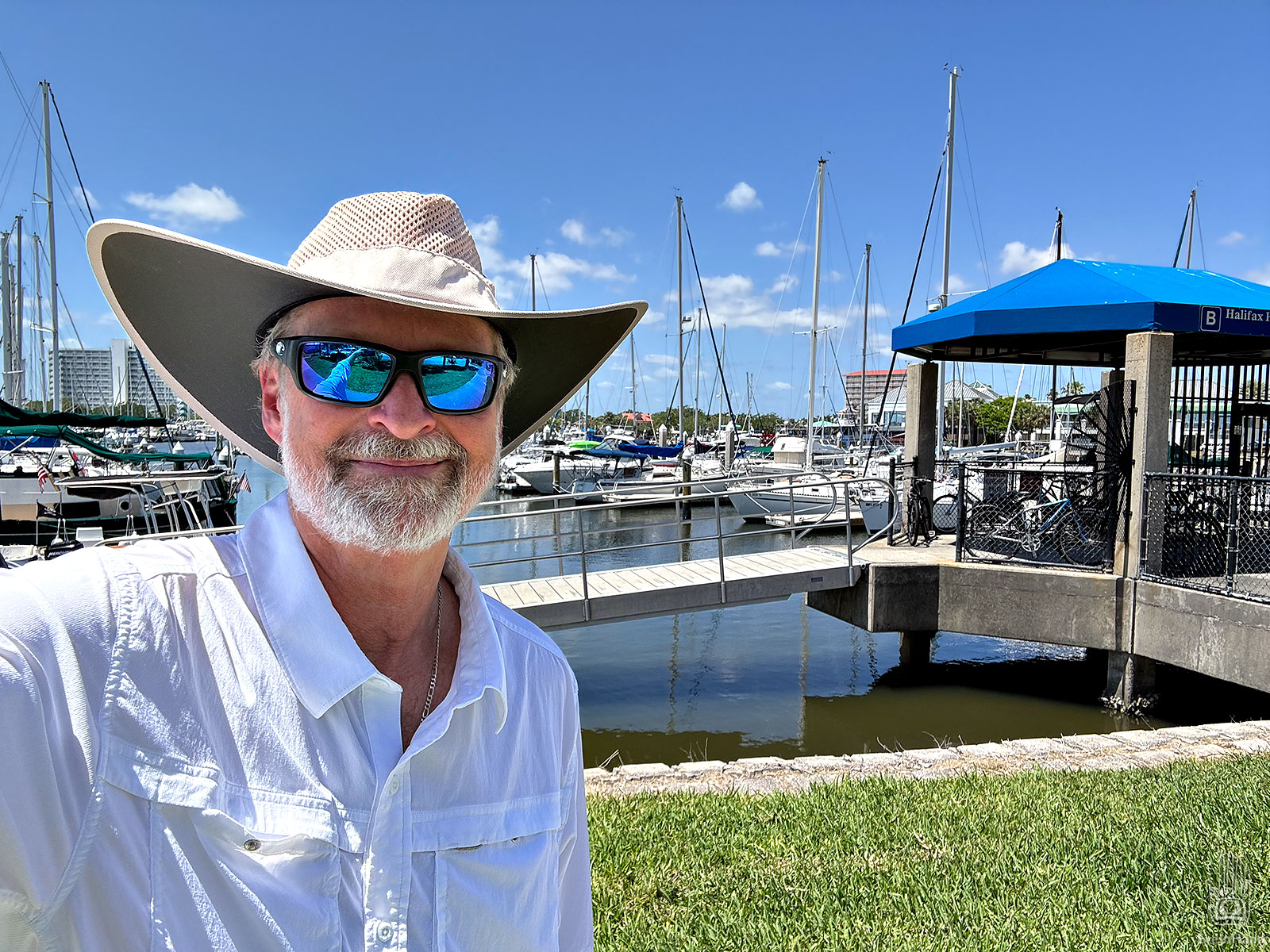
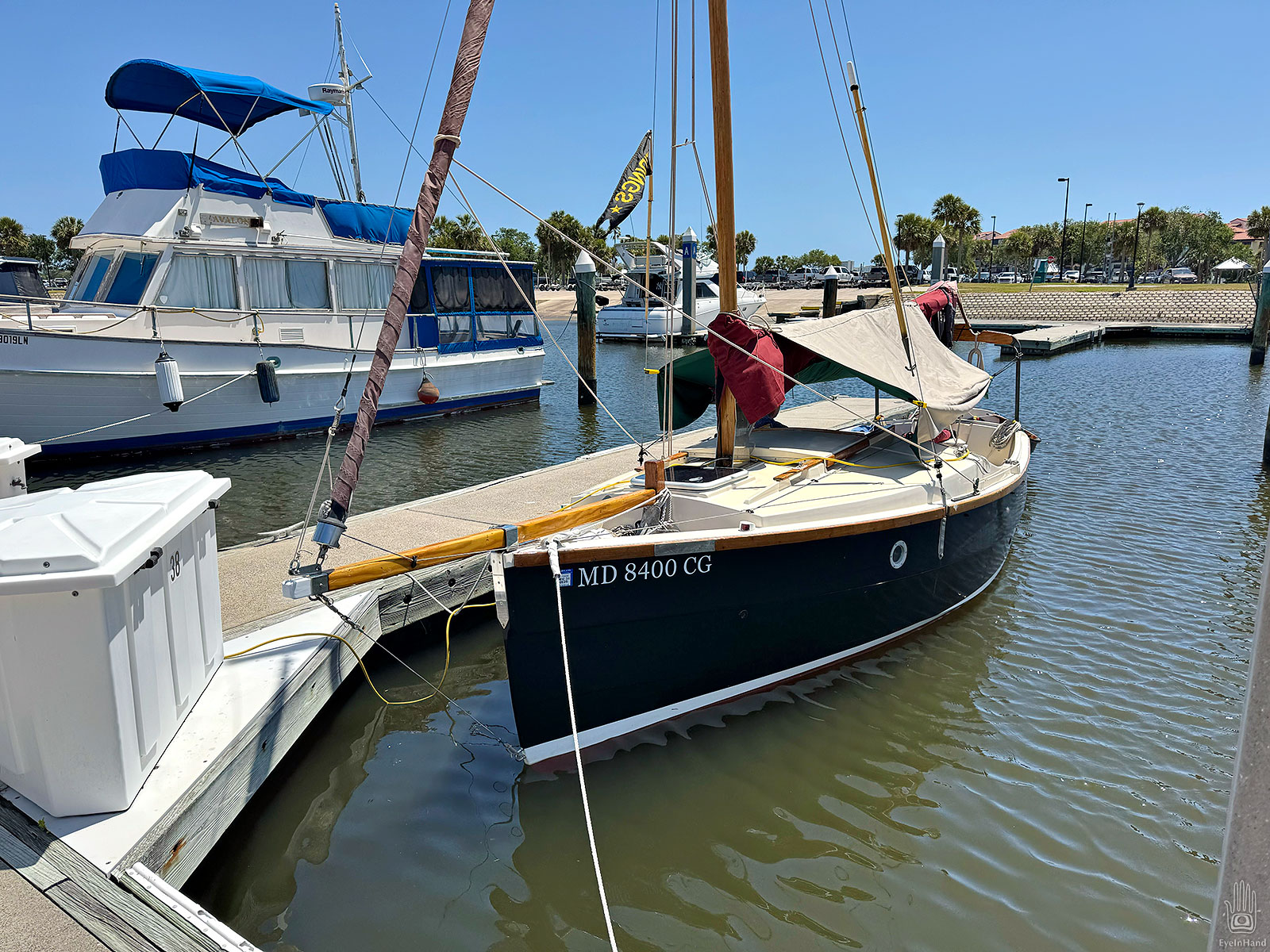
Halifax Marina is a big municipal marina full of big boats. The GDP of a small country is tied up at the docks. He walks me down the gangway to a slip where Tidings is cheerfully holding her own.
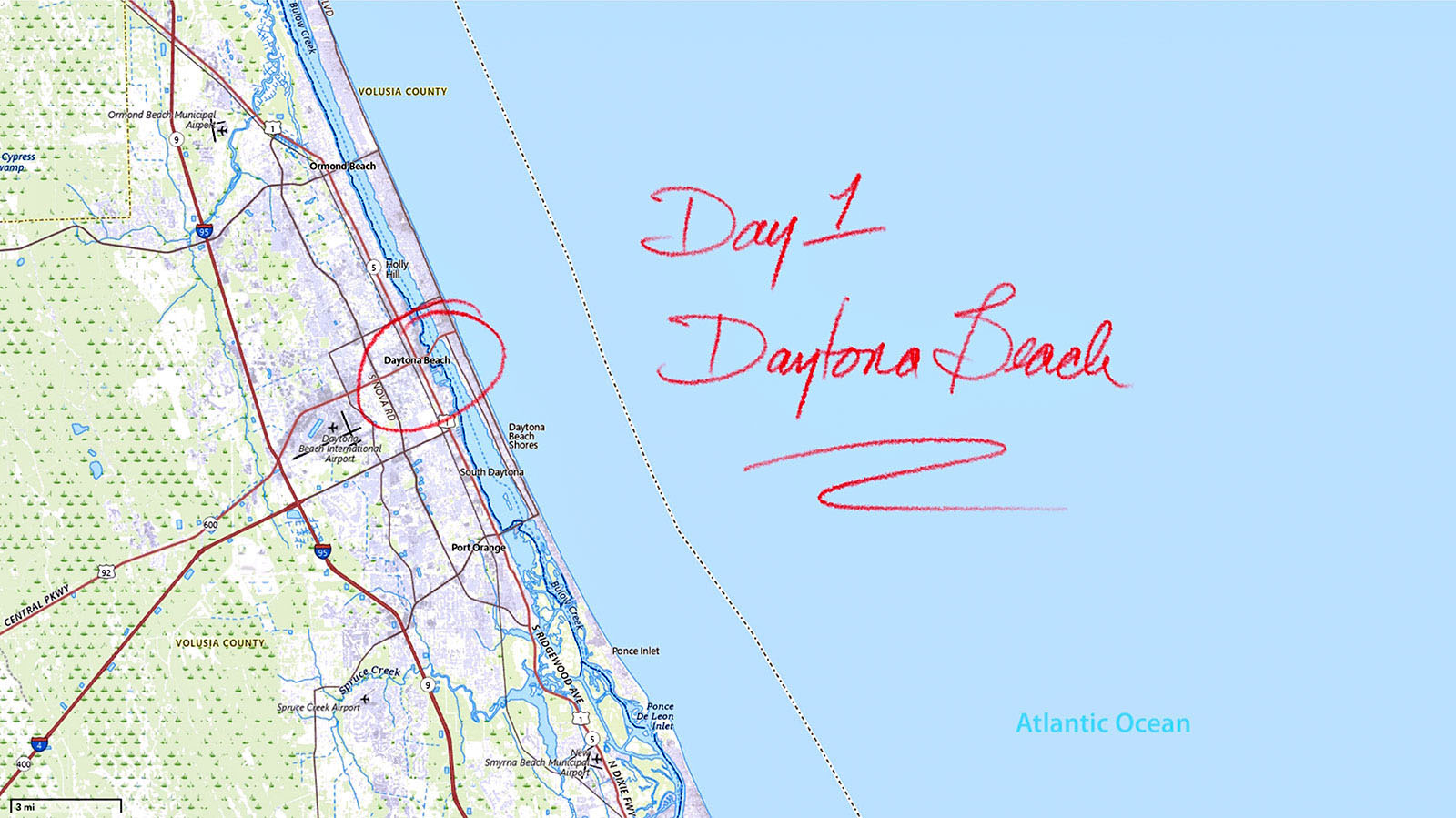
We’ll spend the night here on the boat and get an early start in the morning. I get a quick tour of the layout and stow my duffle, then we’re off again – Doug wants to investigate all this fuss about “World Famous Daytona Beach”.
Beaufort, Port Royal Inlet, and Fripp Island from 30,000 feet.
From 30,000 feet I get a preview of what’s to come. The morning flight drops down out of the clouds, and there below is our destination: Beaufort, and a watery world of marshes, winding creeks, and inlets stretching out to the steel blue Atlantic. It’s deceiving from above as it is up close. The sun glints off obvious water and moves over what one would think is land; but the light strikes water there, too. What appears to be land ribboned with creeks is mainly water, as well. The Low Country and Sea Islands of the South.
One of our daughters and son-in-law moved overseas eight years ago. We tried for years to go see them. As teachers, they have regular breaks to travel. Our simple idea was to meet them somewhere, anywhere. But a worldwide pandemic got in the way, among other things. Plans were made, and cancelled, and made again and cancelled again. It happens. Finally, eight years later, everything fell into place.
They now live in the desert of Saudi Arabia, so they wanted to go somewhere wet and green for spring break. Where else but The Netherlands?
Water everywhere
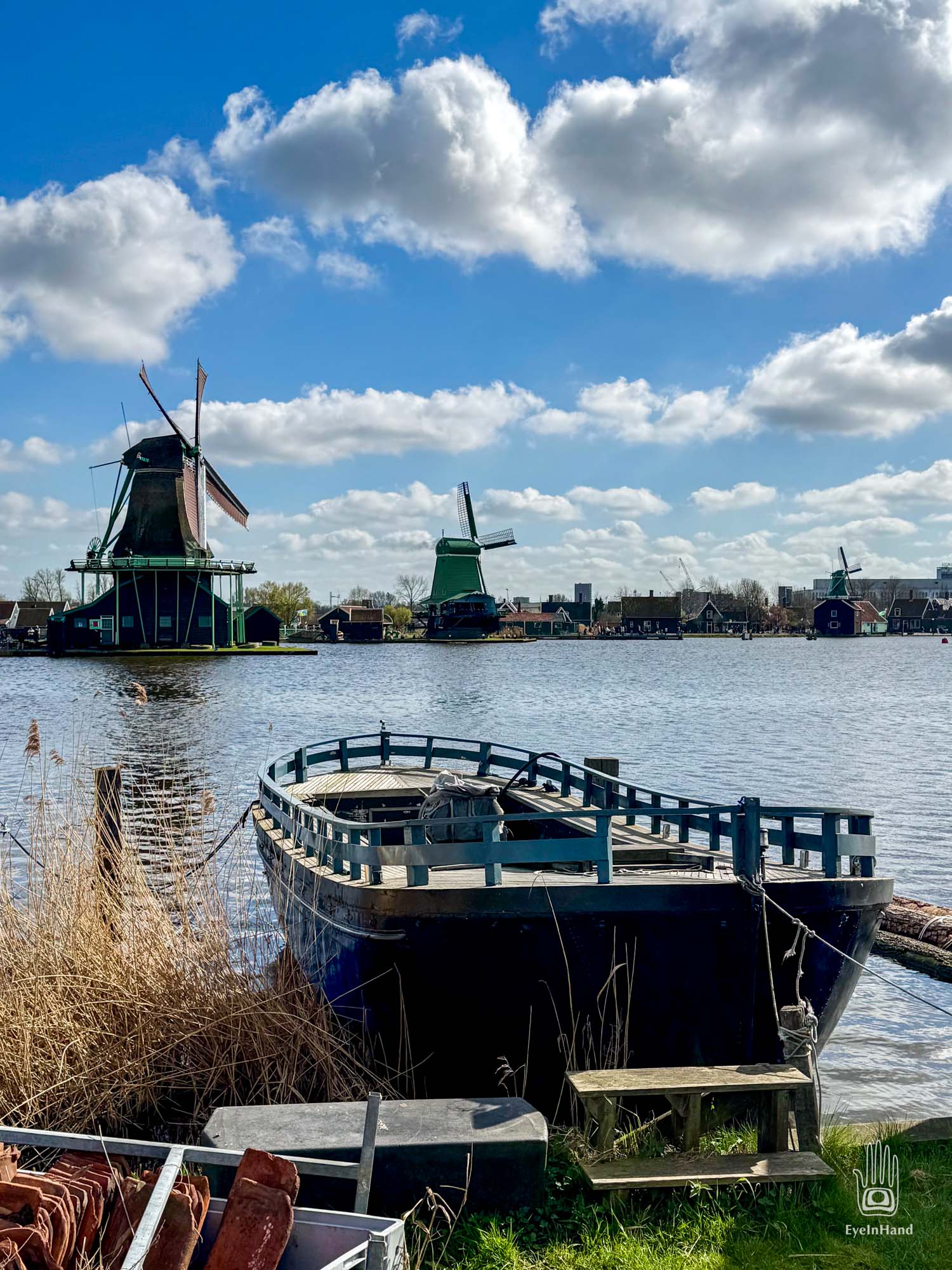
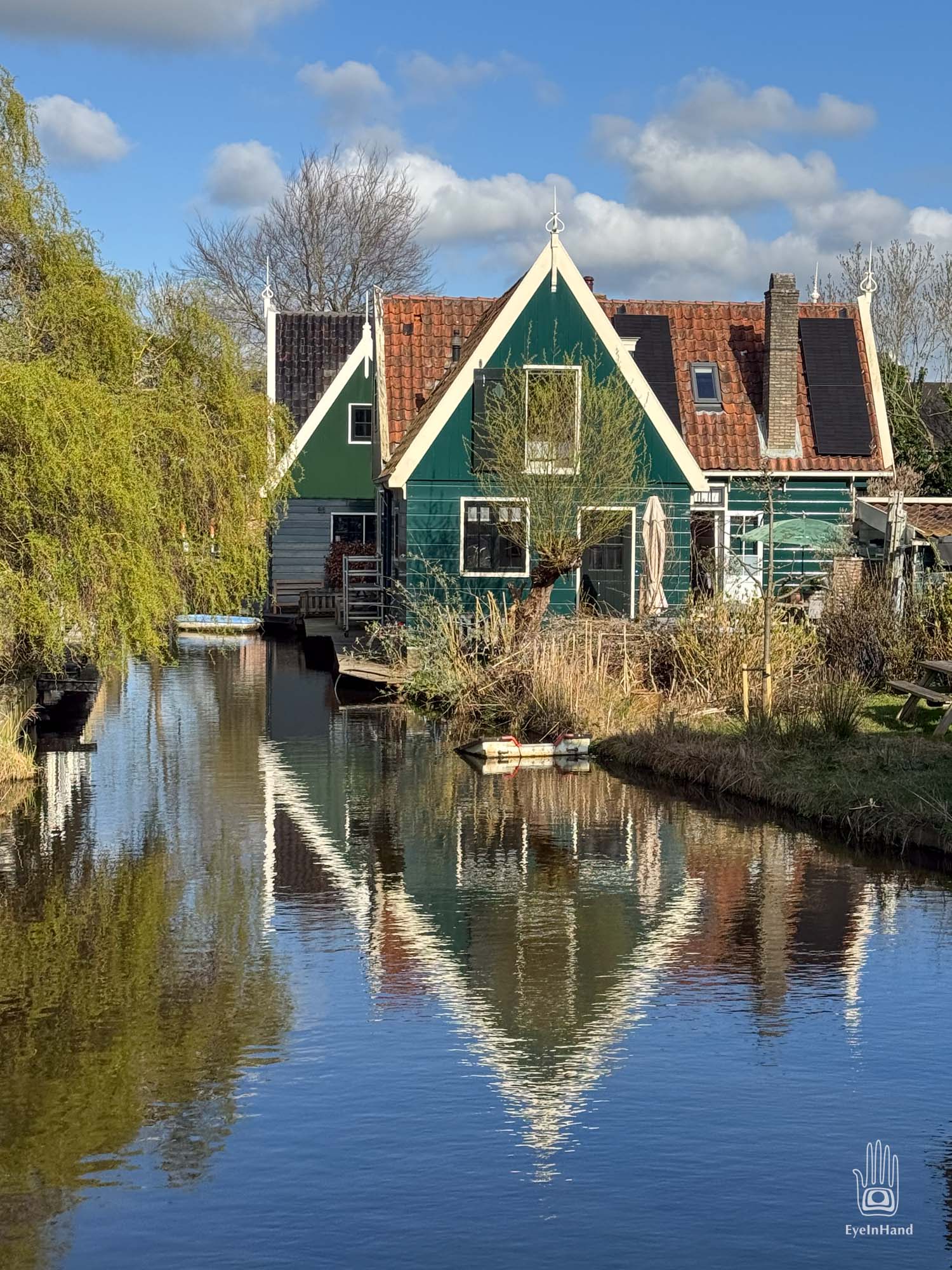
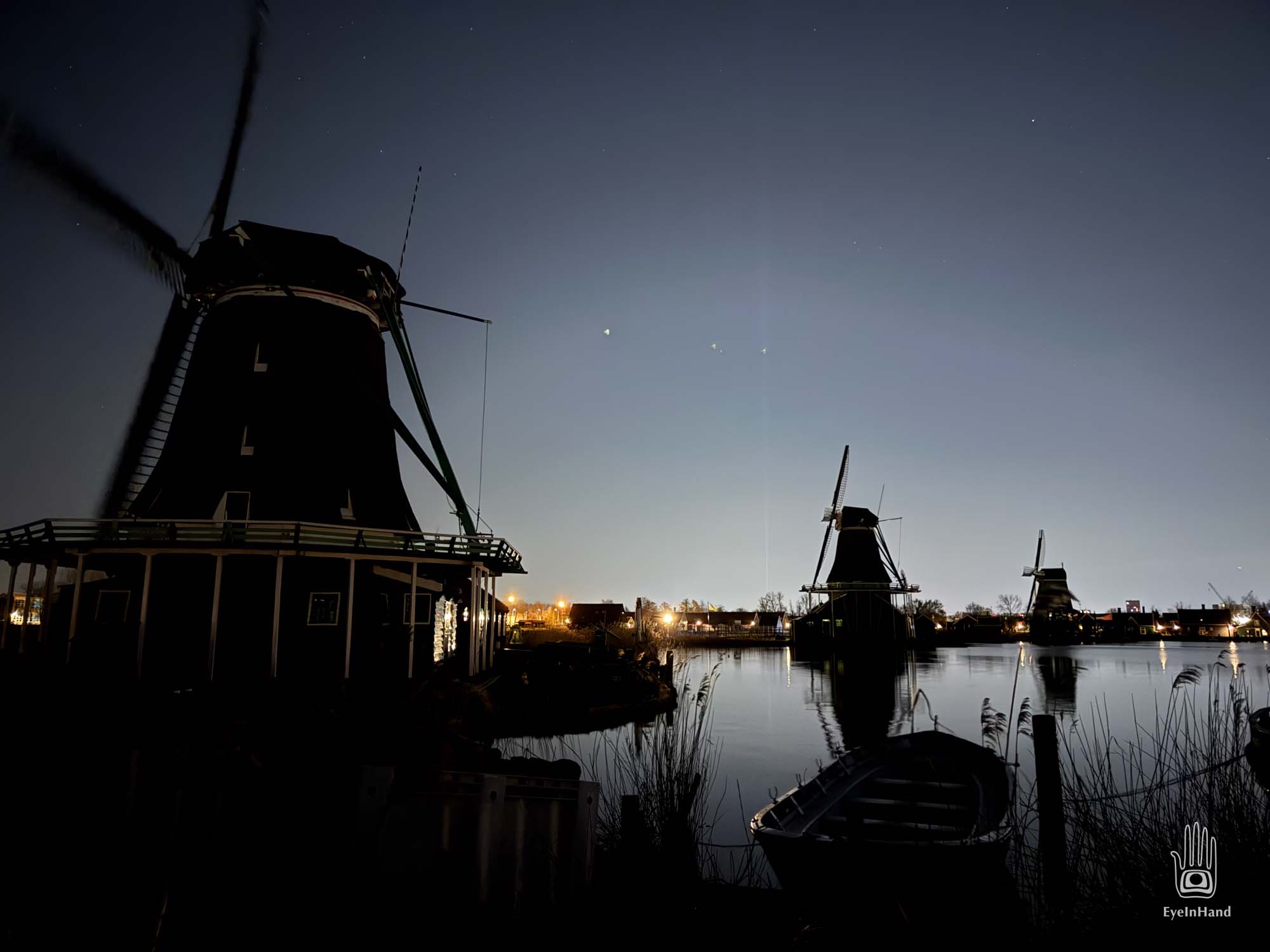
We spent a week in a small cottage in the country, a bit north of Amsterdam. Water everywhere. And windmills. The nearest town of Zaandijk has a train station, bakery, brewery, and couple of cafes, and was just a short bike ride away. A ride along dikes and levees past a dozen working windmills.
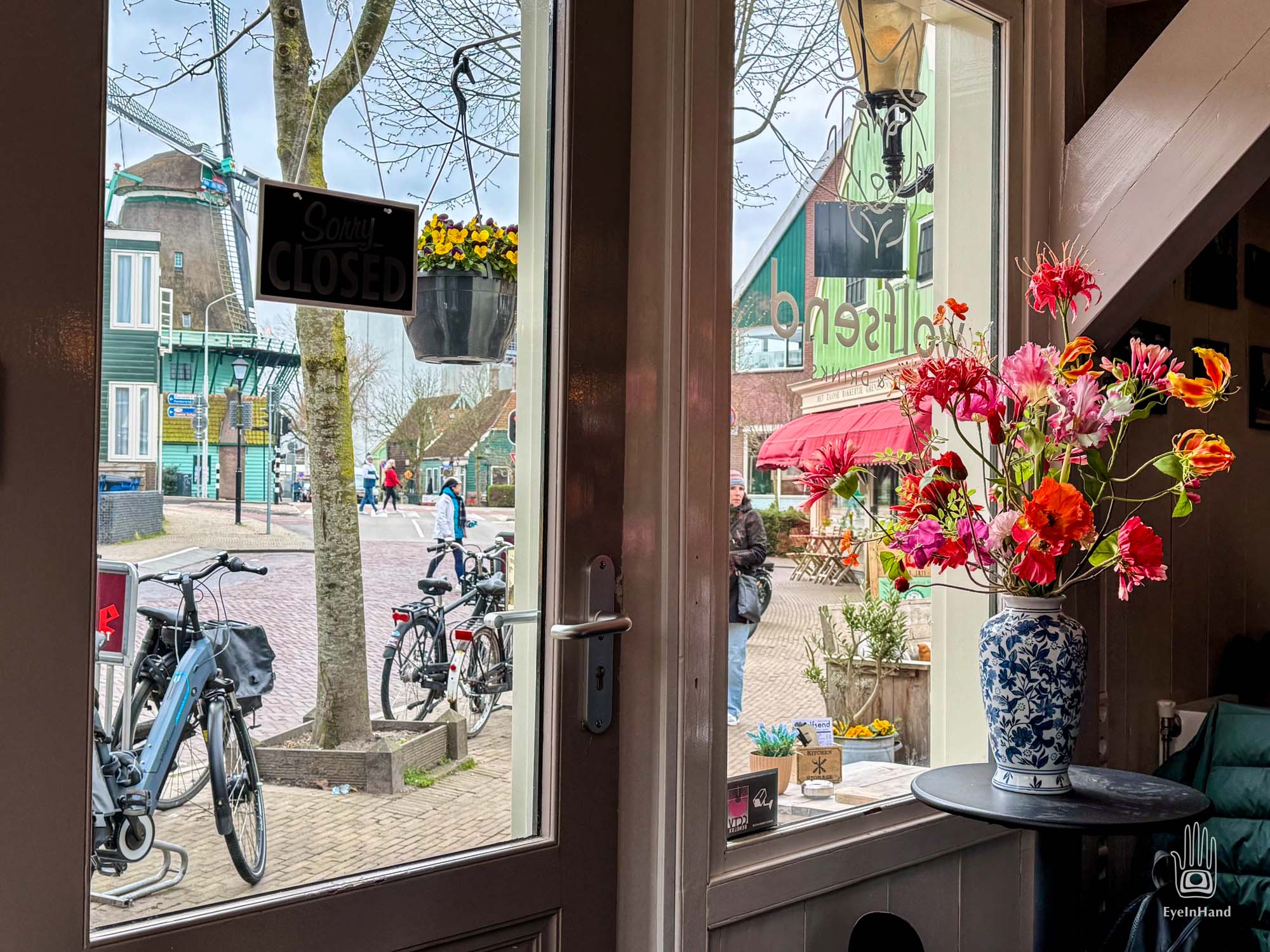
Cafe in Zaandijk
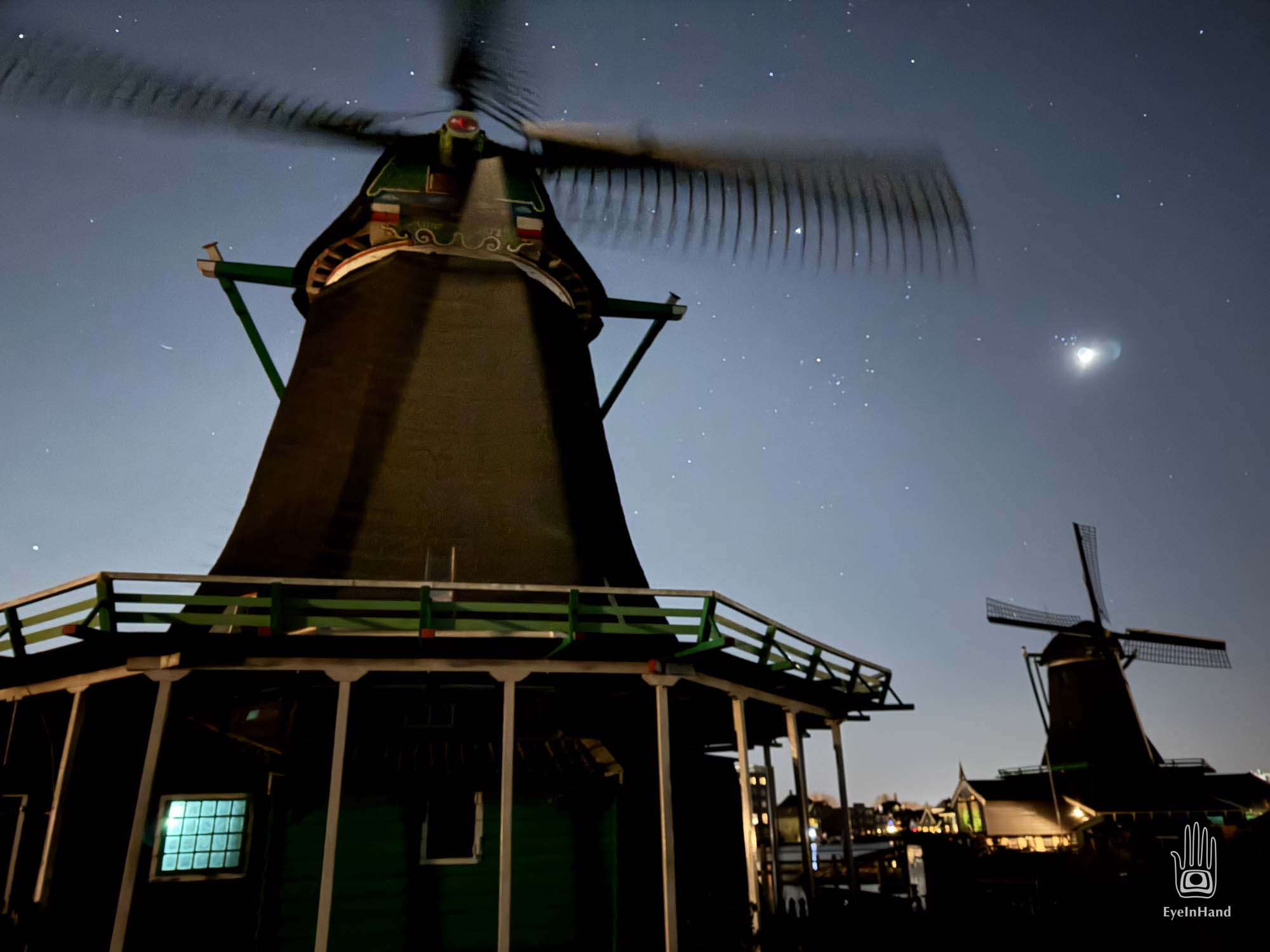
One evening we took the train back from Amsterdam. We walked from the station to the cottage, stopping for dinner in a small cafe. After dinner, we walked the rest of the way back in the moonlight. It was amazing, the windmills whooshing overhead like giant birds flapping in a starry sky. Flocks of geese and ducks in the canals and the polders cackled, adding to the surreal effect.
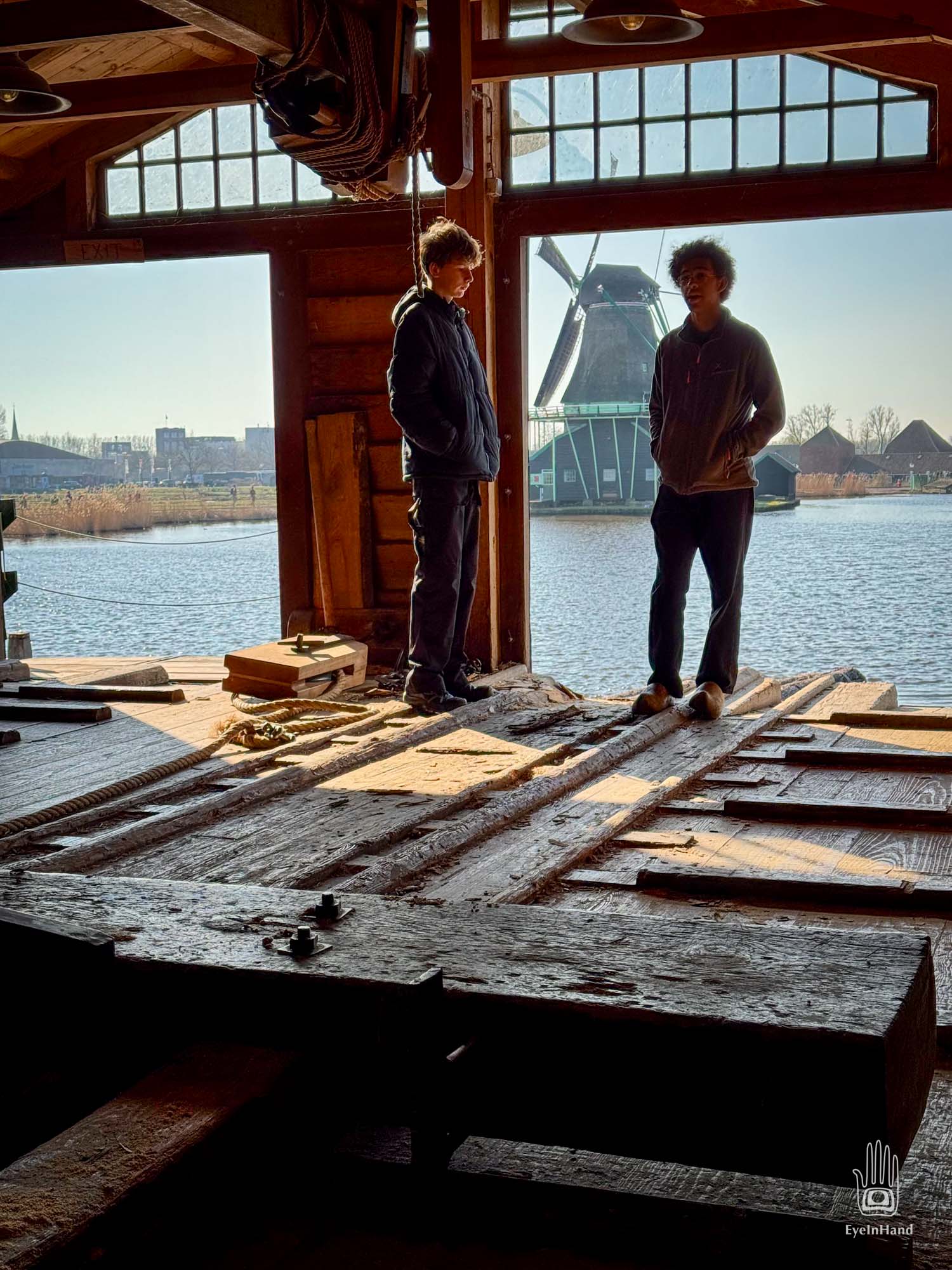
One morning while the others eased slowly out of bed, I rode by as the windmill crews were just opening up. Several of the mills earn their keep doing the same work they’ve done for hundreds of years. One is a working sawmill. At that early hour there were no crowds to contend with – I was the only visitor. Most of the crews are older men who work the mill, and a few young apprentices have joined them. One of the old Dutch guys saw how interested I was and gave me a personal tour, explaining in detail how it all works (in fluent English), and the history of that particular mill.
“The Young Sheep”Young Apprentices
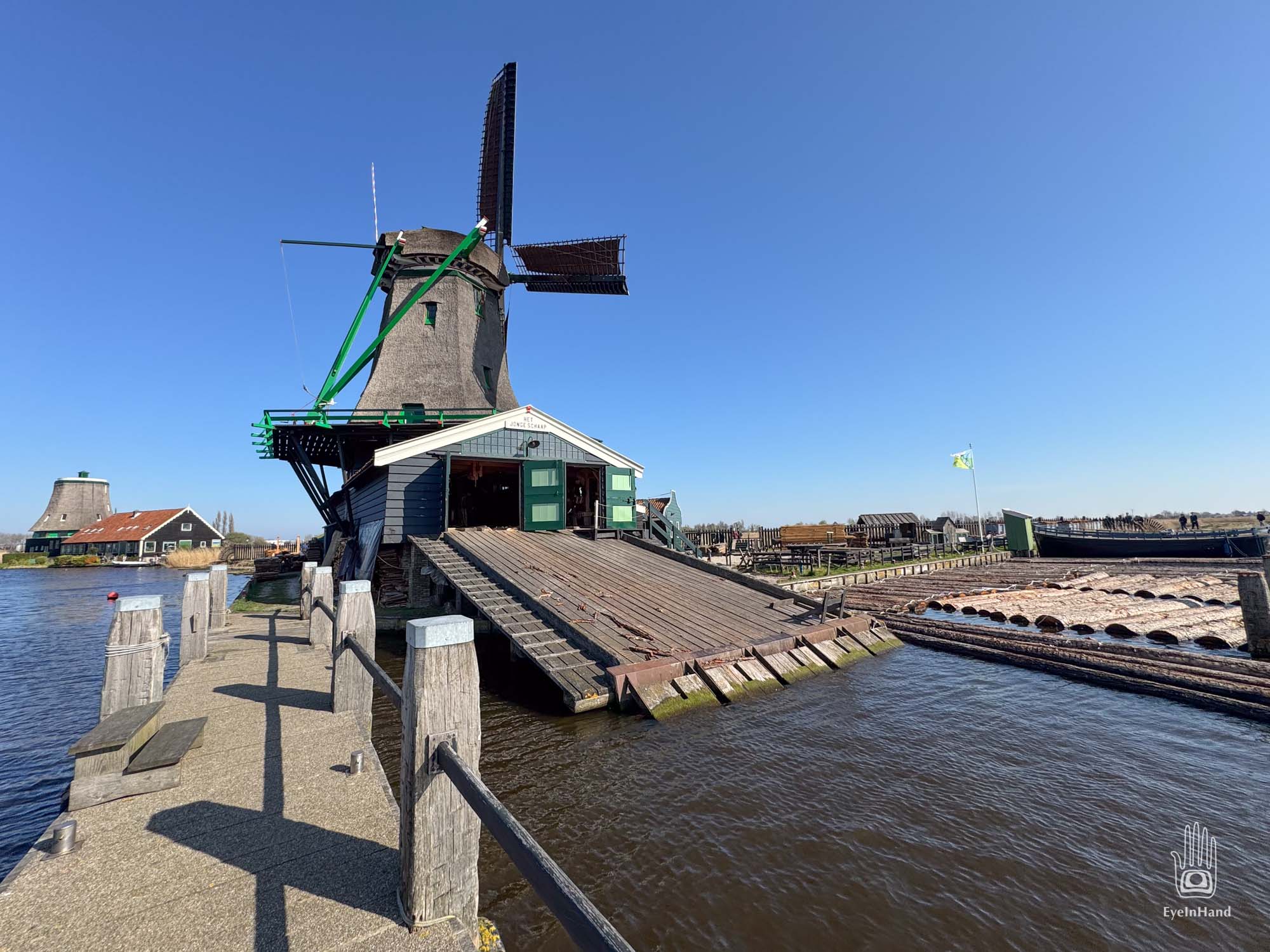
This mill, Het Jong Schaap (“The Young Sheep”), had been in continuous operation for over 400 years, right up until WWII and the Nazi Occupation. Things became so desperate during the war that townspeople needed to dismantle the mill for firewood. But before they did, they documented in detail every piece they removed. Years after the war those plans were found. Funds were raised and the mill rebuilt exactly as it was, along with many others along the Zaans River.
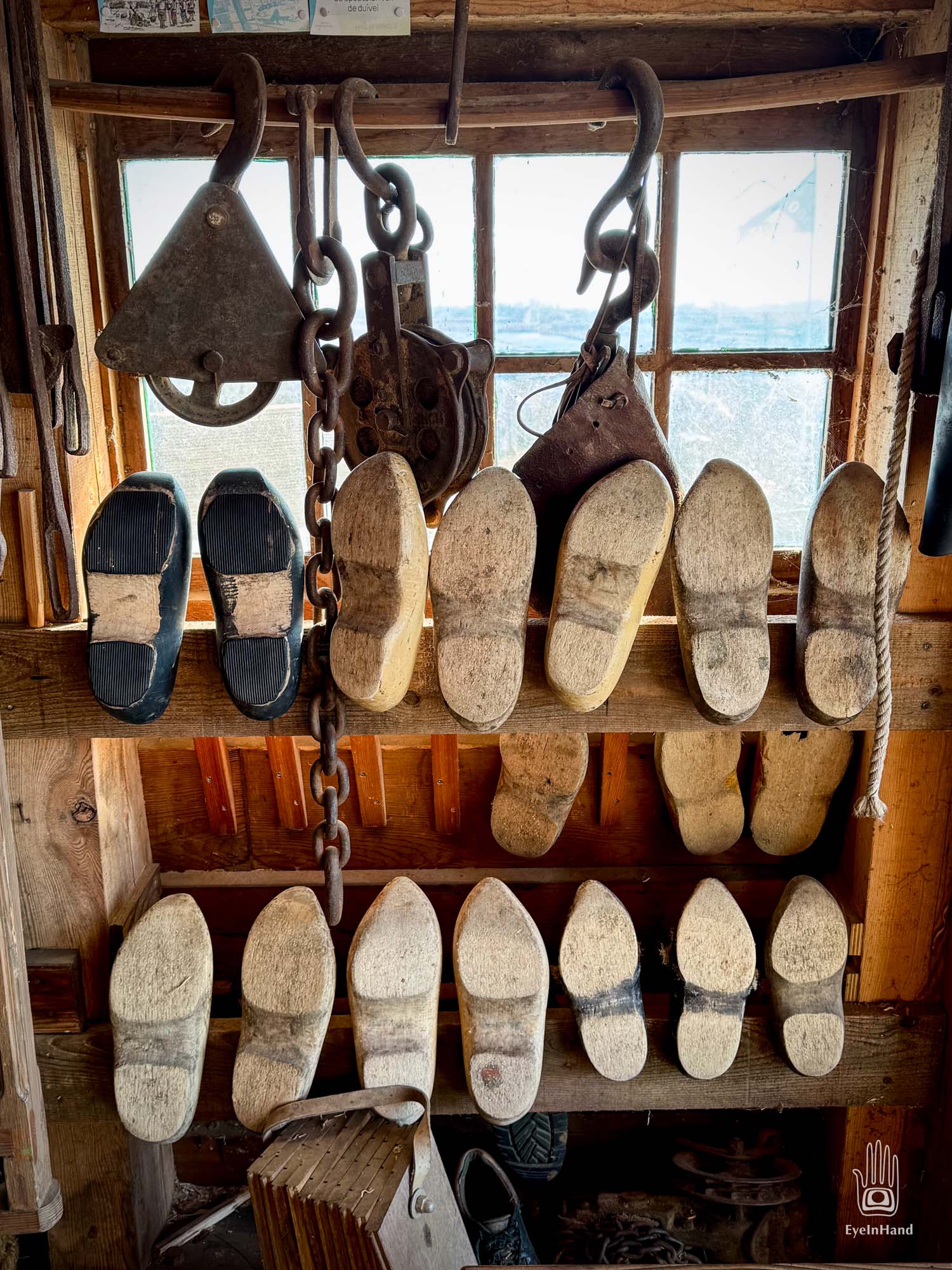
Work Shoes
Inside the mill, I was immediately struck by the sound – it’s like being inside an enormous breathing animal. The pace of respiration rises and falls with natural rhythm of the wind. From slow and steady, like the beast is sleeping, to rapid and muscular.
The canvas on the vanes are trimmed like sails to match the strength of the wind, and the whole head is turned with a crank to follow the wind direction as well, just like a sailing ship. In fact, as he was explaining how the gears work, he suddenly stopped short and made a quick adjustment to take advantage of a gust, which he heard instinctively – just like we do in our small wooden boats. “Just the same, it’s the same principle,” he said.
After the sound, there’s smell of fresh sawdust, and everywhere the rich golden glow of sunlight on wood. No reek of petroleum or exhaust, no screech and whine of industrial motors. Just heaving and sighing.
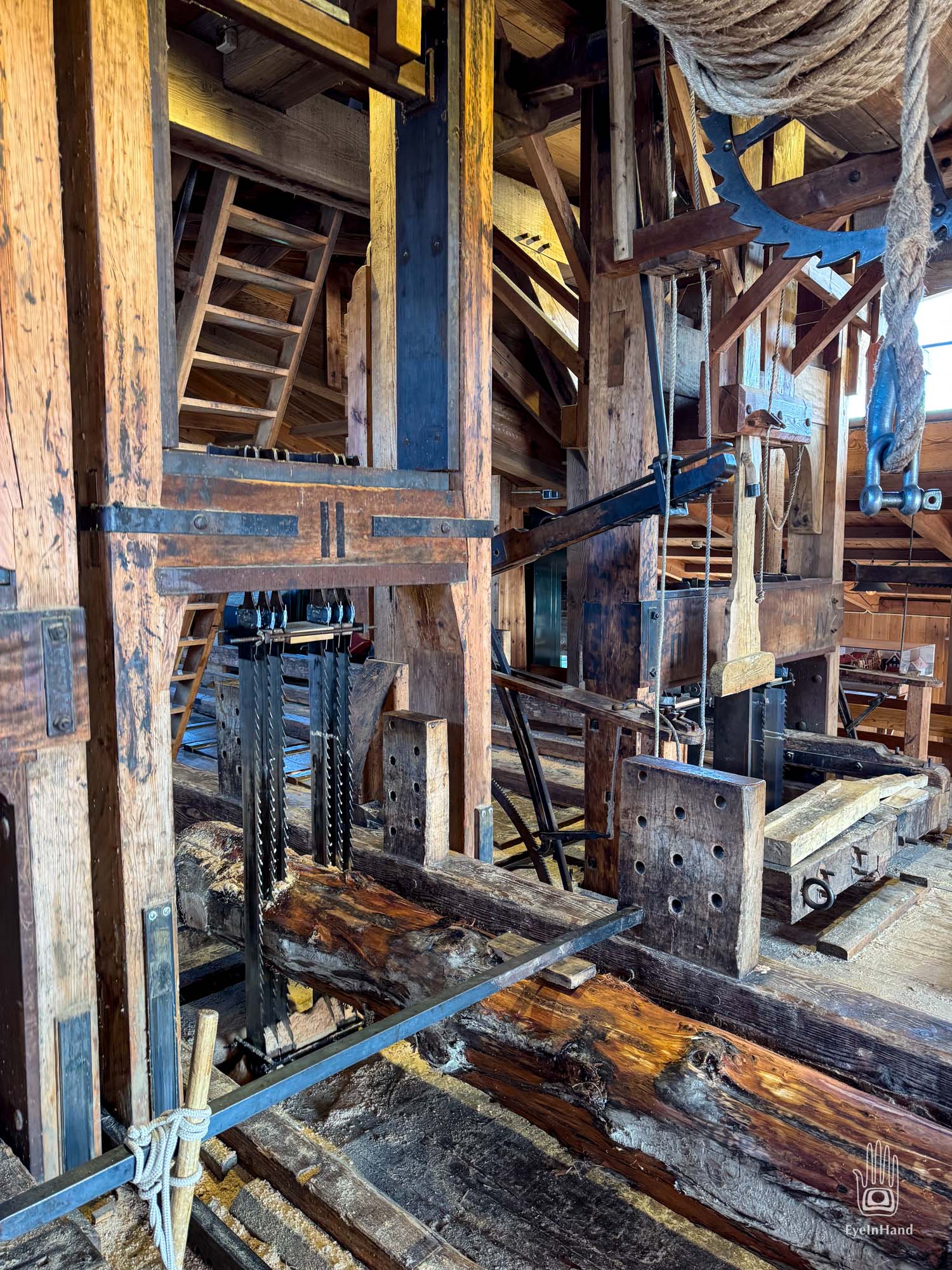
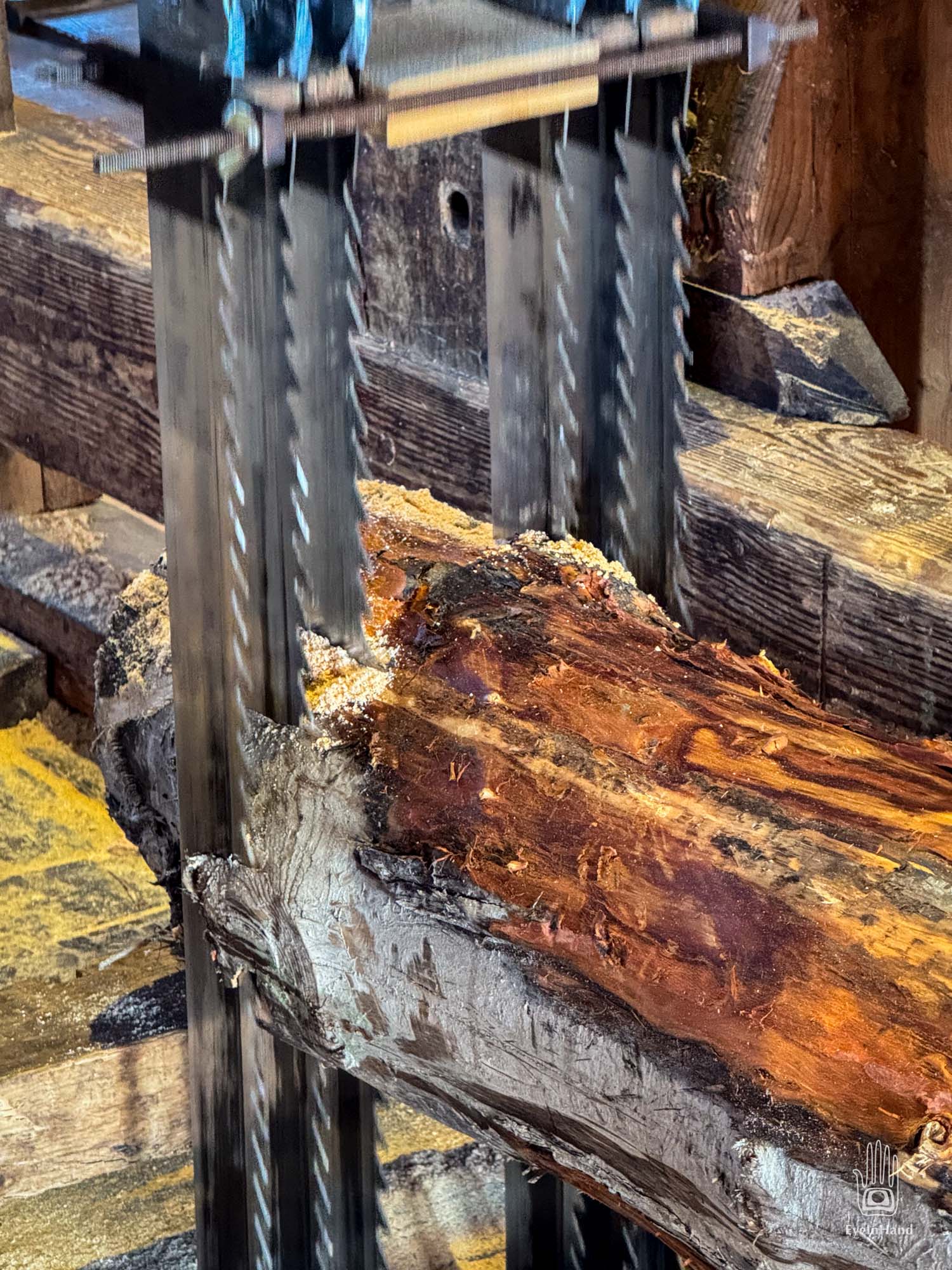
The whole apparatus is built like a big clock inside, and every step of the process is automated and facilitated by the power of the wind harnessed by the vanes. A windlass winds a hawser that hauls logs from the river up the ramp and into the mill, then lifts them onto a carriage where the log is dogged in place. Then another gear, ticking like a slow second hand watch gear, moves the log and carriage steadily into the blades as they pump up and down, the blades driven by a crank shaft turned in the attic by the wind.
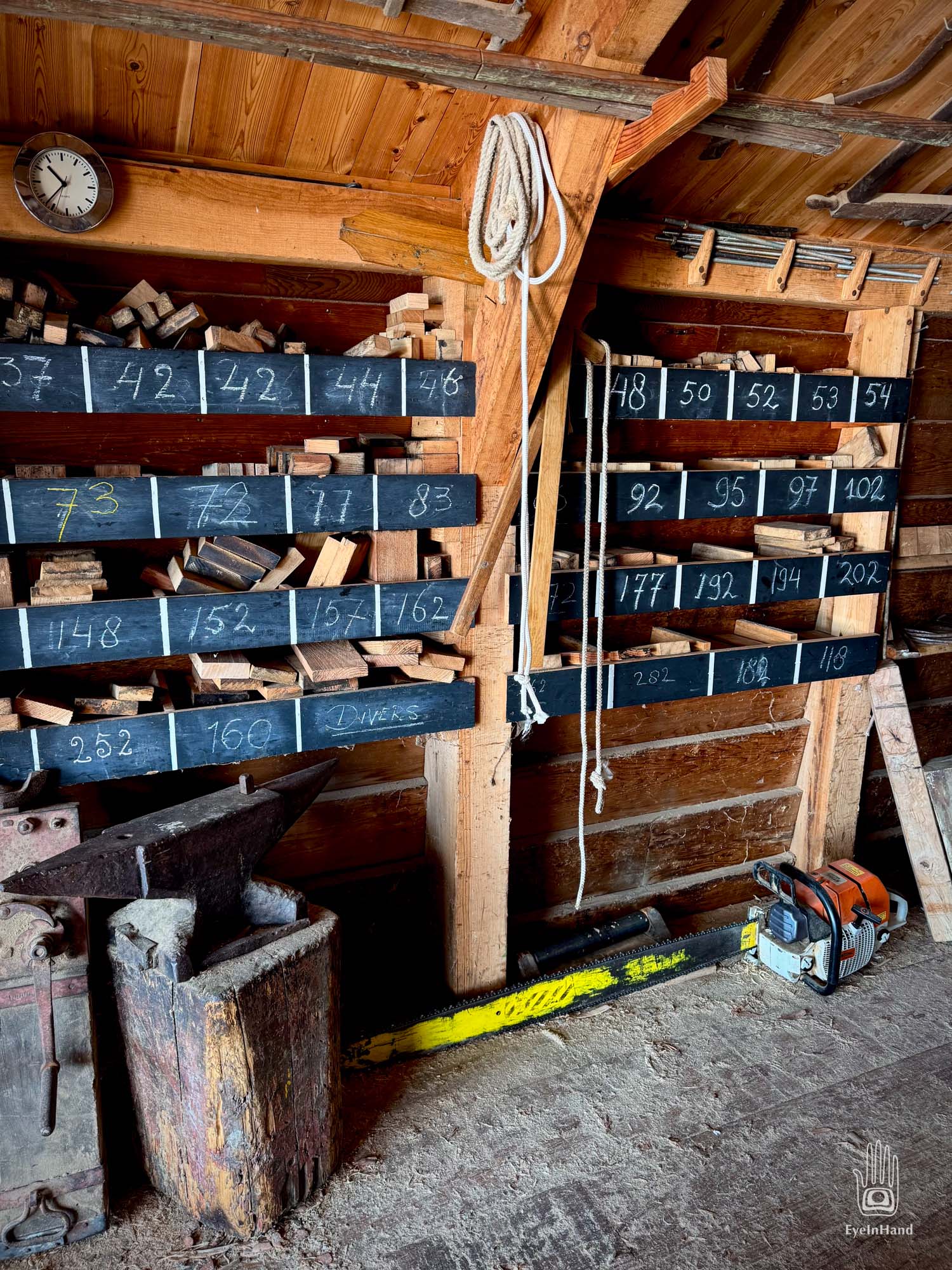
The blades are spaced with wooden blocks measured down to the millimeter. Using a combination of blades and spacers, they can cut thin planks and thick timbers from the same log in a single pass. With good wind, they can cut three logs at once, running all three saws side by side.
Spacer blocks, sorted to millimeter precision.
My guide, knowing I was a sailor, told me they recently had a commission to make a new mast for a large sailing ship. Cut eight sided and tapered. They used a single log 40 feet long, floated down rivers and canals from the Black Forest in Germany. There are small doors at the back of the mill just for this purpose – opened to let oversized pieces extend out through the walls.
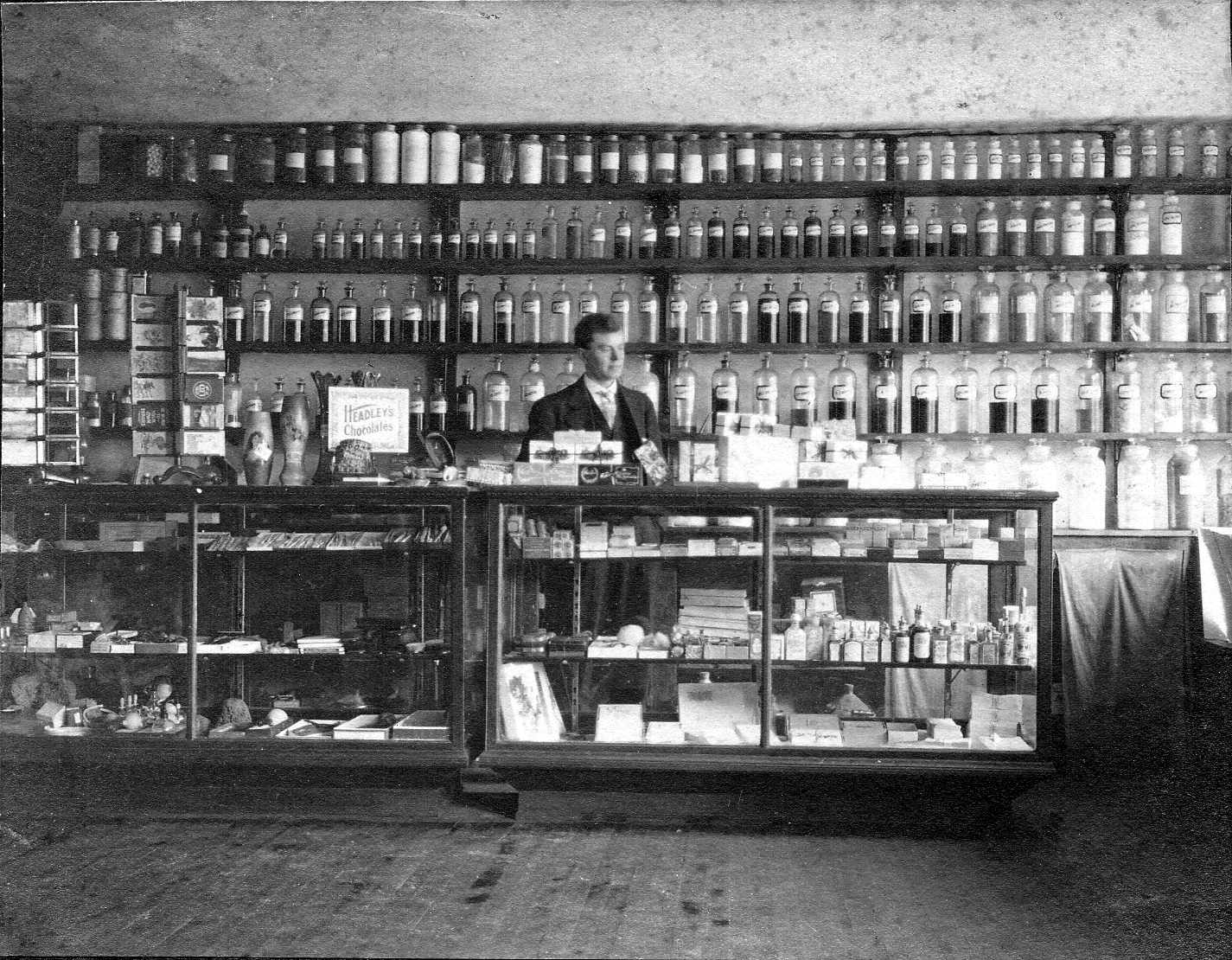
Name: Bruce’s Drug Store Date: ca. 1908 Image Number: SD18cdSD1
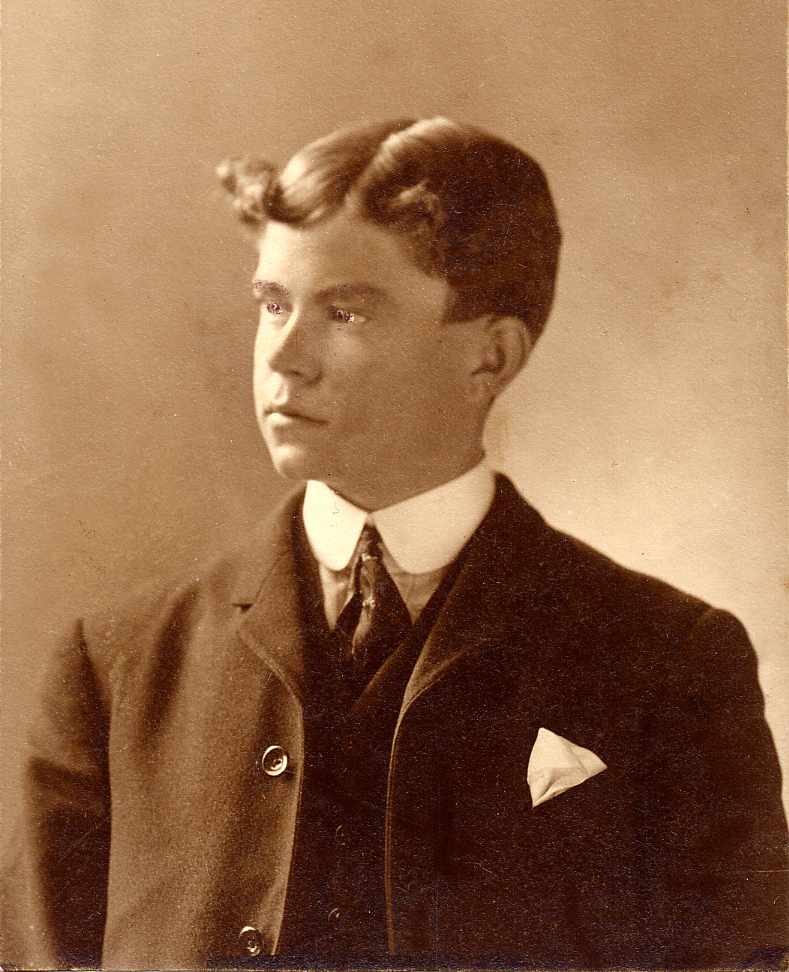
T.E. Bruce, ca. 1906
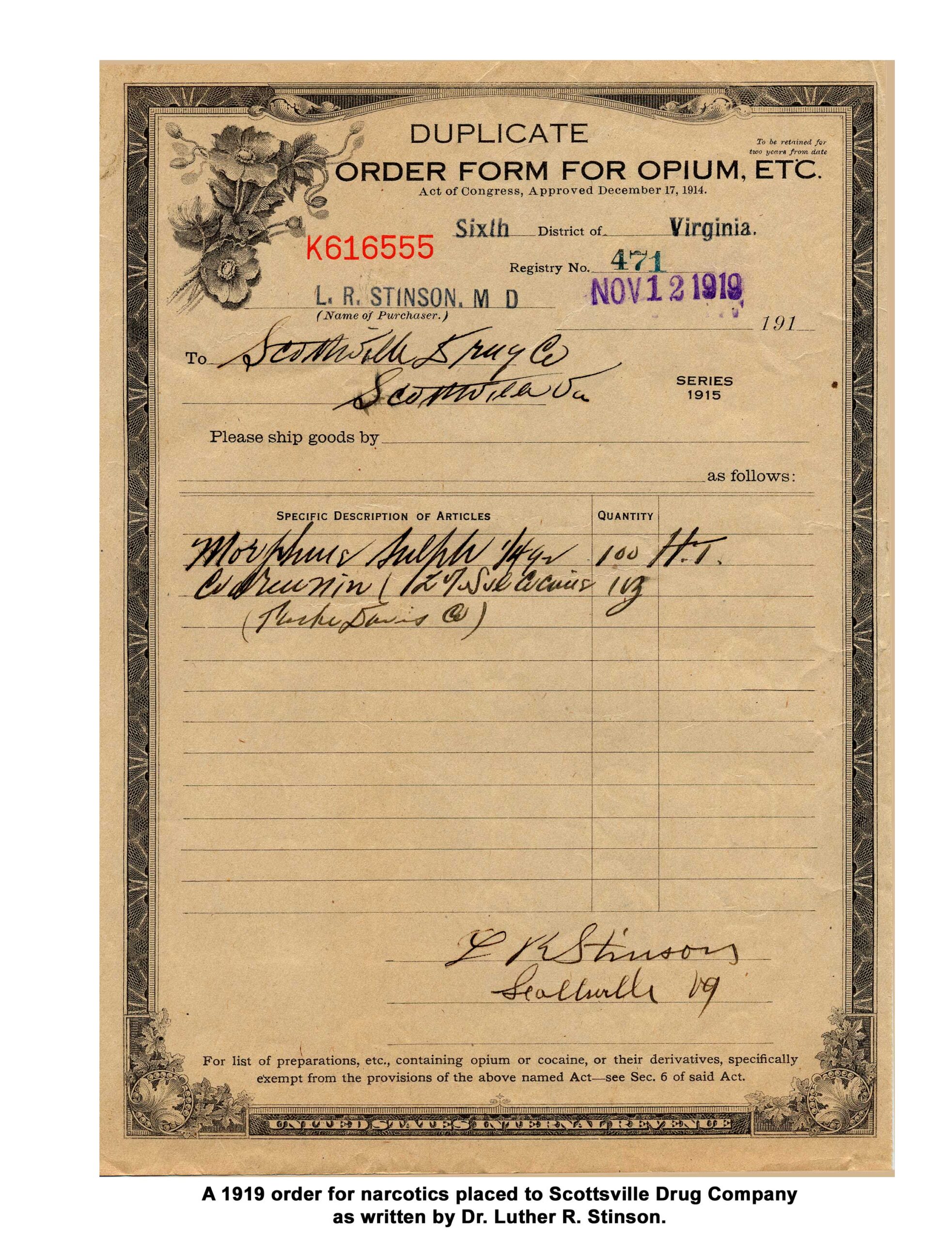
Bruce’s Drug Store began on November 1, 1908, under the name of Scottsville Drug Company. Dr. Luther R. Stinson and Dr. Benjamin L. Dillard, practicing physicians in Scottsville, maintained a small medicine shop in the town’s old apothecary shop on Valley Street (now 510 Valley Street). Finding it inconvenient to keep their shop open as much as the public demanded, the two doctors advertised for a full-time pharmacist in a Richmond newspaper. Thomas Ellison Bruce was working as a pharmacist in Newport News and answered their ad. Ellison and the two doctors formed a partnership in a pharmacy business called the Scottsville Drug Company. In the 1908 photo above, Ellison is shown standing behind the pharmacy counter of this drug store. The medicine bottles behind him held the medicinal supplies Ellison used to fill prescriptions.
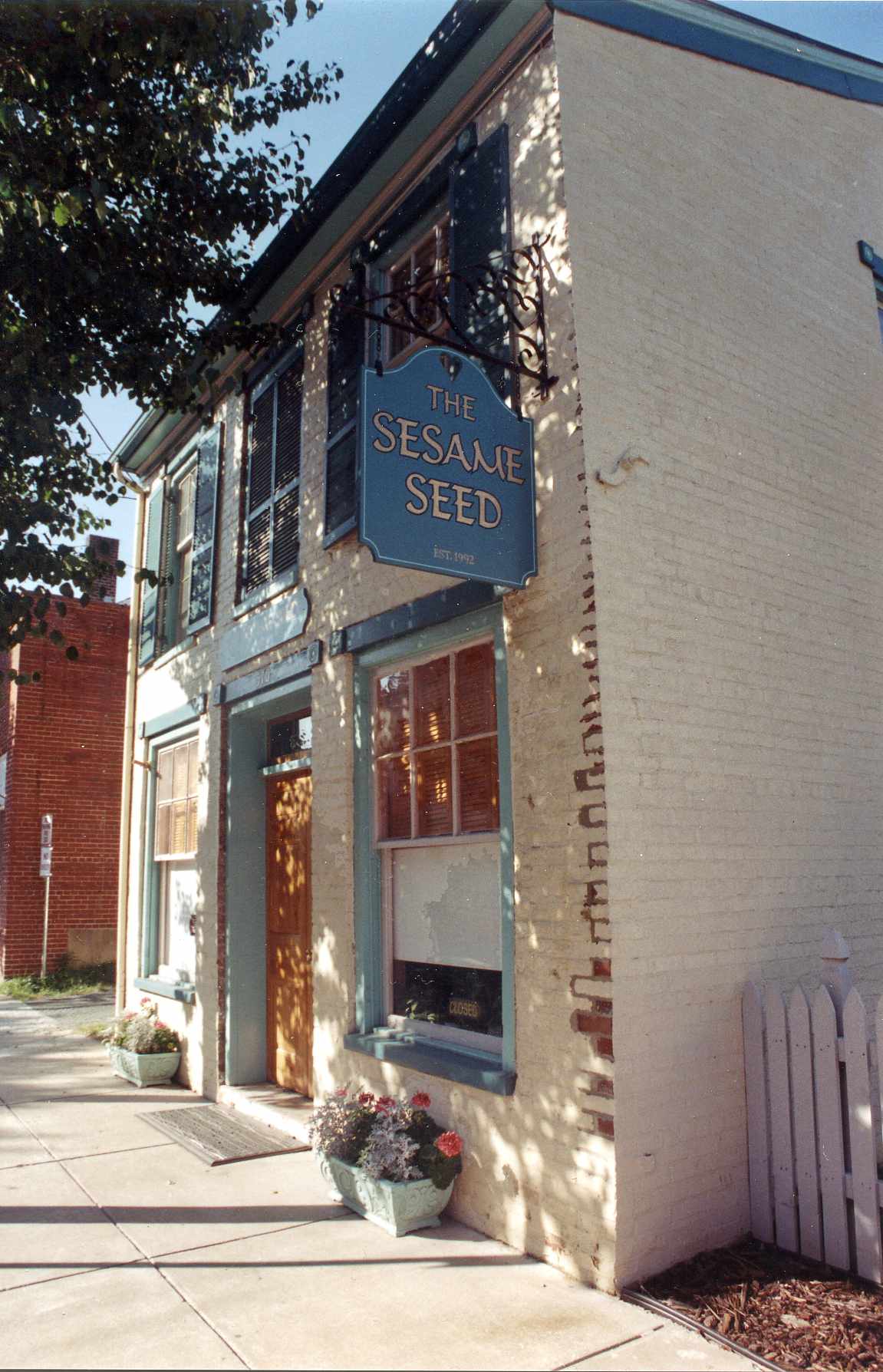
First site of Scottsville Drug Company, 1908-1912
Although only twenty years old, Ellison realized the two doctors greatly needed a pharmacist to help them. He drew up a partnership agreement in which each doctor assumed the financial responsibility for his patient’s medicinal charge accounts. If the business operated at a loss, the partnership agreement required the two doctors to personally pay Ellison a salary. Dr. Stinson stated, “After conducting business under this arrangement for one year, we realized Bruce was the only one making any money!” The two doctors soon sold their interests to Ellison, making him the sole owner of the Scottsville Drug Company. The photo above shows the building that first housed Ellison’s drug store at 510 Valley Street; this old apothecary building was built ca. 1832.
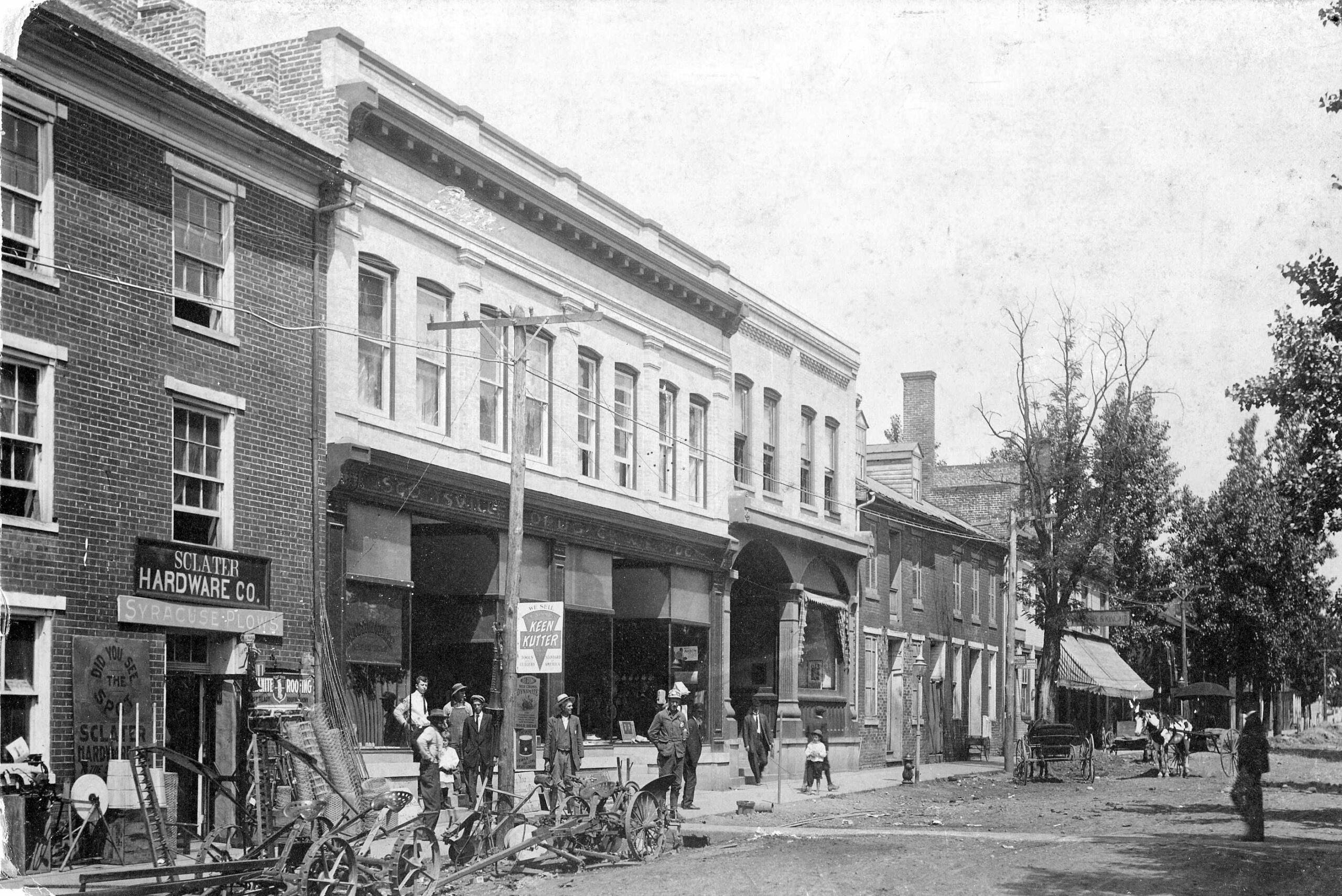
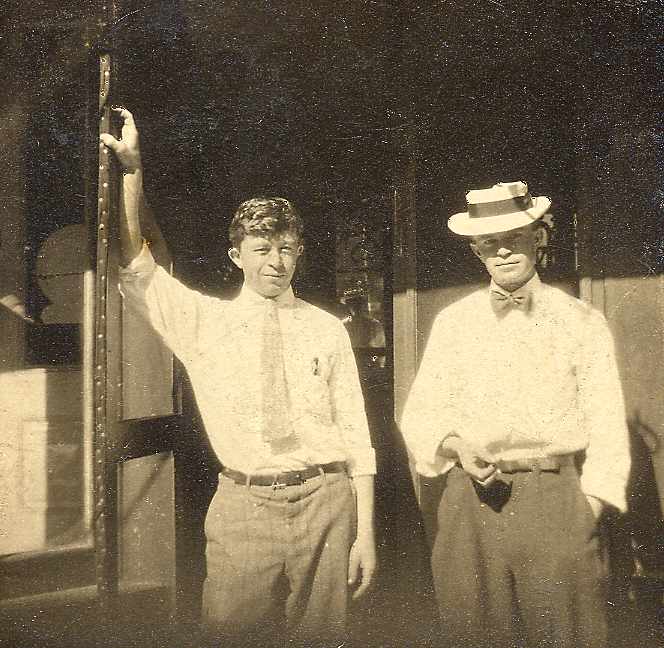
About 1911 or 1912, Ellison moved his store to the Pitts Building on Valley Street (now 330 Valley Street). The photo below at left shows Lee Bruce, Ellison’s brother and store clerk, in white shirt and leaning casually against the Scottsville Drug Company’s front display window. At right, Lee and Ellison pose for a 1913 Kodak snapshot on the drug store’s front steps. In the store’s early days in Scottsville, Lee helped his brother cover their long hours of daily operation for several years. The drug store opened seven days a week, although Sunday sales were for medicinal purposes only. In the early 1920’s, Ellison changed his store’s name to Bruce’s Drug Store.
Scottsville Drug Company at 330 Valley Street, 1912
Lee Bruce and Ellison Bruce, 1913
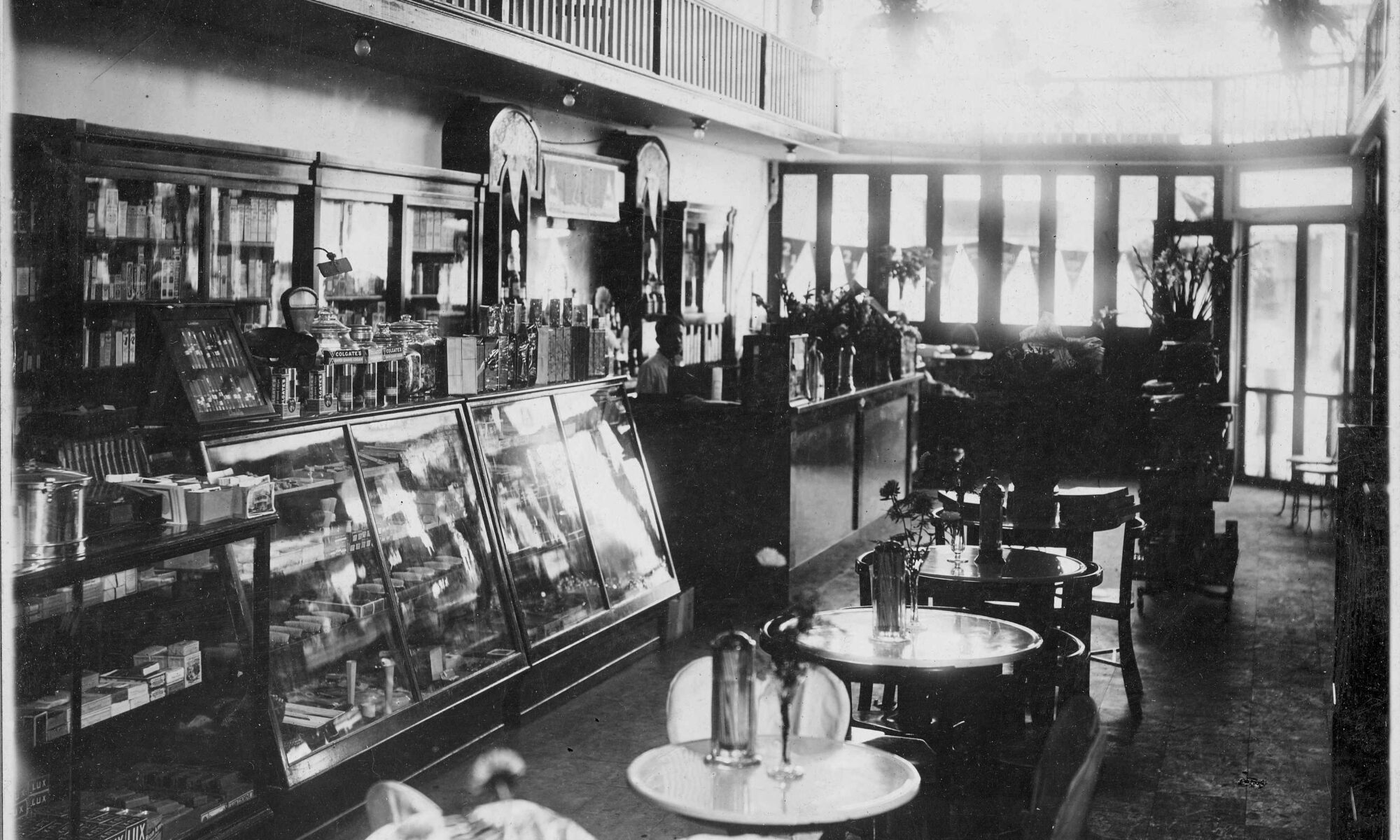
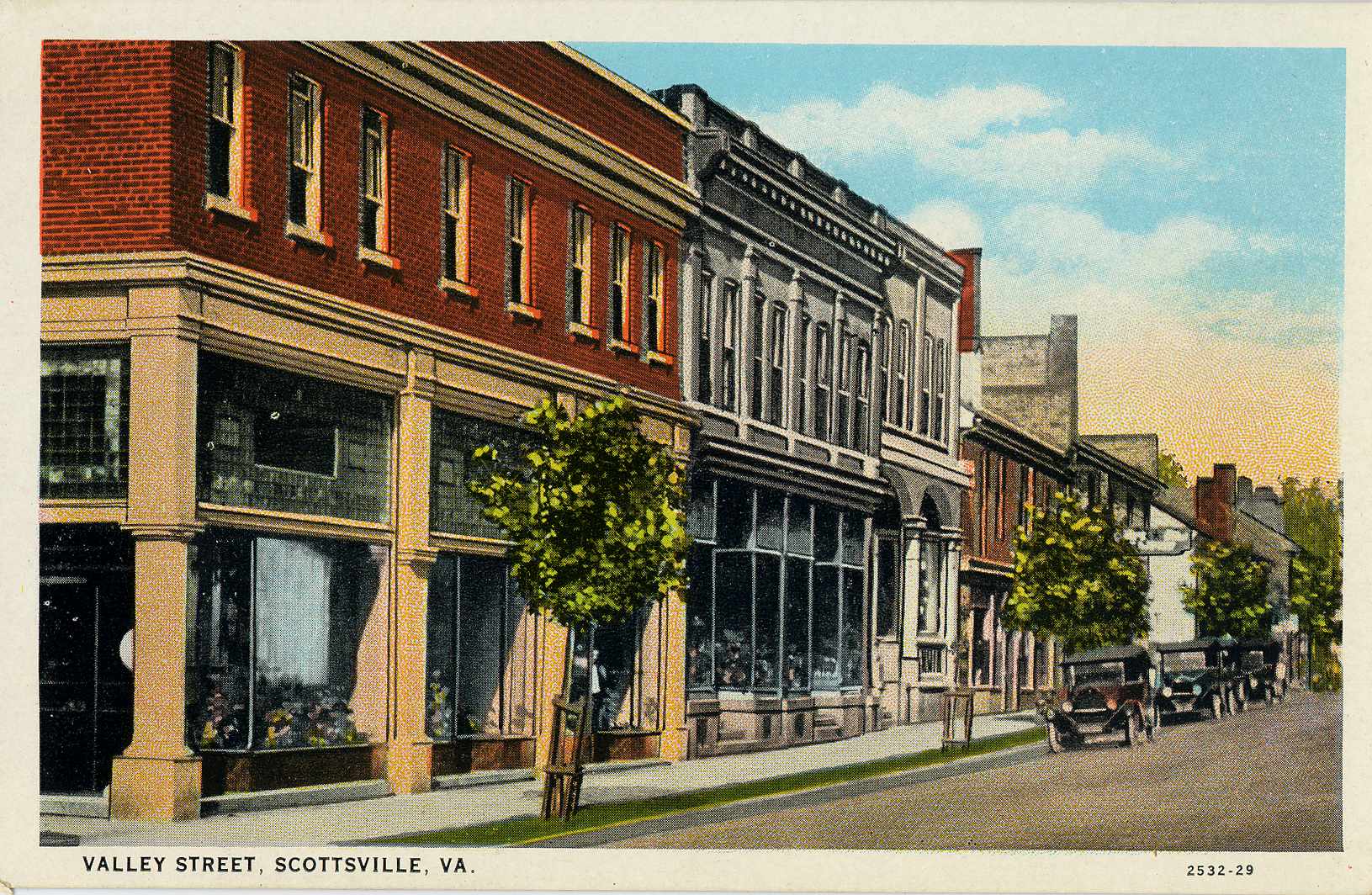
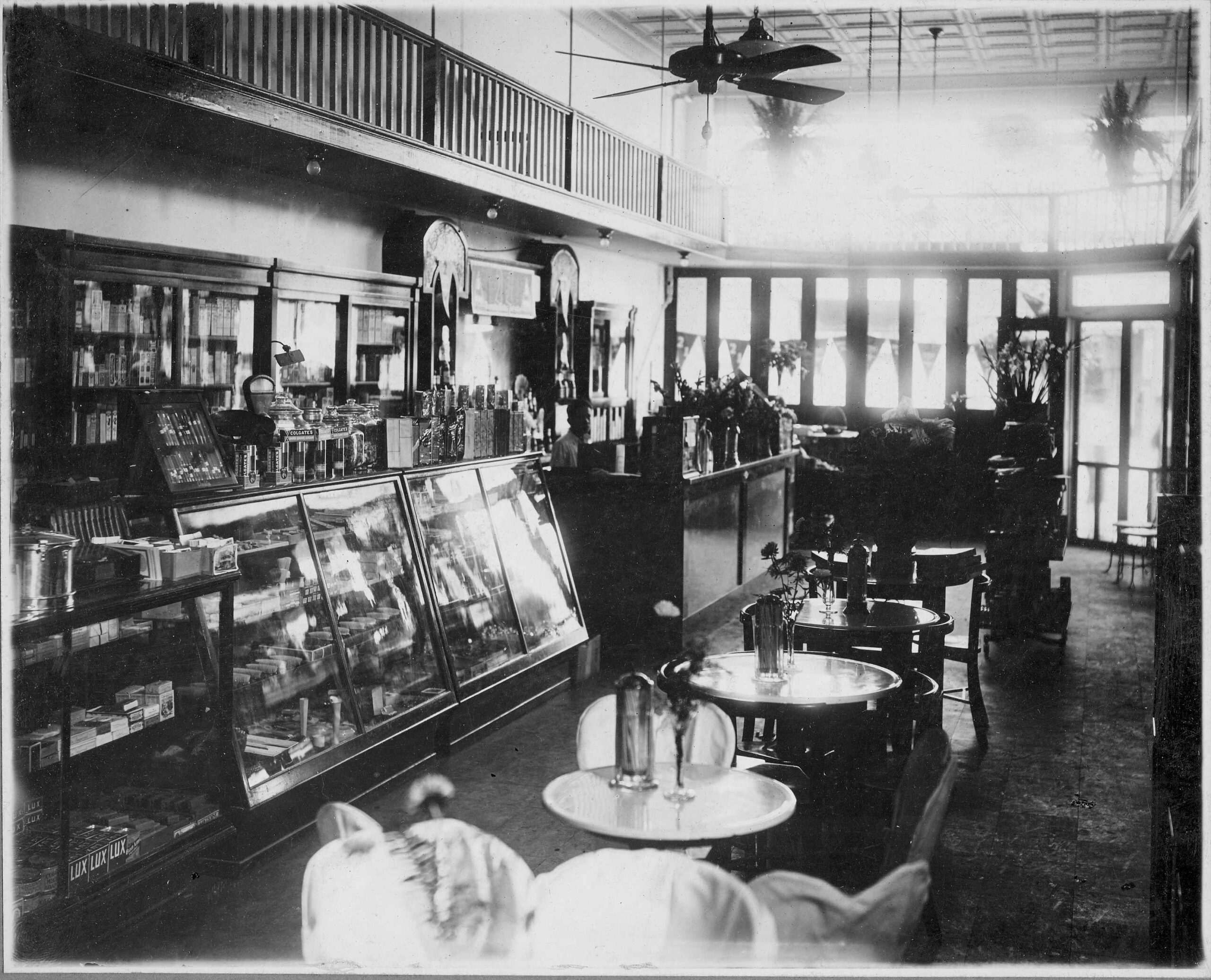
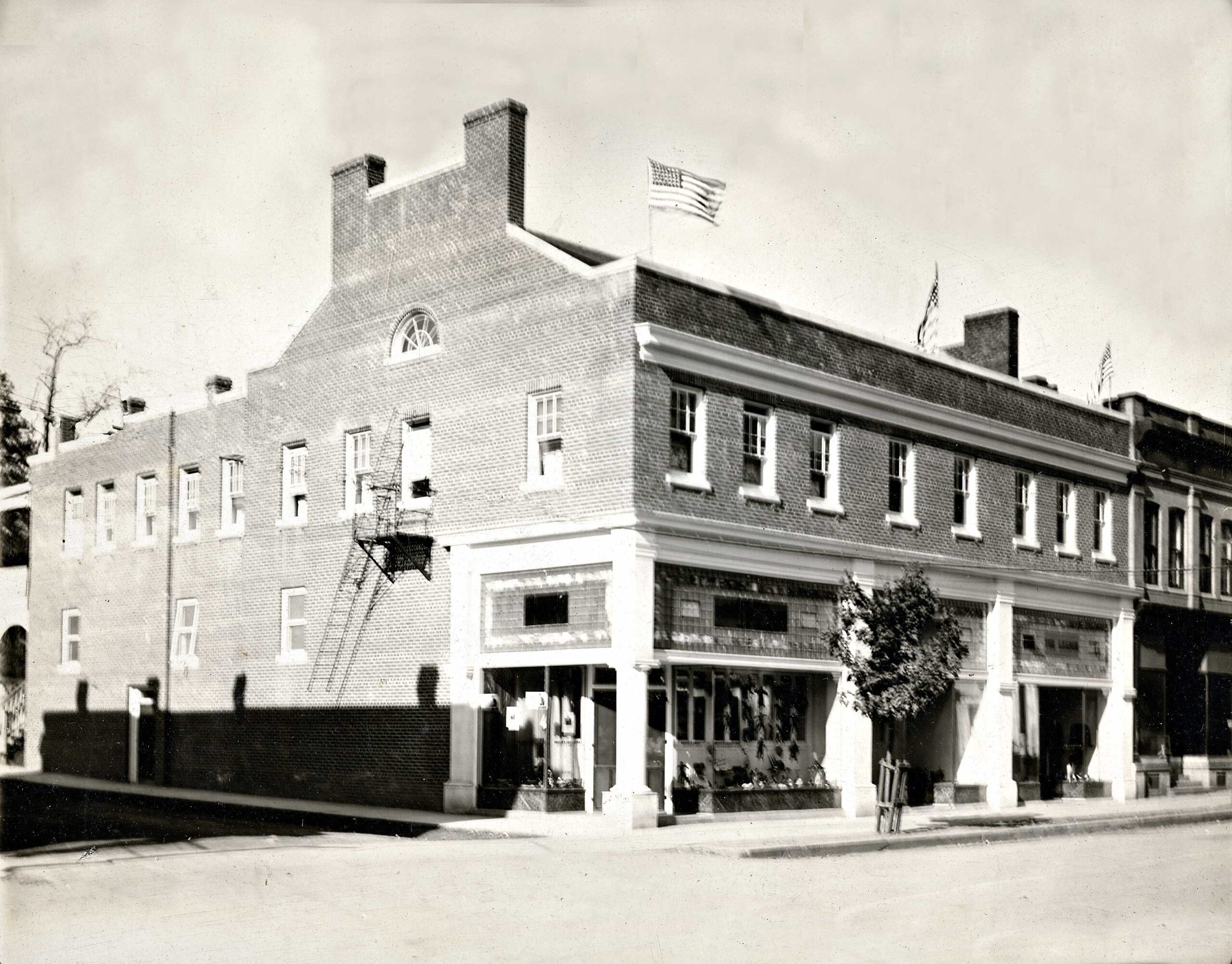
In late 1927, Ellison purchased the old Carlton House hotel, which was the building next door at the corner of Valley and West Main Street. After extensive renovations, Bruce’s Drug Store moved into this building in 1928 and continued in operation at that location until November 22, 2003. Shown below is a 1928 Burgess post card of Valley Street, which shows the newly renovated Bruce’s Drug Store in the red brick building at photo left. The photo at right below shows an interior view of the drug store during its September 1928 grand opening.
Bruce’s Drug Store at corner of Valley and Main Streets,1928
Interior of Bruce’s Drug Store on Opening Day, 1929
In his store’s early days in Scottsville, Ellison ordered his drug store merchandise through a wholesale ‘drummer.’ Drummers were salesmen, who traveled about the area, ‘drumming up business for their companies. A drummer would arrive in Scottsville by train, spend the night at the Traveler’s Rest Hotel on Main Street, and leave by train the next day with Ellison’s handwritten order. On the weekend, all of the drummer’s orders were turned in to the wholesaler, who packed and shipped each order during the next week via railroad freight. Such freight shipments arrived at Bruce’s Drug Store roughly seven to ten days after the order was placed. By the 1930’s, the automobile expedited this procedure so that orders could be delivered in two or three days. In today’s world (2004), computers handle orders with next day delivery via truck.
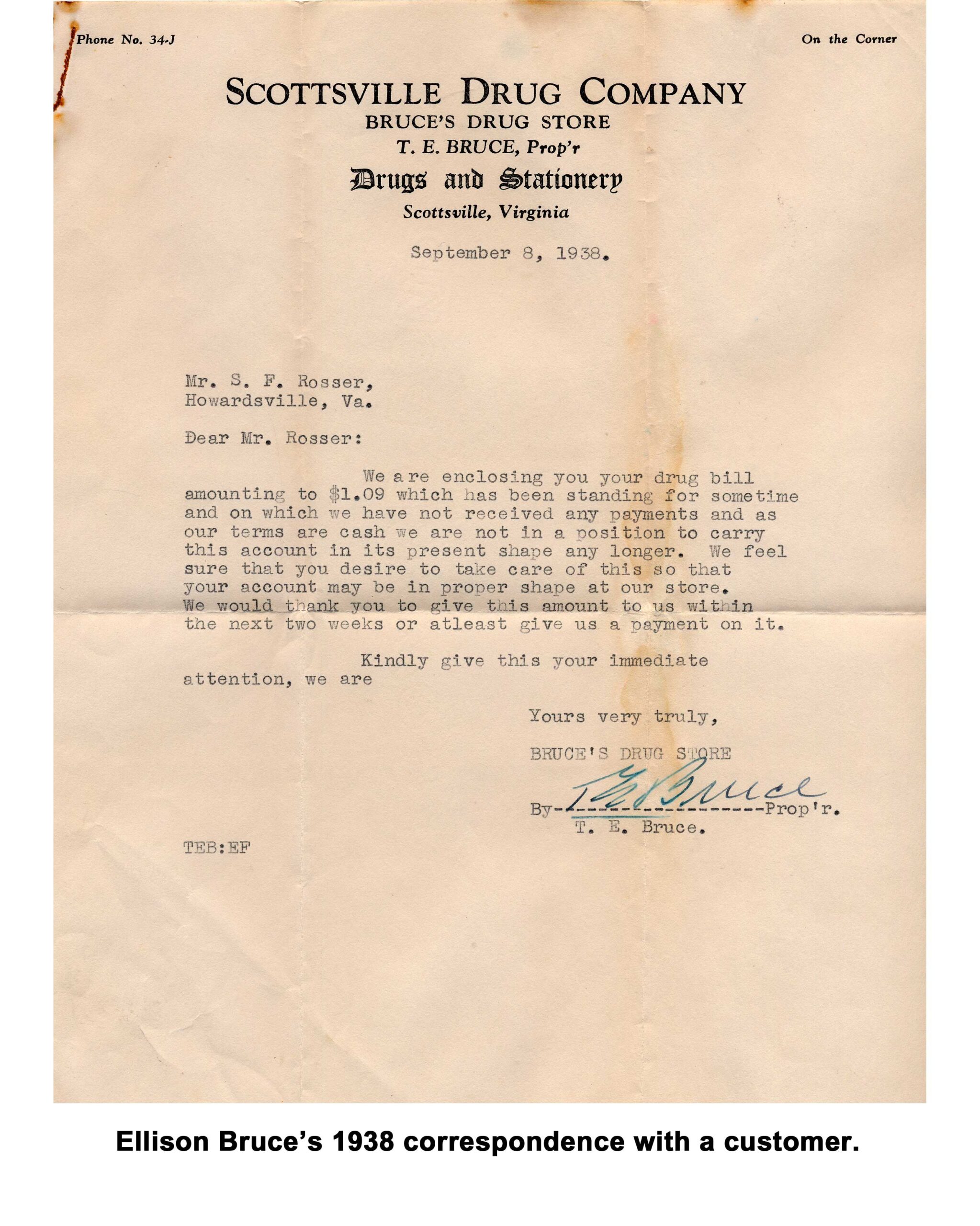
From its early days, Bruce’s Drug Store began to fill the medicinal needs of the town’s citizens and the country population of south Albemarle, Buckingham, and Fluvanna Counties. Ellison Bruce, and later his son, Tom Bruce, served the needs of the community with a generosity in time and account payments. During the 1930s when money was a scarcity in this predominantly farming area, payments on account to Bruce were sometimes made by barter. When customers were unable to pick up prescriptions, the pharmacists themselves delivered them.
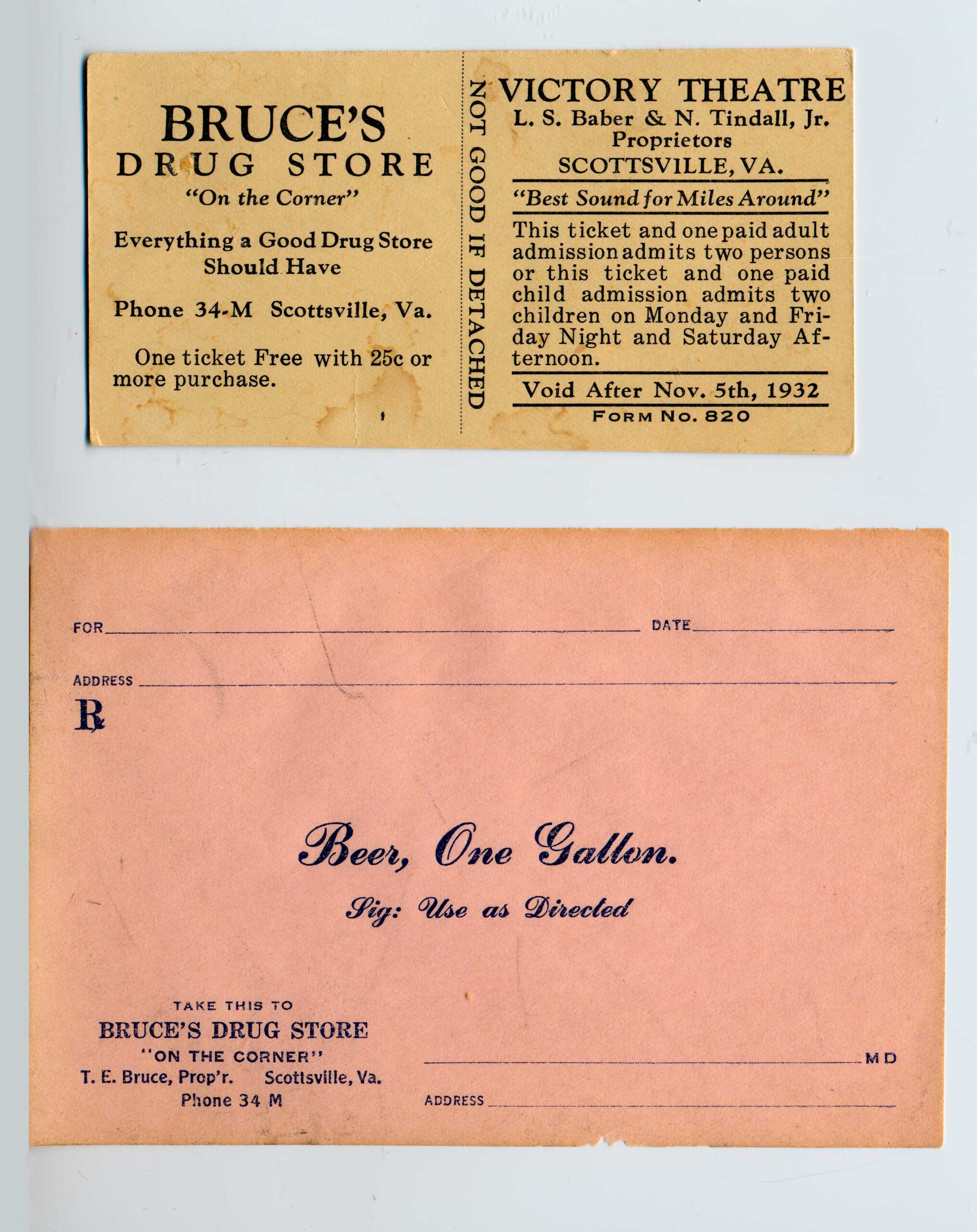
Prescription for beer during Prohibition
In the 1930’s, the State of Virginia allowed the sale of alcohol only for medicinal purposes. At Bruce’s Drug Store, this sale went on with the required prescriptions. However, the sale of medicinal alcohol became too frequent, and ABC officials withdrew the pharmacy’s right for alcohol sales.
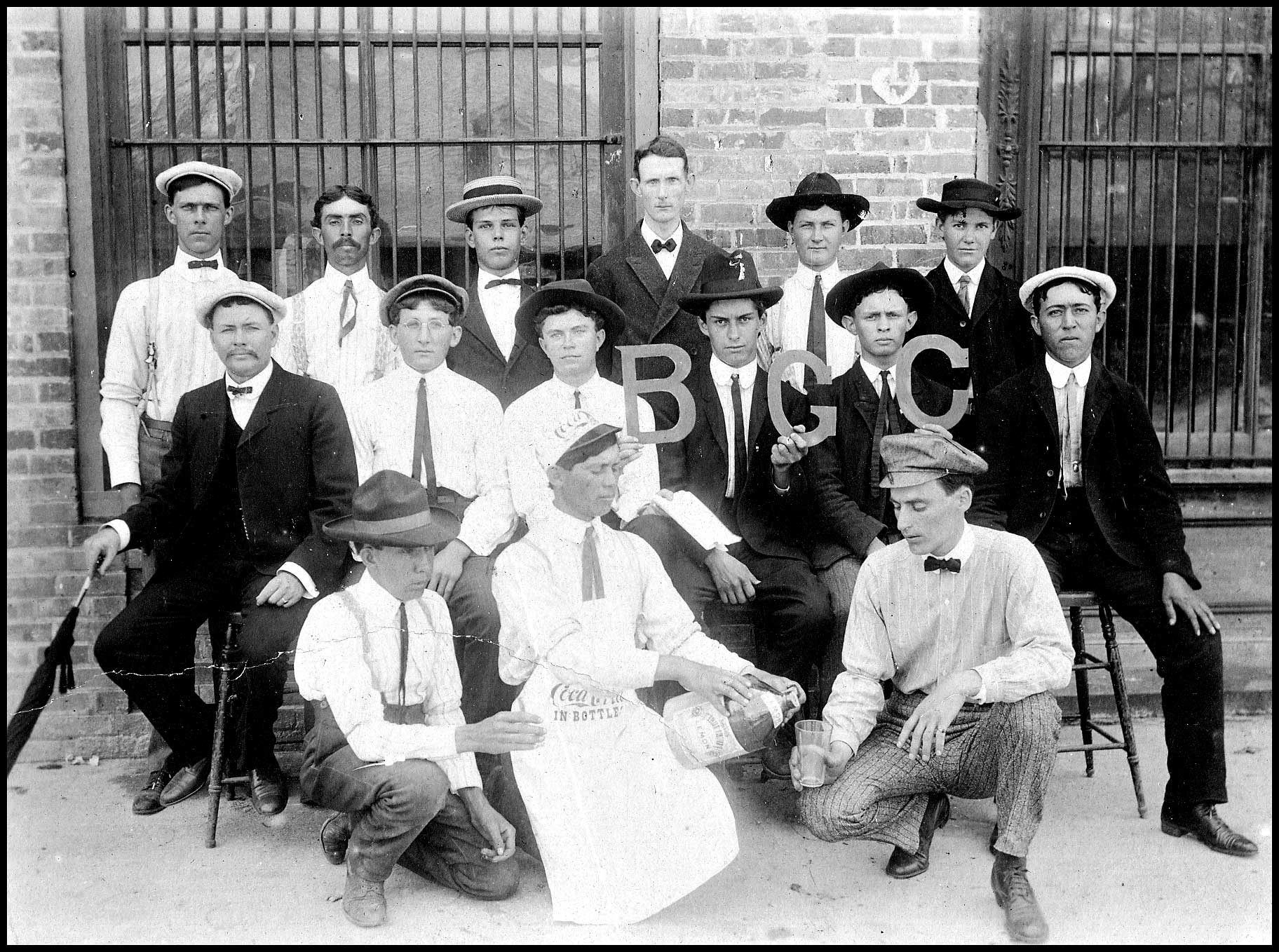
When Ellison became sole owner of Scottsville Drug Company, he added a small soda fountain. A revolving, hand-turned drum produced carbonated water for soda drinks, and Ellison made ice cream in a hand-turned freezer. Photos of his first storefront show ‘Bruce’s Ice Cream Parlor’ and ‘Drink Coca Cola’ stenciled on the store’s front window. About 1920, Ellison installed an electric-operated soda fountain and ordered his ice cream from a commercial dairy. When Bruce’s Drug Store moved to the corner of West Main and Valley Streets in 1928, Ellison installed a modern soda fountain with counter stools and tables with ice cream chairs (shown in grand opening photo above). Later Ellison installed two booths, which were popular with Scottsville High School students. From 1930 – 1951, Bruce’s Drug Store made its own ice cream, which is remembered by many as the best treat ever. The soda fountain business, however, gradually became unprofitable and was removed from the store in April 1958.
Amanda Payne Hall remembers free ice cream.
Memories of Bruce’s Drug Store include its important place in the community for medicines and prescriptions. Citizens of all ages fondly remember ‘going to Bruce’s’ for a soda, ice cream, or just plain good conversation. Druggist Bruce, slight in build, large in friendliness and smiles, would cram a mountain of ice cream into a nickel cone, much to the delight of his customers. As one soda fountain regular fondly recalls, “A great Scottsville memory is going to Bruce’s Drug Store for lunch. Some days I forgot about the real food and just got my favorite ice cream cone, a black raspberry triple dip. I have not had such good ice cream since then!”
George Howard remembers buying a milkshake with his first paycheck.
Ellison Bruce operated Bruce’s Drug Store until his death in November 1947. His son, Thomas Ellison Bruce, Jr., took over management of the drug store after his father’s death. Although educated as an accountant, Tom, Jr., went back to school in pursuit of a pharmacy degree at the Medical College of Virginia. He completely remodeled the drug store in 1953, installing new fixtures and air conditioning. In 1969, Hurricane Camille flooded Bruce’s Drug Store with 8.5 feet of water and James River mud, destroying its interior. Tom again remodeled the drug store and reopened in 1970. Two years later in June 1972, Tropical Storm Agnes flooded Bruce’s Drug Store with 12 feet of water. Again Tom remodeled and reopened his drug store.
Tom Bruce continued to operate Bruce’s Drug Store after the floods and employed another pharmacist, G. Richard Sago, in October 1974. Tom retired in April 1977, when he sold his drug store to Richard Sago and his wife, Ann, who is also a pharmacist. The Sagos operated Bruce’s Drug Store at the corner of Valley and West Main Street until November 22, 2003, when they moved the store to its fourth and current location in the old Maxwell Furniture building across from Scottsville Museum on Main Street.