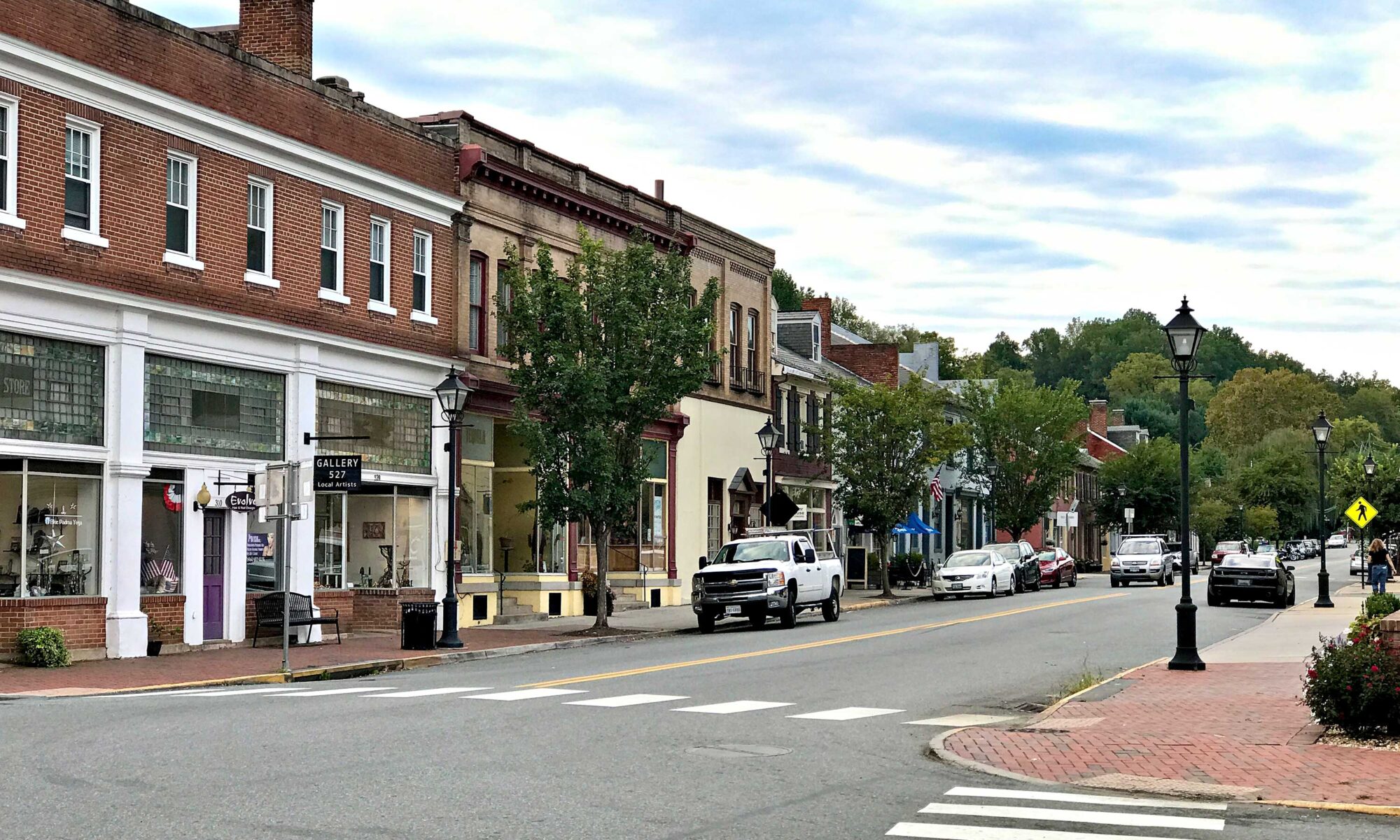
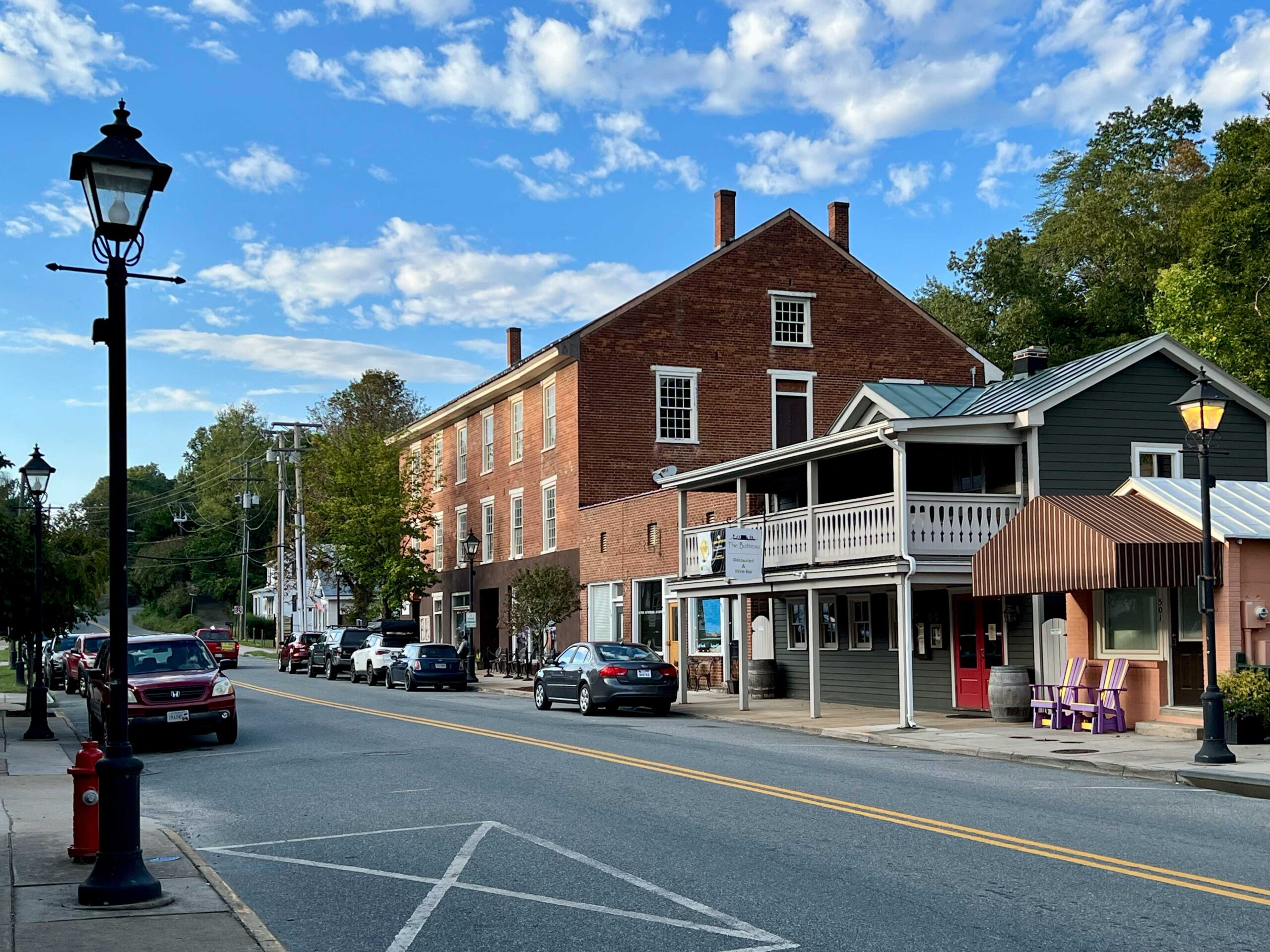
Since the colonial era, Vally Street has been the main commercial corridor in Scottsville. A natural ravine led down the high bluffs to the ferry at Scotts Landing, providing access for wagons loaded with goods and passengers to the James River and trade with the outside world.
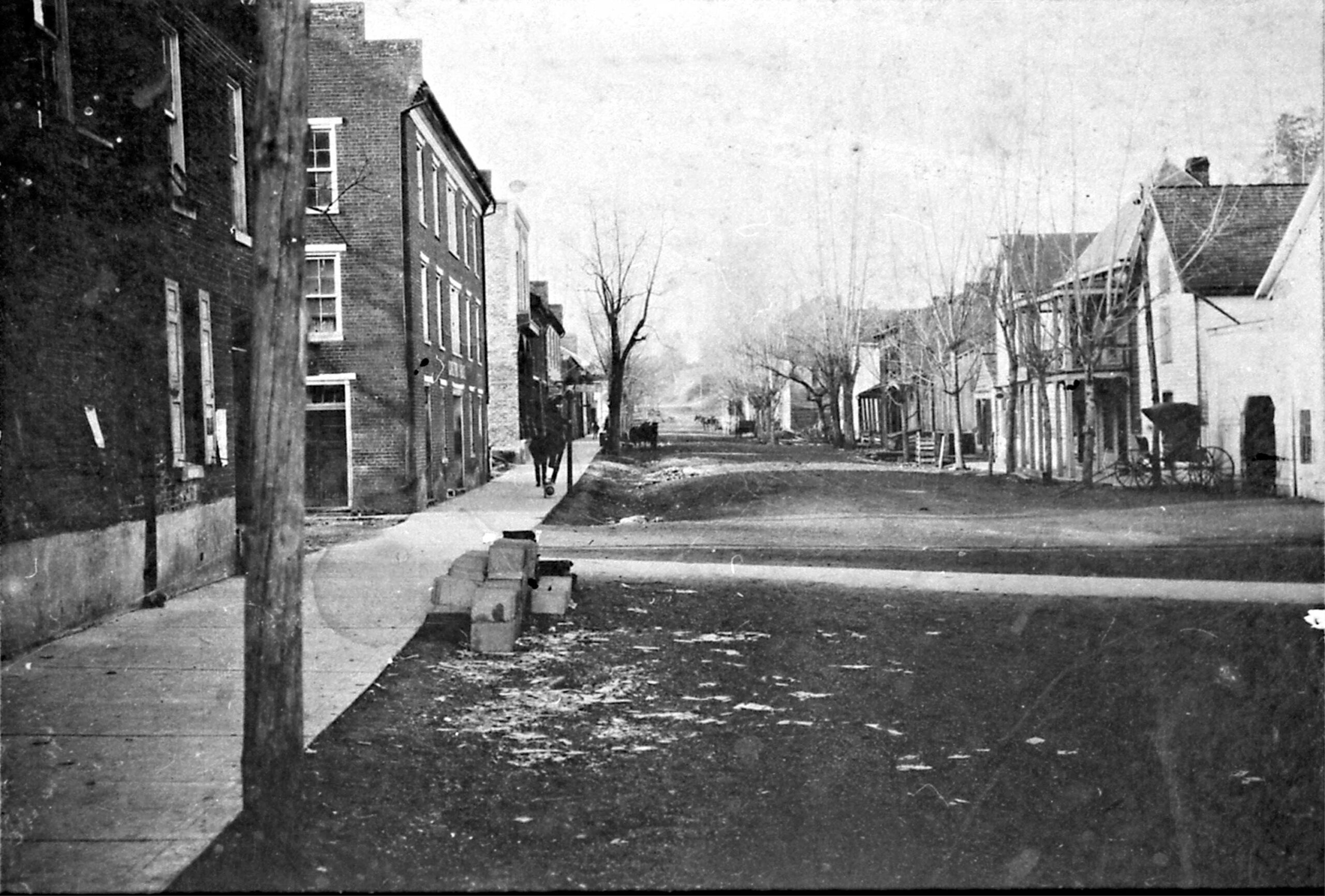
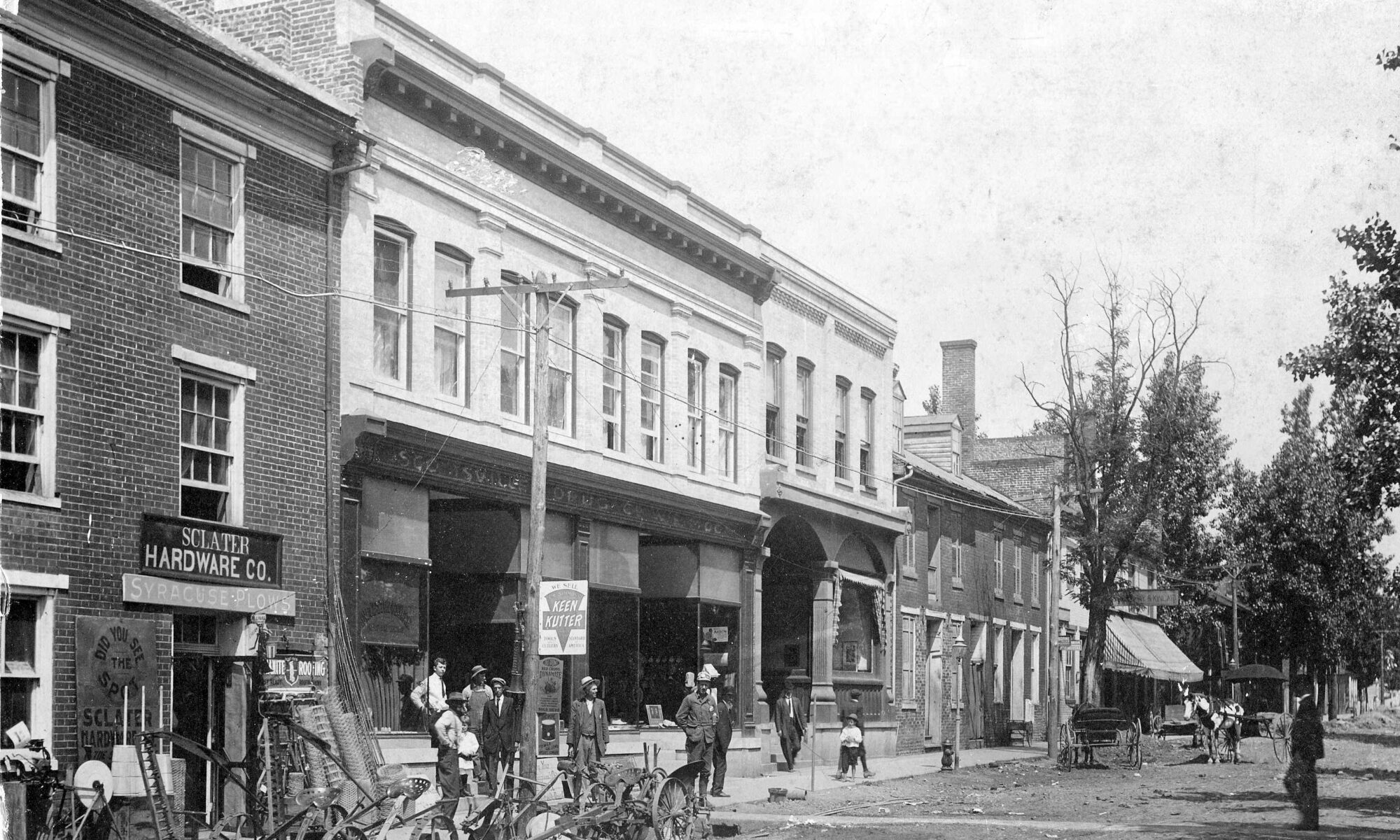
Valley Street in Scottsville, Virginia, circa 1898
Burgess took the photo above, the oldest in the collection, with his camera pointing north up Valley Street and his back to the James River. On the sidewalk at the left of the photo, a man can be seen standing on a short ladder to light a carbide street lamp. At that corner, Main and Valley street intersect.
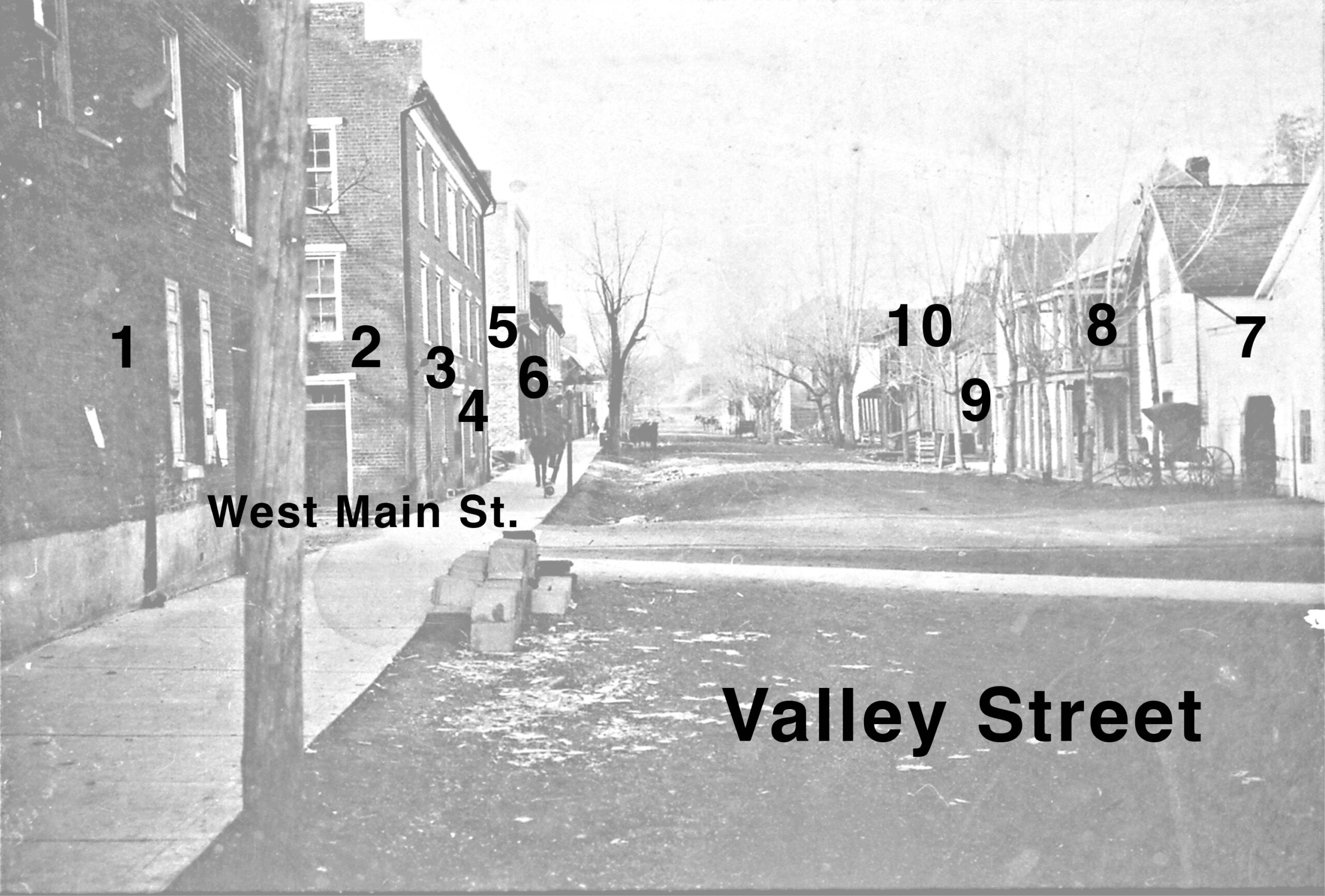
See the image below as a guide to these specific buildings:
(1) Dorrier Building (Corner of Valley Street and West Main) – served as a general merchandise and feed-grain store for many years until its recent conversion to a grocery store.
(2-4) Carlton House – built c. 1840 and contained 3 entrances. Entrance 2 at the corner of Valley Street and West Main was Dickinson’s Drug Store; Entrance 3 at the center of the building was the Carlton House Hotel with its lobby on the first floor and stairs leading to the rooms upstairs; Entrance 4 was to Sclater Hardware Co.
(5) National Bank of Scottsville – David Pitts served as President and Walter Dorrier as cashier.
(6) Post Office and Griffin Building – constructed c. 1840, these two identical brick buildings appear to be one structure. The first building was the town post office from 1884-1914.
(7) Livery Stable – located on the northeast corner of Valley and Main St. Buggy and stable belonged to Charlie Harford.
(8) Fidelity National Bank – this bank was owned and managed by Jacinto V. Pereira. Dr. Wade had his dental offices on the second floor of this building.
(9) Luther Lewis’ General Grocery Store
(10) Moon Bank. Upstairs were the law offices of Hobhouse and Douglas Patterson.
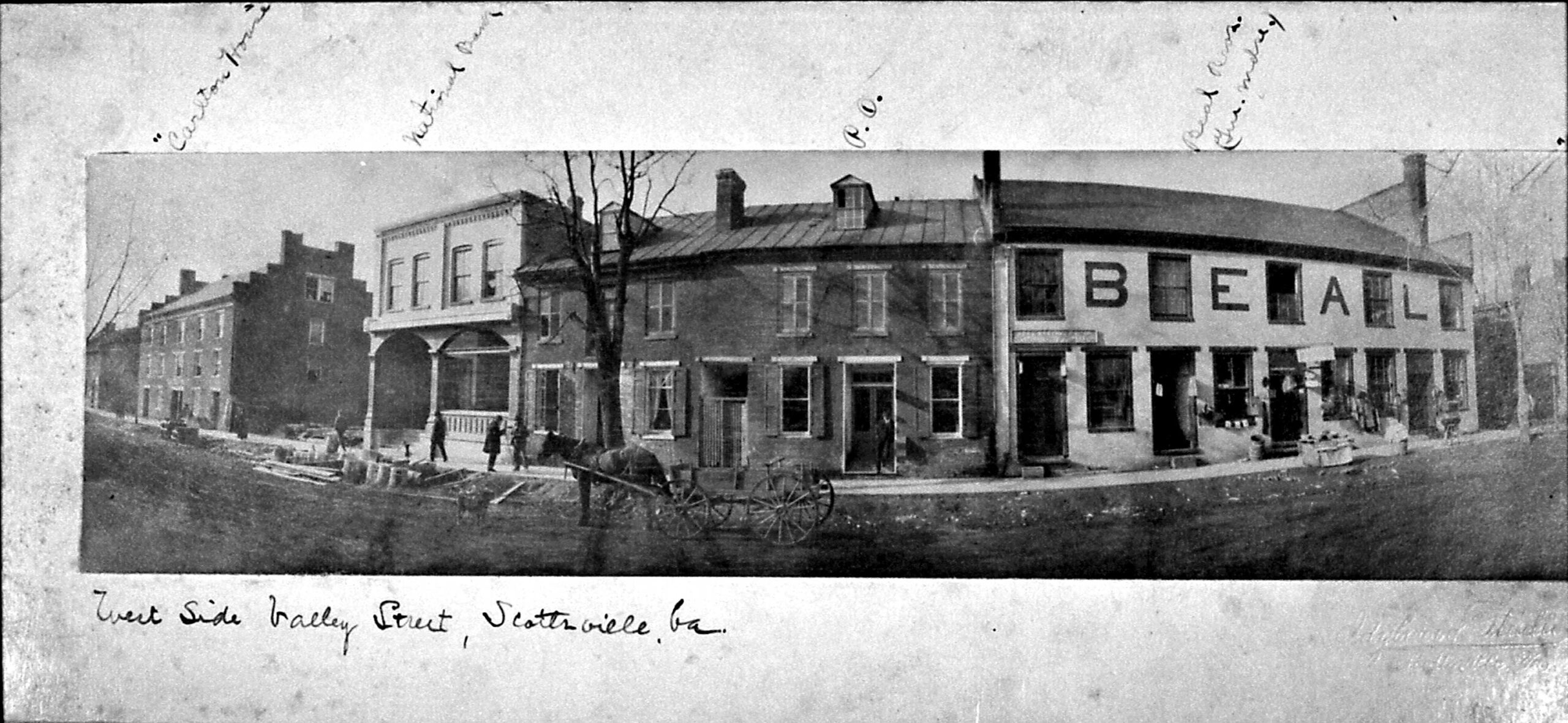
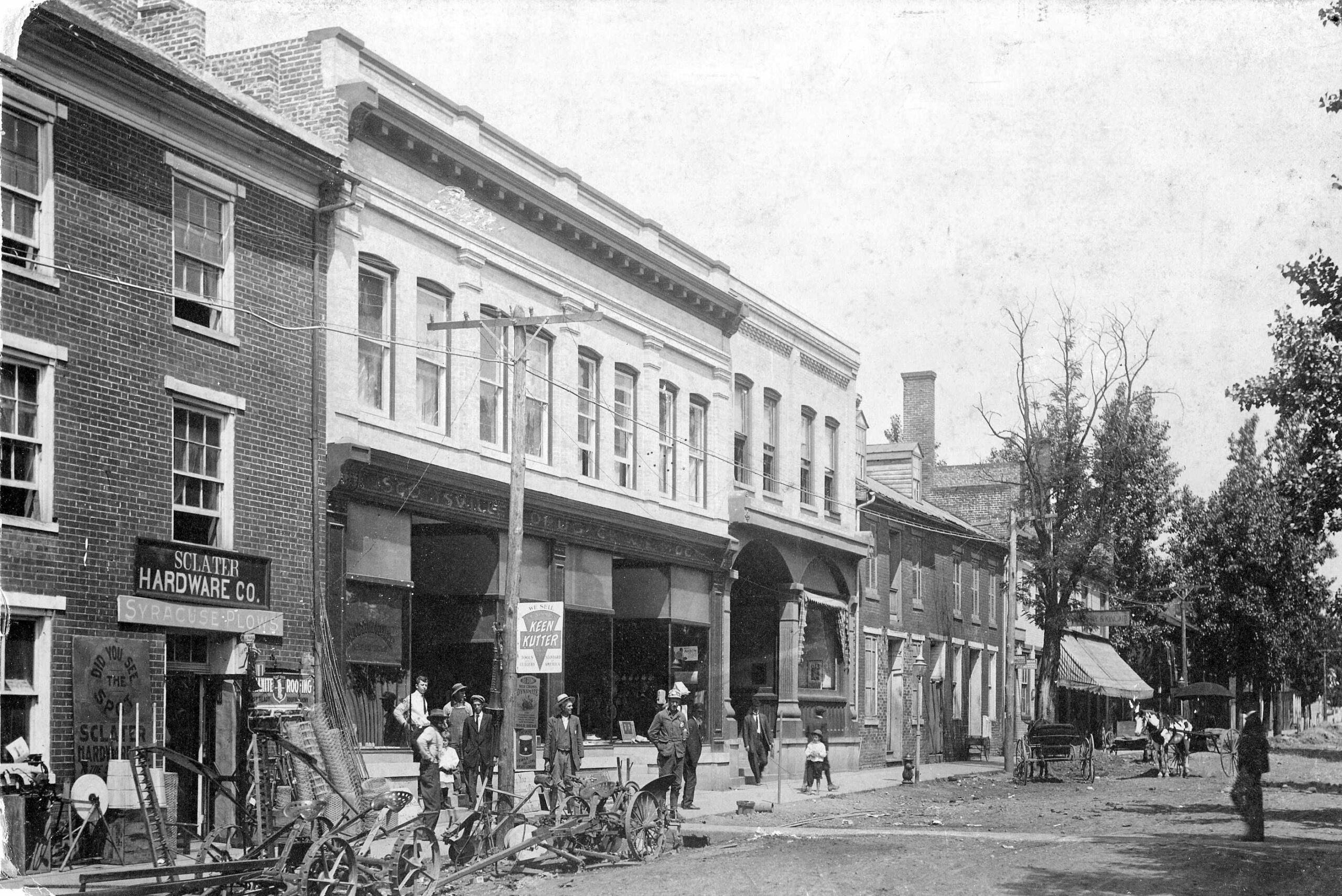
Burgess captured the west side of Valley Street in this photograph, using his panoramic camera with a fisheye lens.
West side of Valley Street in Scottsville, Virginia, circa 1900
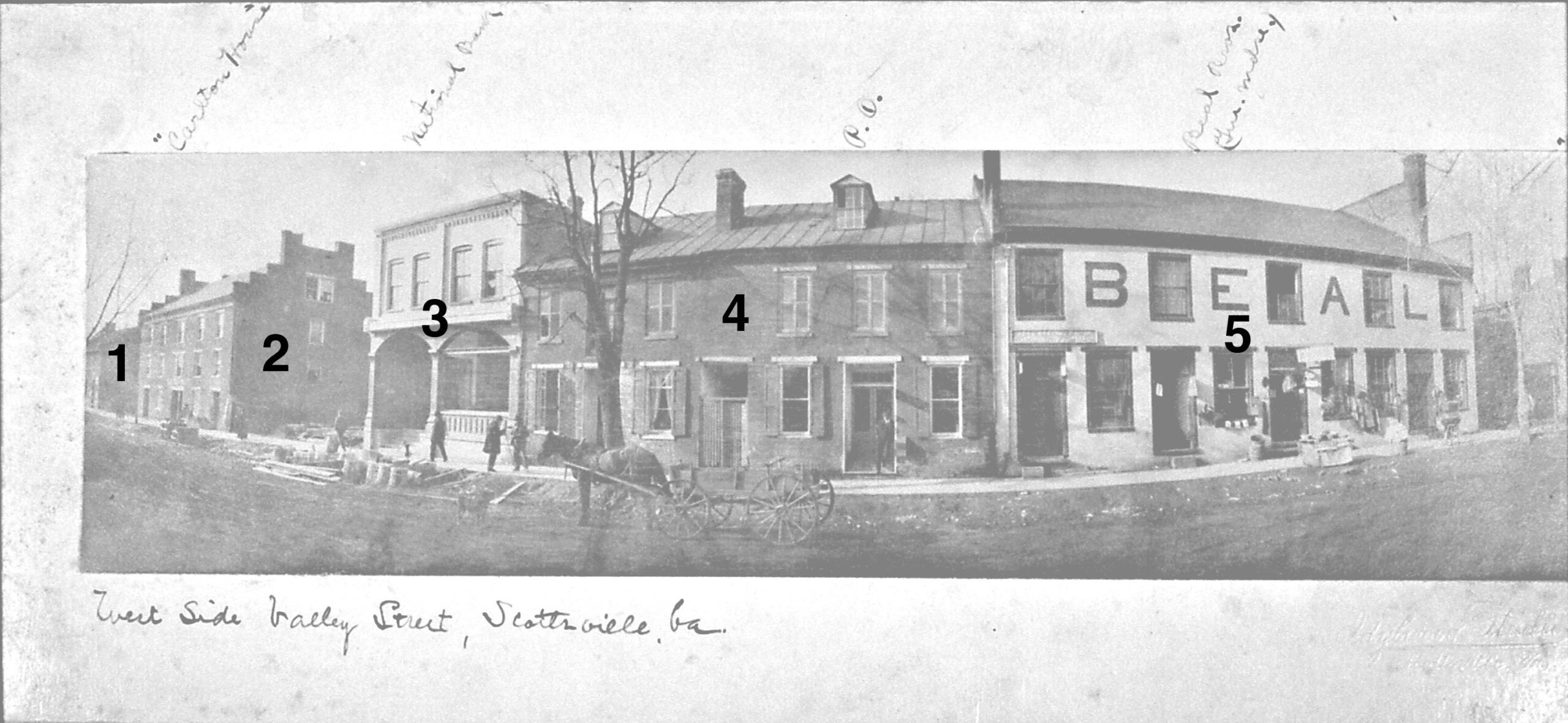
The image below is a guide to specific buildings:
(1) Dorrier Building (Corner of Valley Street and West Main) – served as a general merchandise and feed-grain store for many years until its recent conversion to a grocery store.
(2) Carlton House – built c. 1840 and served as a Civil War Hospital. At this time, the building contained 3 businesses: Dickenson’s Drug Store at the corner of Valley Street and West Main, the Carlton House Hotel at the center entrance with a lobby on the first floor and stairs leading to rooms upstairs; and at the north entrance to the building was Sclater Hardware Co.
(3) National Bank of Scottsville – David Pitts served as President with Walter Dorrier as cashier.
(4) Post Office and Griffin Building – Constructed c. 1840, these two identical brick buildings appear to be one structure. The first building was the town post office from 1884-1914.
(5) Beal Building – This two-story brick building was built about 1840 by the Beal family, and Scottsville Mayor Jackson Beal, Sr., had his office here. For many years, town court was held on the second floor. Here also was the law office of Thomas Staples Martin, elected in 1895 to the U.S. Senate where he served 25 years.
– o • 0 • o –
Population of Scottsville In 1900 Was 1,248; Paper Reveals Interesting Facts Scottsville Sun, May 15, 1958
The population of Scottsville in 1900, according to the geography of Virginia published that year, was 1,248.
At that time, according to The Scottsville Courier, you could get on a train any afternoon or evening, bound for Lynchburg, Cincinnati, Louisville, Chicago, St. Louis, or any point west, or a train leaving the Scottsville Depot twice a day took passengers to Richmond and the Virginia “seaside.” There was a controversy over the financing of a Scottsville bridge in Buckingham County, with poems pro and con taxation to finance it in the editorial columns.
T.W. Heath knew the value of advertising and advertised his Scottsville Roller Mills, adding that “To my Buckingham patrons, I wish to say that I have made an arrangement with Captain Thomas to ferry them across the river and return for 25 cents per wagon.” He also advertised building materials, painting, paper-hanging, and was an agent for “Antiseptic Laundering.”
For $45 you could buy one “brand new top buggy, and spring, piano box, leather top.” A condensed encyclopedia cost 50 cents, and jobs were offered ambitious salesmen who could make $780 to $936 a year, while the “best shoes in the world” cost $3 a pair.
In the issue of July 5, 1901, we find that a rumor was going around that the Albemarle Soapstone Company had bought a controlling interest in the Virginia Soapstone Company, and the two would merge soon.
D. H. Pitts was elected treasurer and Dr. J.P. Blair secretary of the Scottsville Town Council when Messrs Beal and Pereira were added as new members. The tax on whisky was raised to $40 and a tax on dogs was levied.
The wedding of Frank Russell Moon and Annie Dunscomb Horsley was written up in the social column. It took place June 26, 1901 in Grace Church, Buckingham County. The bride, escorted by her brother, Alexander Caldwell Horsley, was attired in white Paris muslin trimmed with lace and carried a shower bouquet of roses. Her attendants carried ferns and daisies.
Conducting the service was Rev. T.H. Lacy. The groom was attended by his brother, Carey Nelson Moon. Mrs. John Horsley played the wedding march.
Mr. Moon was “a popular and prosperous merchant of Manteo.”
After the wedding, “an elaborate luncheon was served” at Traveler’s Rest, Warminster, home of the bride. She was the daughter of the late John Horsley and great granddaughter of Major Charles Yancy of Virginia.
Mrs. Henry Burton, matron of honor, was attired in her wedding gown of white silk.
Cures for stomach ailments were advertised in several columns.
The Scottsville National Bank was established in 1901 and advertised “a general banking business.” Dr. J.P. Blair was the dentist, who advertised that he would visit Buckingham, Columbia, Arvonia, and Howardsville, and the doctor, J.S. Pendleton, also advertised that he would practice in Albemarle, Buckingham, and Fluvanna. In a town of over 1,000, this seems to show that either not so many people were ill as they are nowadays, or the doctors and dentists put in longer hours, and less time per patient!
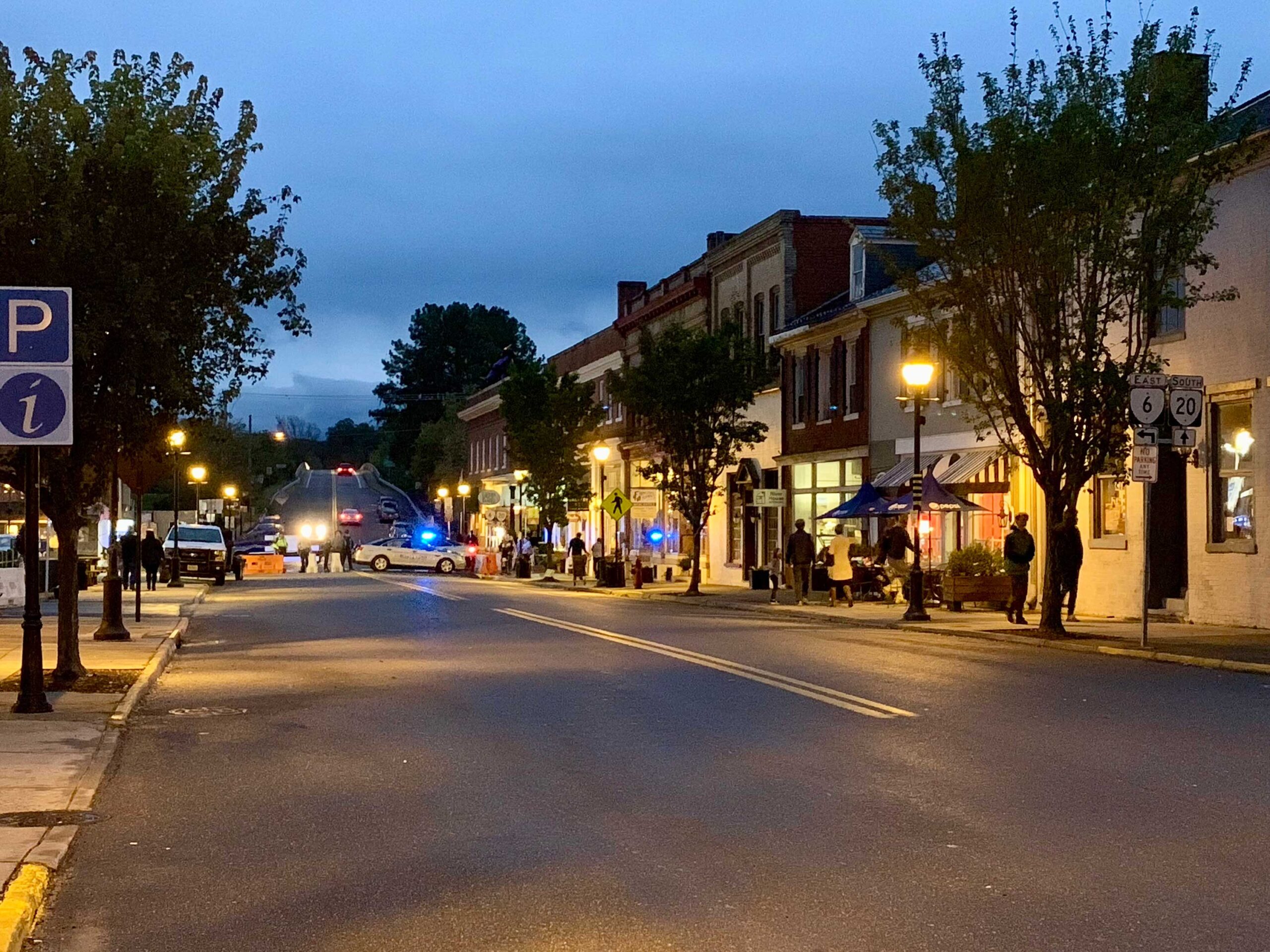
Valley Street traffic paused for Halloween Trick-or-Treeting
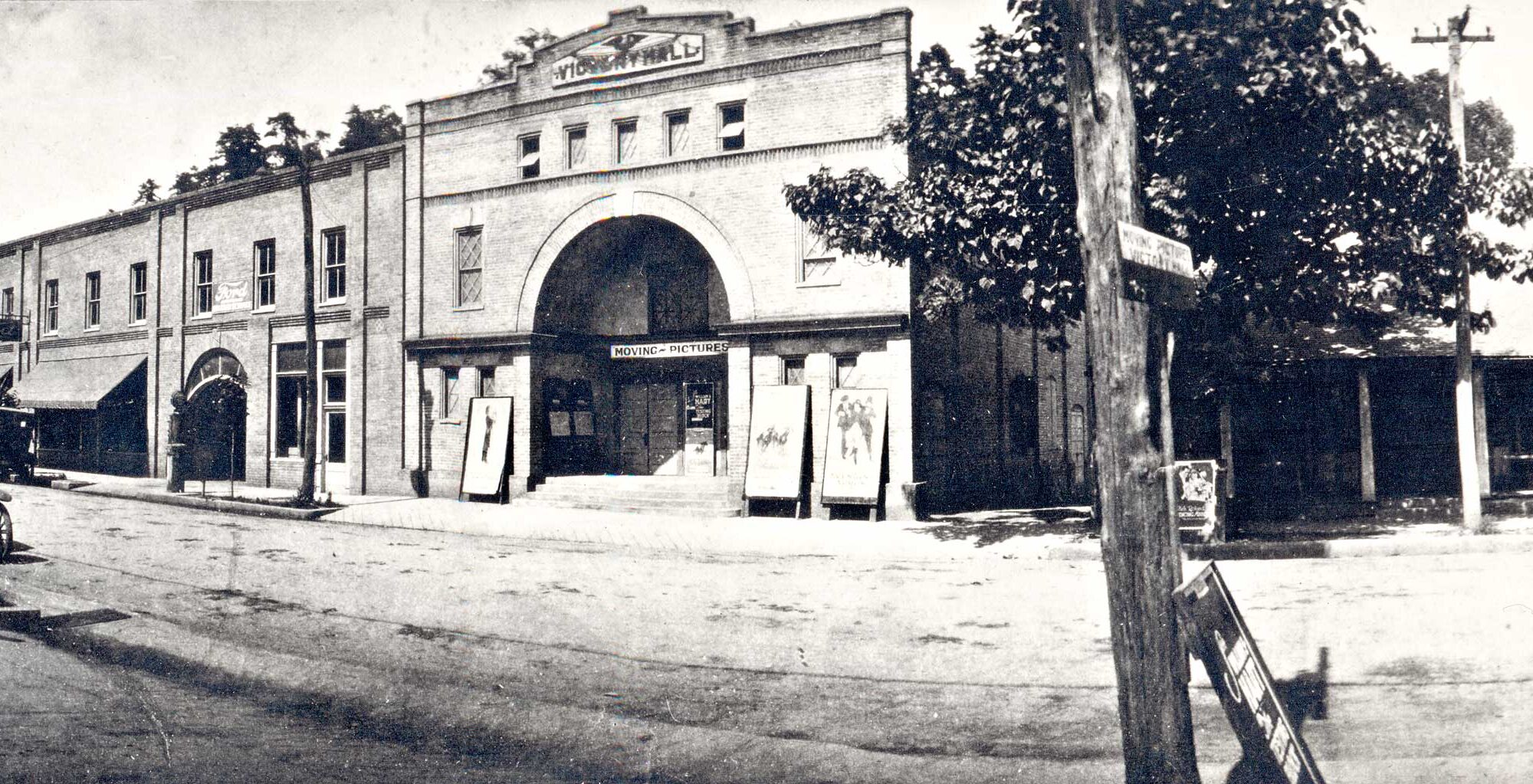
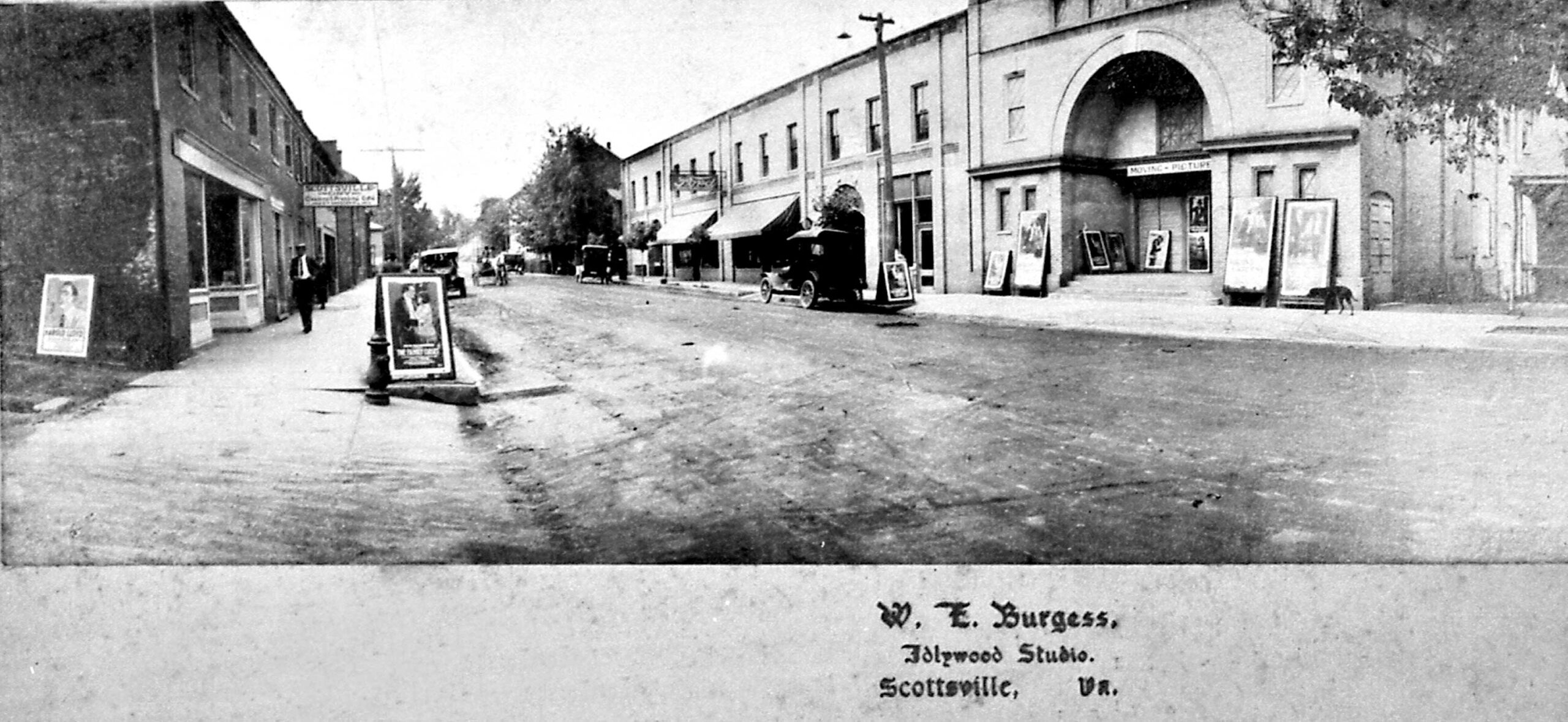
Looking north on Valley Street, Victory Hall on right circa 1925
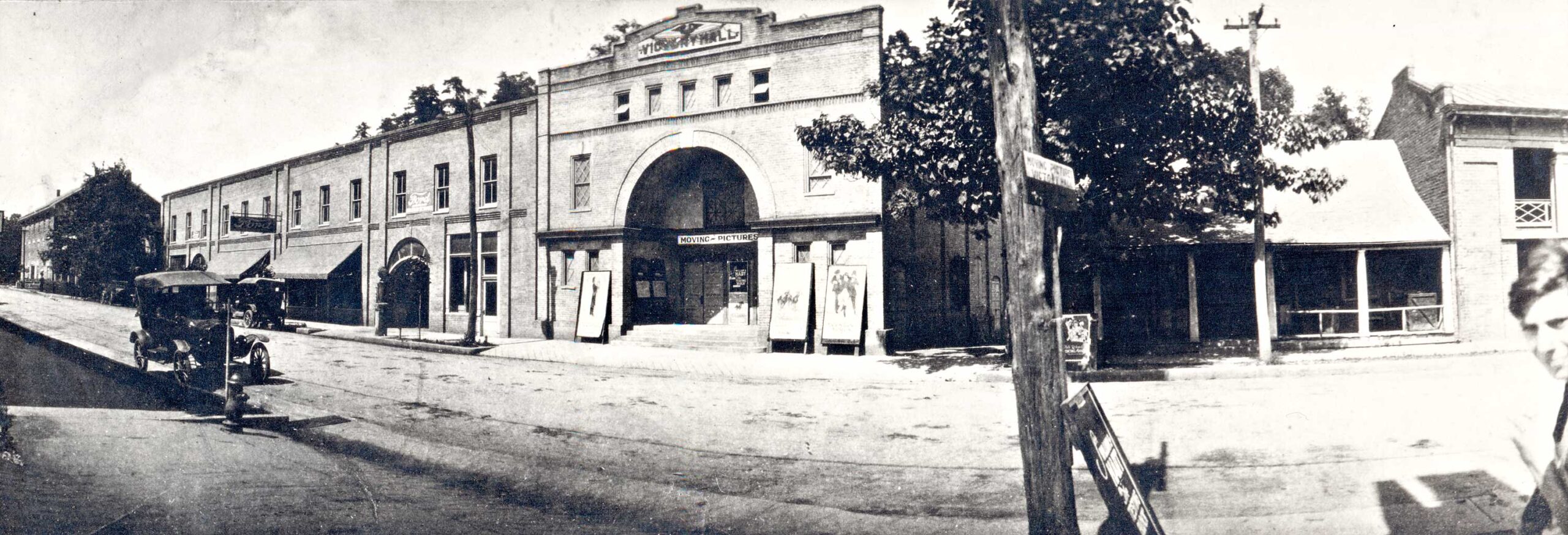
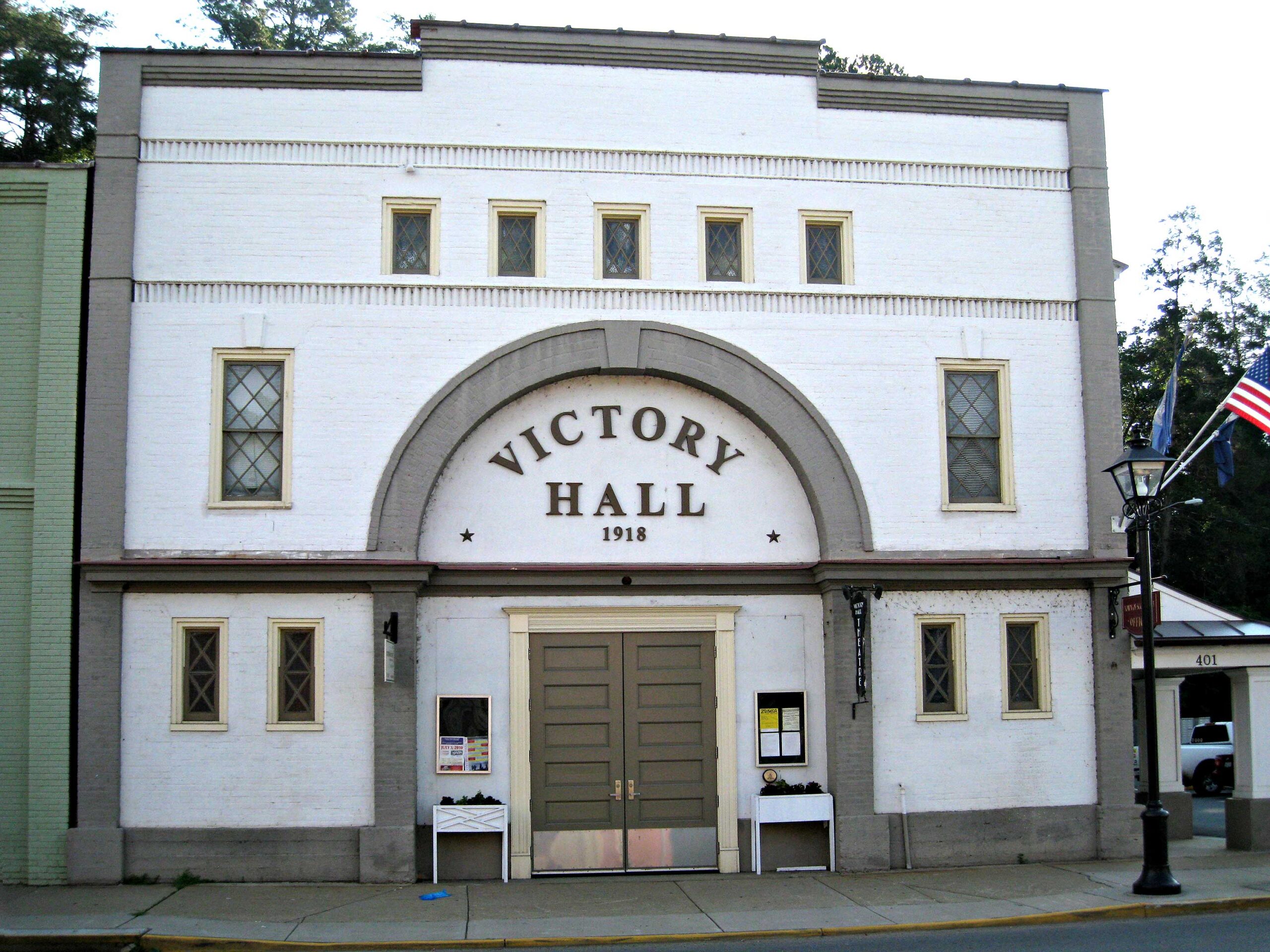
Victory Hall, later called Victory Theatre, was completed in 1920 on Scottsville’s Valley Street to commemorate the Armistice of World I. It was the dream of Scottsville drama teacher, Marion McKay, to have a setting for dramatic performances and traveling vaudeville and Chautauqua shows. Designed by D. Wiley Anderson, a local architect, the hall was constructed of yellowish brick made from John Martin’s foundry on the low grounds of old Snowden. Victory Hall became Scottsville’s cultural center for over four decades as it hosted local dramatic productions as well as the traveling shows that came to town each year. Even the famed violinist Fritz Kreisler once appeared here.
Victory Hall circa 1922
The exterior featured steps, an alcove, and an open half-dome, now preserved in the arch above recently-added front doors. The interior, designed like an opera house, had a lobby, stage, and proscenium. The hall comfortably sat an audience of over three hundred with an interior with a balcony, a lovely heavy velvet stage curtain and embossed valance, and two, large moose heads were displayed on each side of the stage. There were also two backstage dressing rooms. An ornate mirror, recently discovered intact, was part of the elegant decor which included chandeliers and upholstered theatre seats.
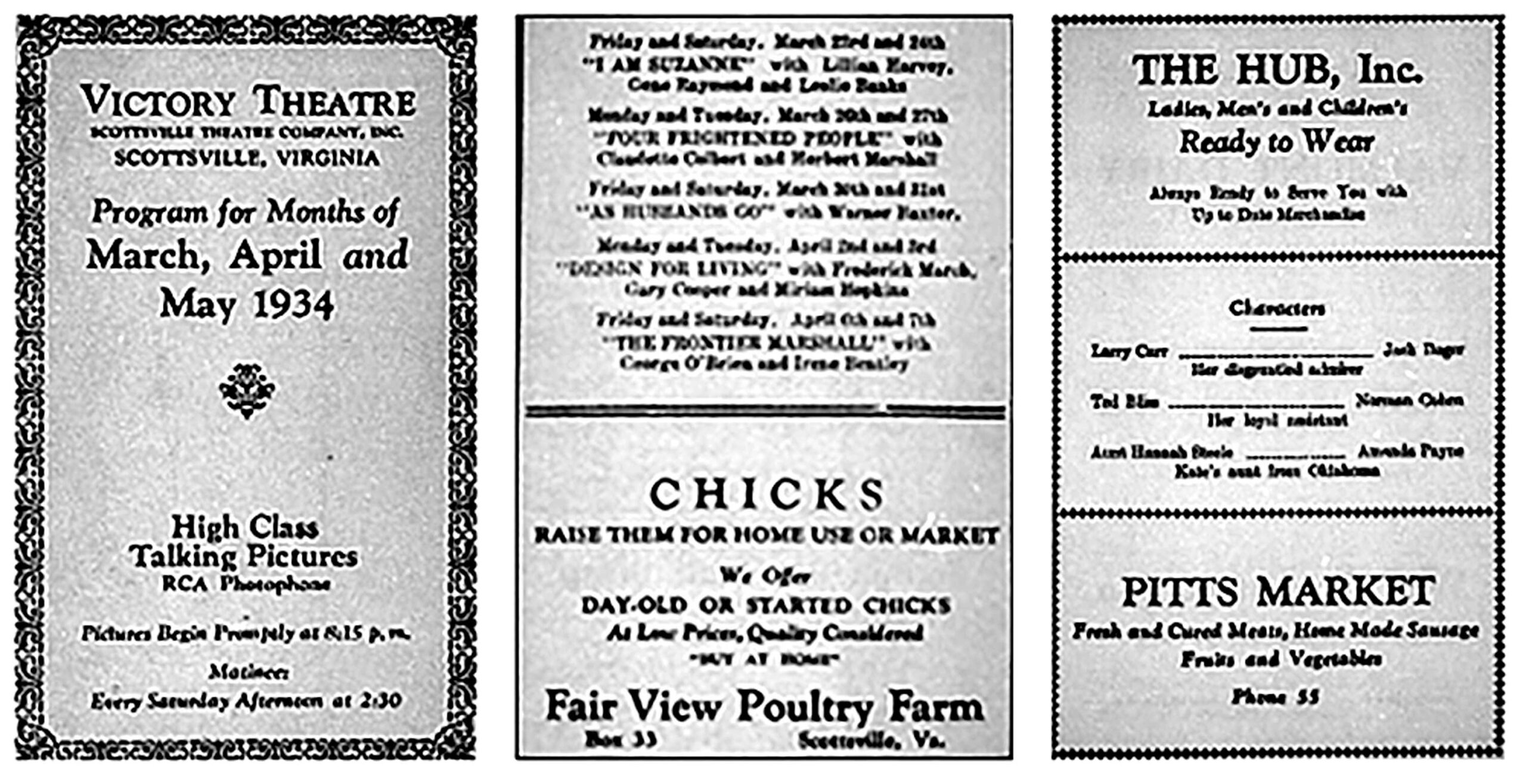
With the advent of movies, William E. Burgess introduced silent films with player piano accompaniment to Victory Hall audiences. Eventually the classics and musicals of Hollywood’s Golden Era were shown here using a big screen and modern projectors; shown below is the Burgess ‘Talking Pictures’ program for three months in 1934. However, live performances and events were always welcome on its stage. For over thirty years, Victory Theatre was the venue for Scottsville High School’s senior class plays, graduation ceremonies, beauty contests, and local talent shows. In the 1940’s and 50’s, many of the future greats of country music performed on the Victory Theatre stage.
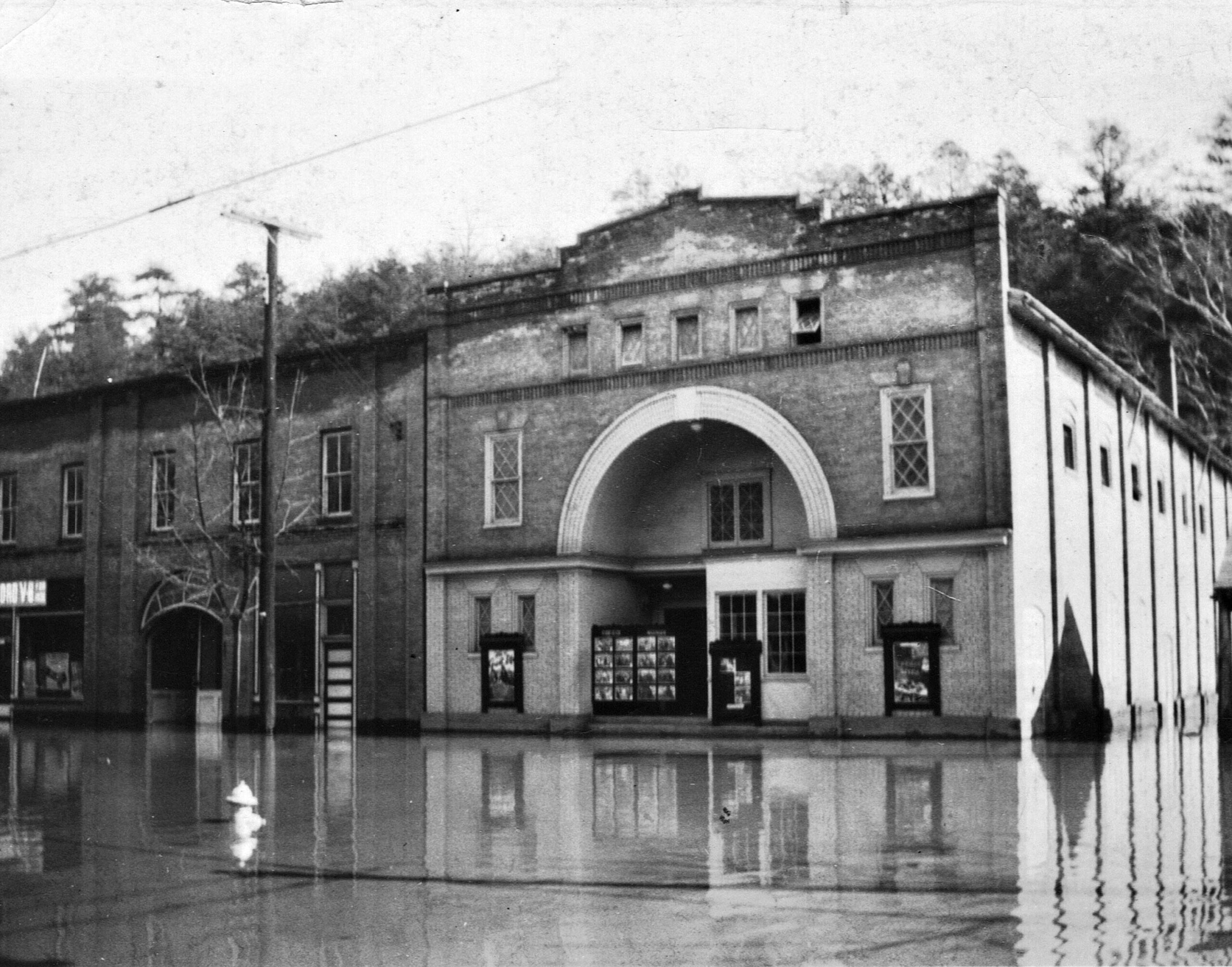
Victory Hall during the flood of 1936Victory Hall, 2010
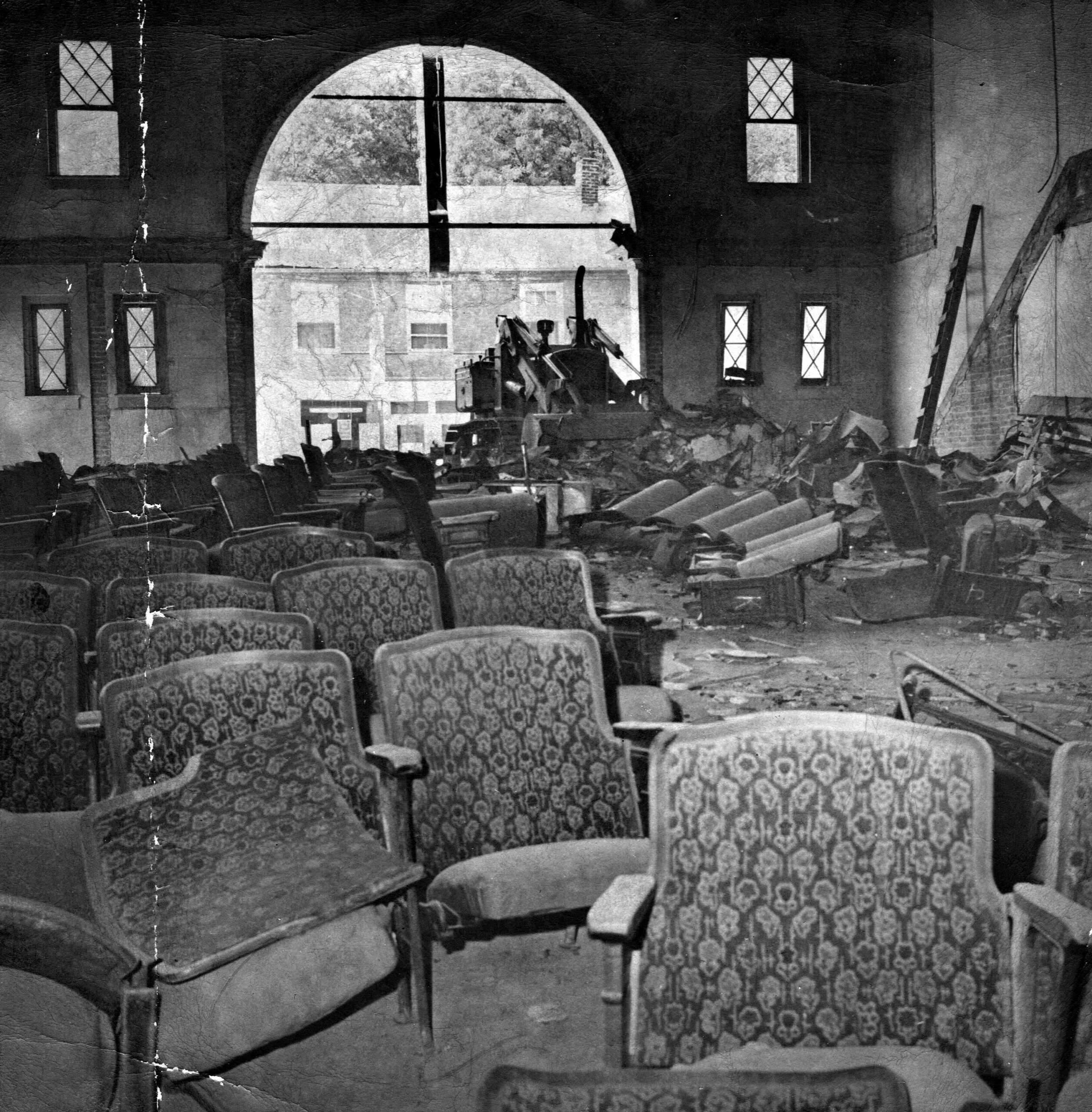
Victory Theatre eventually closed due, in part, to modern transportation and the increasing popularity of television. In the early 1960’s, it was converted into the Scottsville Municipal Building with town offices and meeting rooms upstairs, and a large parking bay downstairs which was first used by the volunteer fire department and later by the volunteer rescue squad for housing vehicles.
Theater conversion to rescue squad in 1967
After the rescue squad moved to its current Scottsville location, the Horseshoe Bend Players received permission to perform The Lion in Winter in the spring of 1999, using portions of the original Victory Theatre stage and auditorium. This was the first dramatic performance in the building in over thirty years.
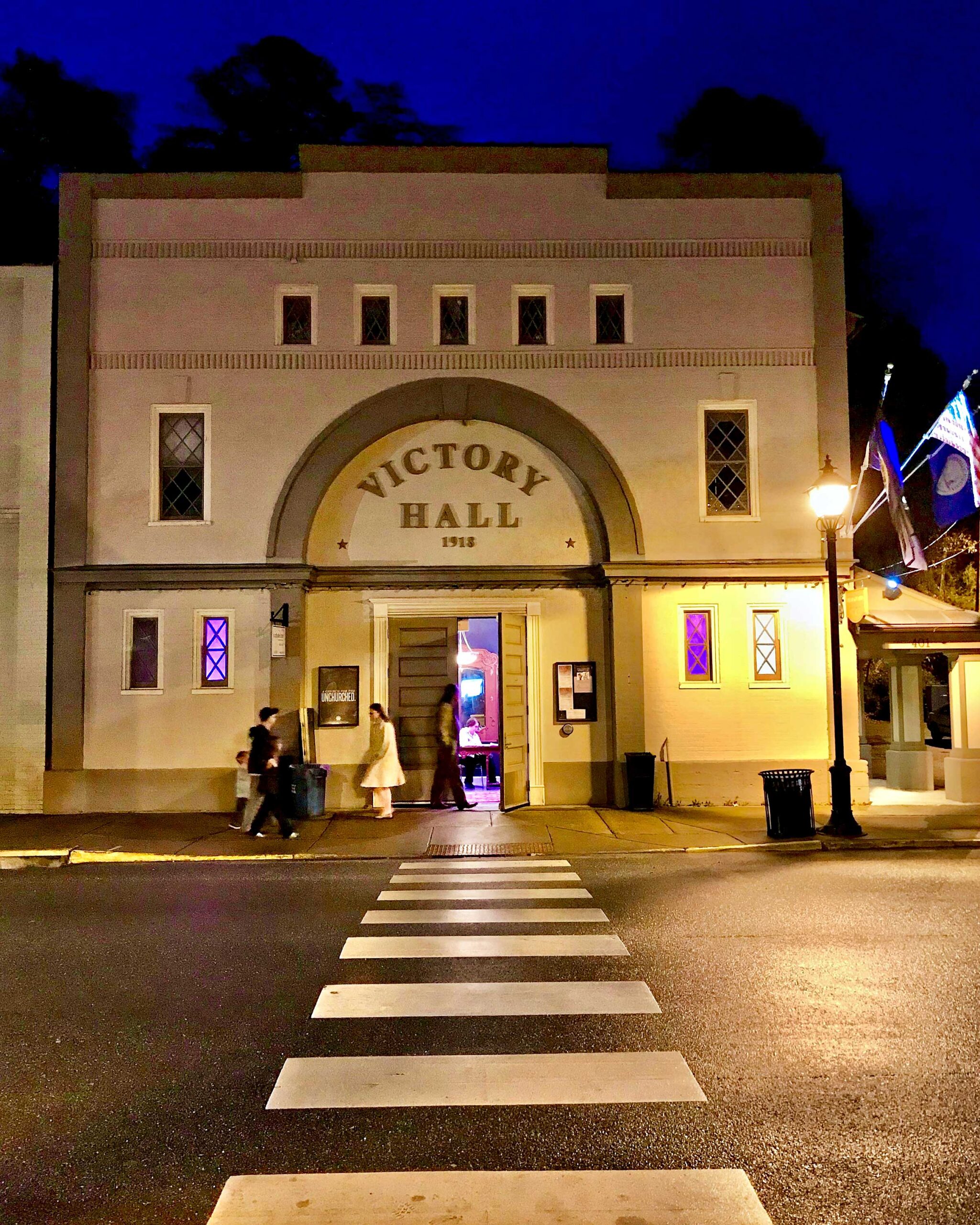
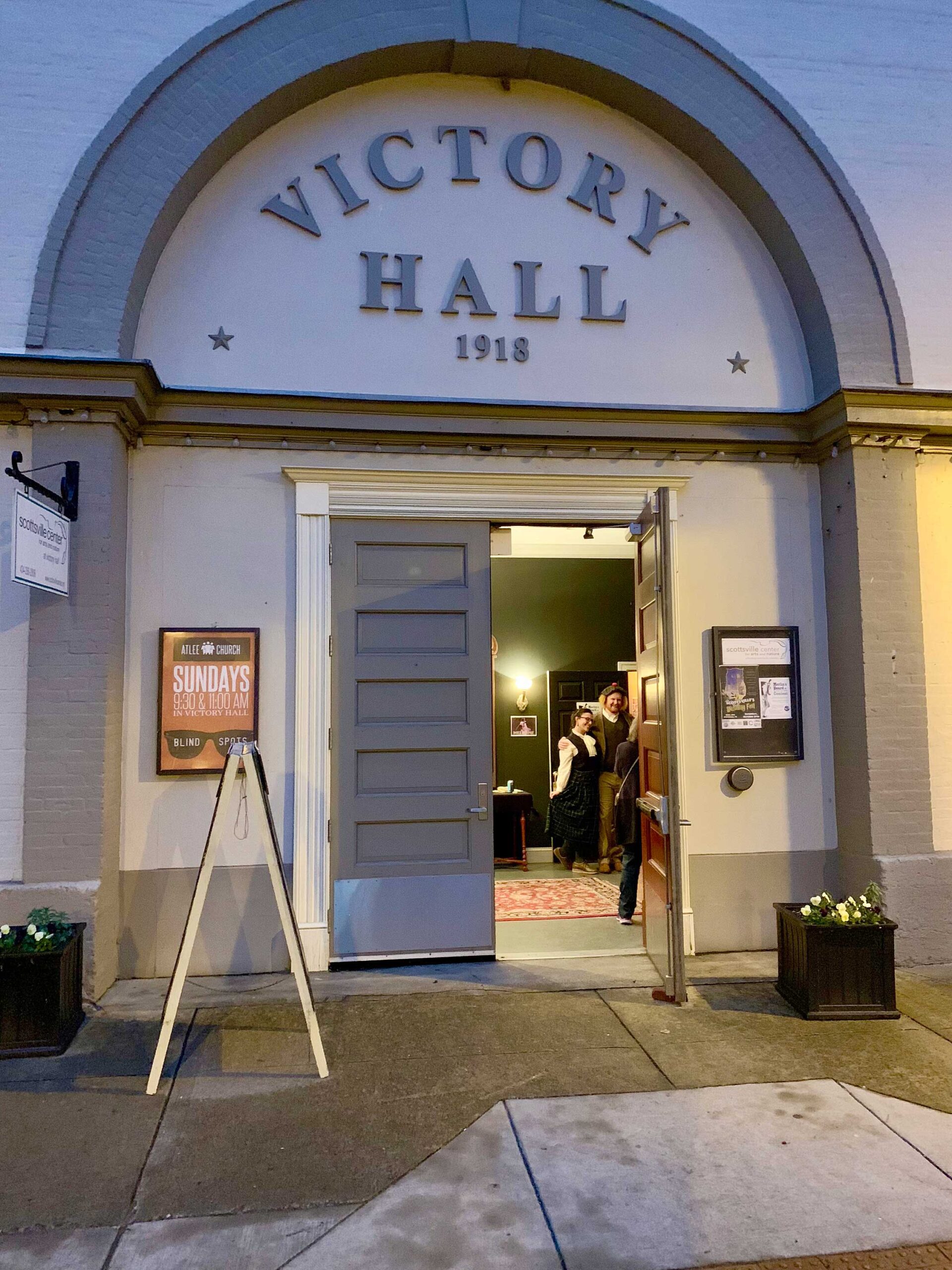
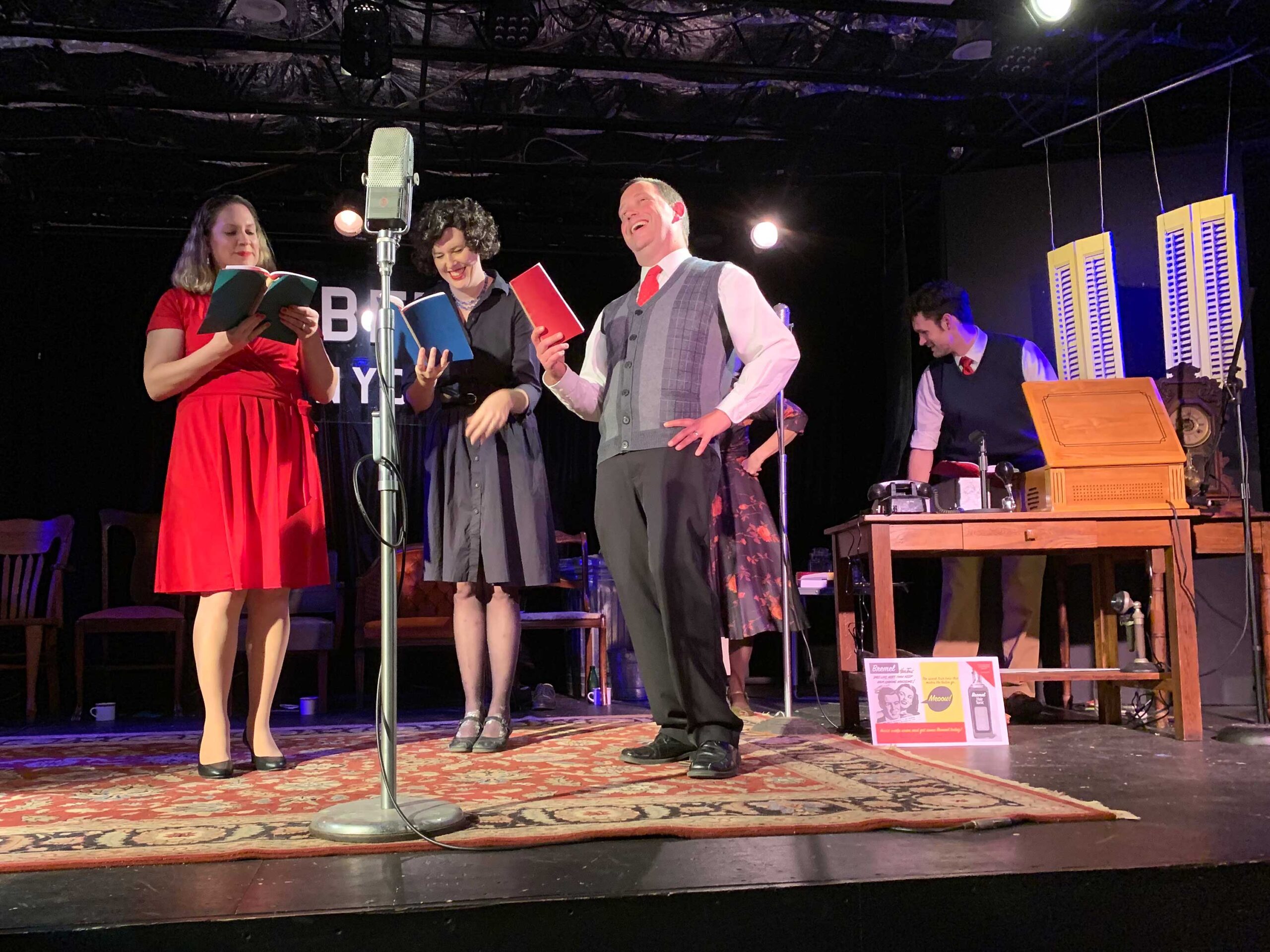
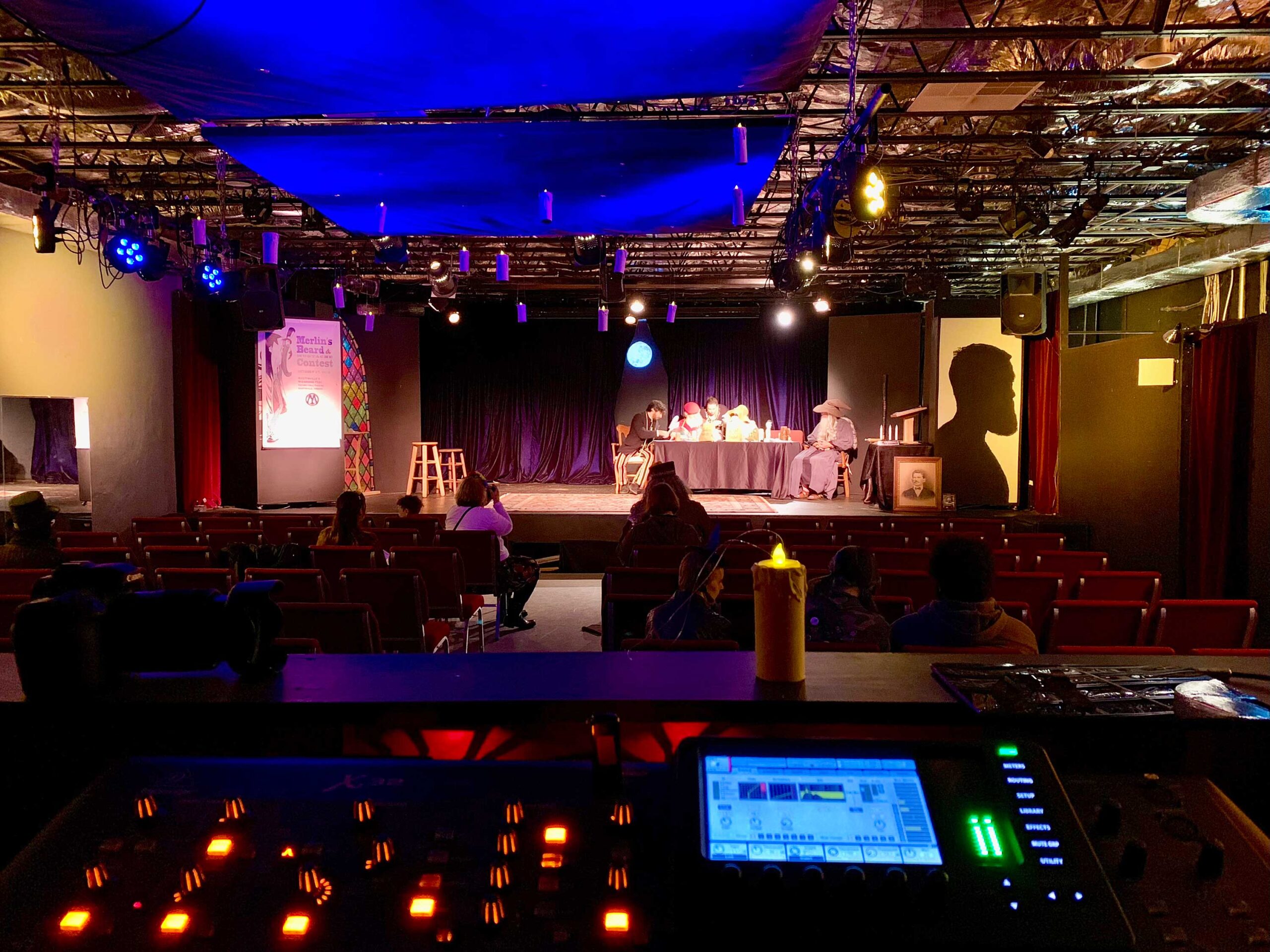
With help from the community and Town Council, the downstairs area of Victory Hall is once again a flexible community theatre space, a venue for music, drama, films, and cultural events. Exterior doors were installed in the front of the building. Interior spaces were constructed accommodating the ‘black box theatre’ performance area, a backstage area, tech booth, and renovated lobby. Scottsville Town Offices remain upstairs in this building.
– o • 0 • o –
Scottsville’s Victory Hall Has Played Many Roles by Robert K. Spencer Scottsville Museum Newsletter Number 9, March 1999
Victory Hall was conceived as a Scottsville community project in 1918 at the Armistice of World War I, when America emerged victorious in the so-called war to end all wars. The leading force behind the project was a lady by the name of Mrs. Marion McKay, a resident and drama coach well known for her productions to entertain townsfolk. Besides commemorating the Armistice, the chief practical impetus for the Victory Hall Project was the fact that Miss Hannah Moore’s Entertainment Hall was no longer usable. Her hall and her pond, which stood at the far east end of what is now known as Jefferson Street and in the shadow of School House Hill, had been the sites of innumerable good times for local folks. The hall had been the town showplace, and the pond, when frozen over in winter, provided great recreational skating.
Mrs. McKay quickly gained the backing of other prominent citizens who recognized the need for a town hall with an auditorium, including local architect D. Wiley Anderson, who drew up the plans for the building, and Mayor Jackson Beal, who probably thought of the idea of people sponsoring bricks for the construction. Soon nearly everyone in the community was helping with the Victory Hall Project.
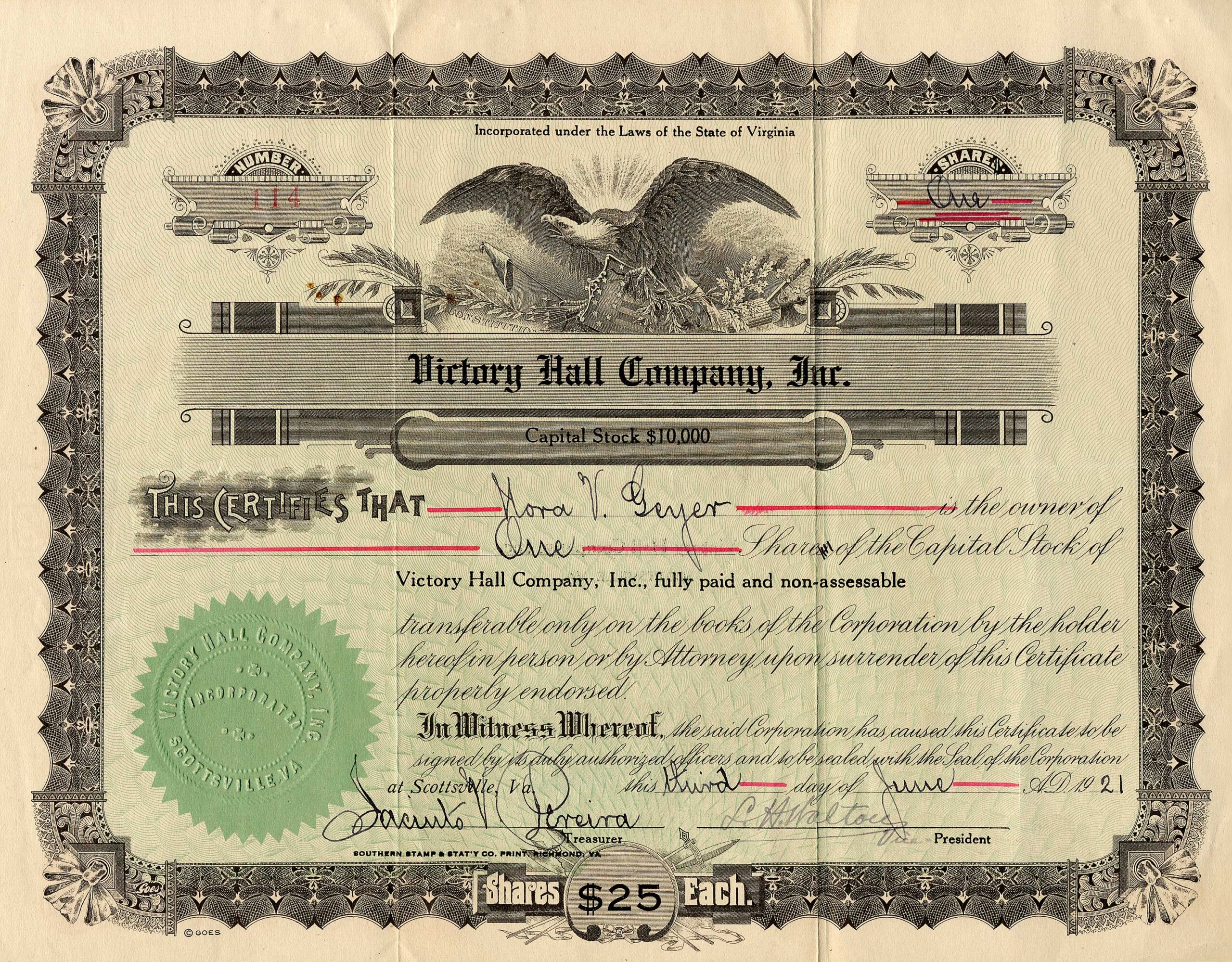
Citizens were invited to subscribe to stocks in the Victory Hall Company, Inc., for funding construction, and certificates were issued. People were asked to buy as many bricks as they could afford for the building. The yellowish gray bricks used were made in John Martin’s foundry located on the lowgrounds at Snowden across the James River Bridge. These bricks also were used in several other structures in town. At a meeting of the corporation held on March 13, 1920, Mr. Jacinto Pereira, Treasurer, reported that to date $2,837.50 had been collected, and he urged that all subscribers who had not paid up should do so immediately, so that the building could be pushed to completion. Indeed, Victory Hall was completed that year, and Scottsville had a spacious new public auditorium that would efficiently and variedly serve the community’s cultural and social needs for several decades.
Not only did the new facility provide a venue for Mrs. McKay’s dramatic productions, it also was acclaimed by the Chautauqua and vaudeville performers who came to town every year and it became the site of many special events and ceremonies of Scottsville High School, and it was a splendid place for town meetings, public recitals and lectures, and forums. For three decades, graduation ceremonies, Senior Class plays, beauty contests, and talent shows were held in Victory Hall.
When the first moving pictures (the “silents”) became available, Victory Hall was leased to Mr. Willie Burgess, the famous local photographer who brought that new form of entertainment to Scottsville Later on, from the mid-1930’s to the early 1950’s, the hall became known as Victory Theatre, showing as many as three feature movies a week. From the late Depression years through World War II, Nelson Tindall and Luther Baber of nearby Centenary leased the theatre and showed the great early musicals and all the war movies. Sometimes there were special showings of movies like “Mrs. Miniver” to benefit the war effort with bond sales. From the mid-1940’s until the advent of TV, the theatre was operated by Reeve Nicholas and Edward “E.D.” Dorrier, who continued to bring all the movies of Hollywood’s Golden Era to our small-town, loyal audiences. It was not unusual on Friday or Saturday evening in the 1940’s for almost all of the 386 seats, including the balcony, to be filled. Tickets then were 35 cents for adults and 25 cents for children under twelve.
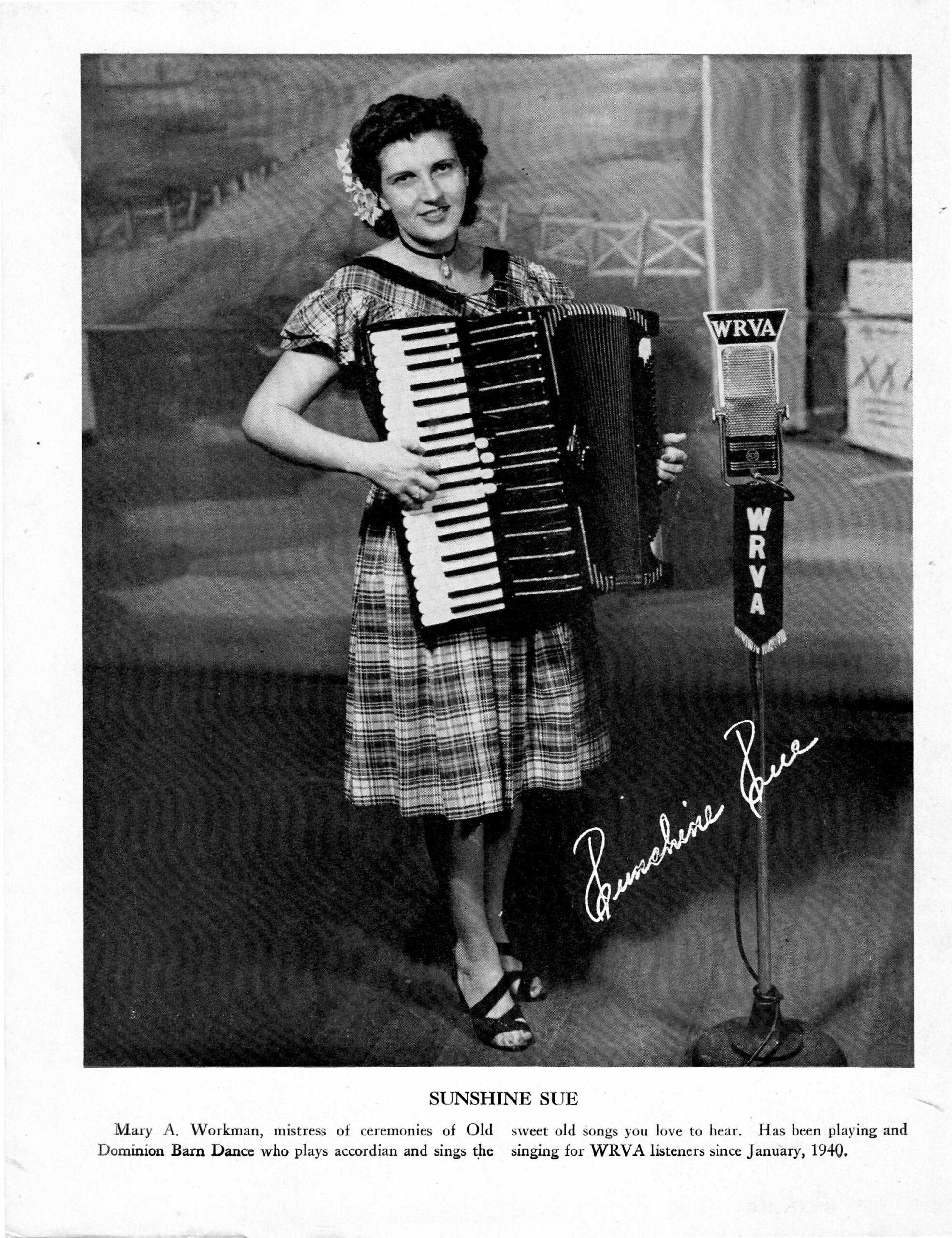
Through all its years of operation, the Victory Theatre also booked an impressive array of “live, in person, on the stage” shows ranging from western movie stars, future country music greats, magicians, and novelty entertainers to Bob Portfield’s trouping Barter Theatre actors. Many of these were sponsored by civic groups wishing to raise funds and, of course, there were annual events like the Lions Club Variety Show and the “Miss Scottsville” Beauty Contest put on by a school group. Country music stars, long “before country became cool,” were a big draw at the Victory Theatre, sometimes necessitating two or more performances. A particular favorite was Sunshine Sue (shown at right) of WRVA Radio in Richmond, and her Old Dominion Barn Dance gang, which included such future greats as Chet Atkins, Grandpa Jones and Ramona, Joe and Rose Maphis, and June Carter Cash. Others who appeared were the Carter Sisters with Mother Maybelle, Lester Flatt and Earl Scruggs, Bill Monroe, Mac Wiserman, Stoney and Wilma Lee Cooper, Patsy Cline, Hank Williams, Smokey Graves, and so on.
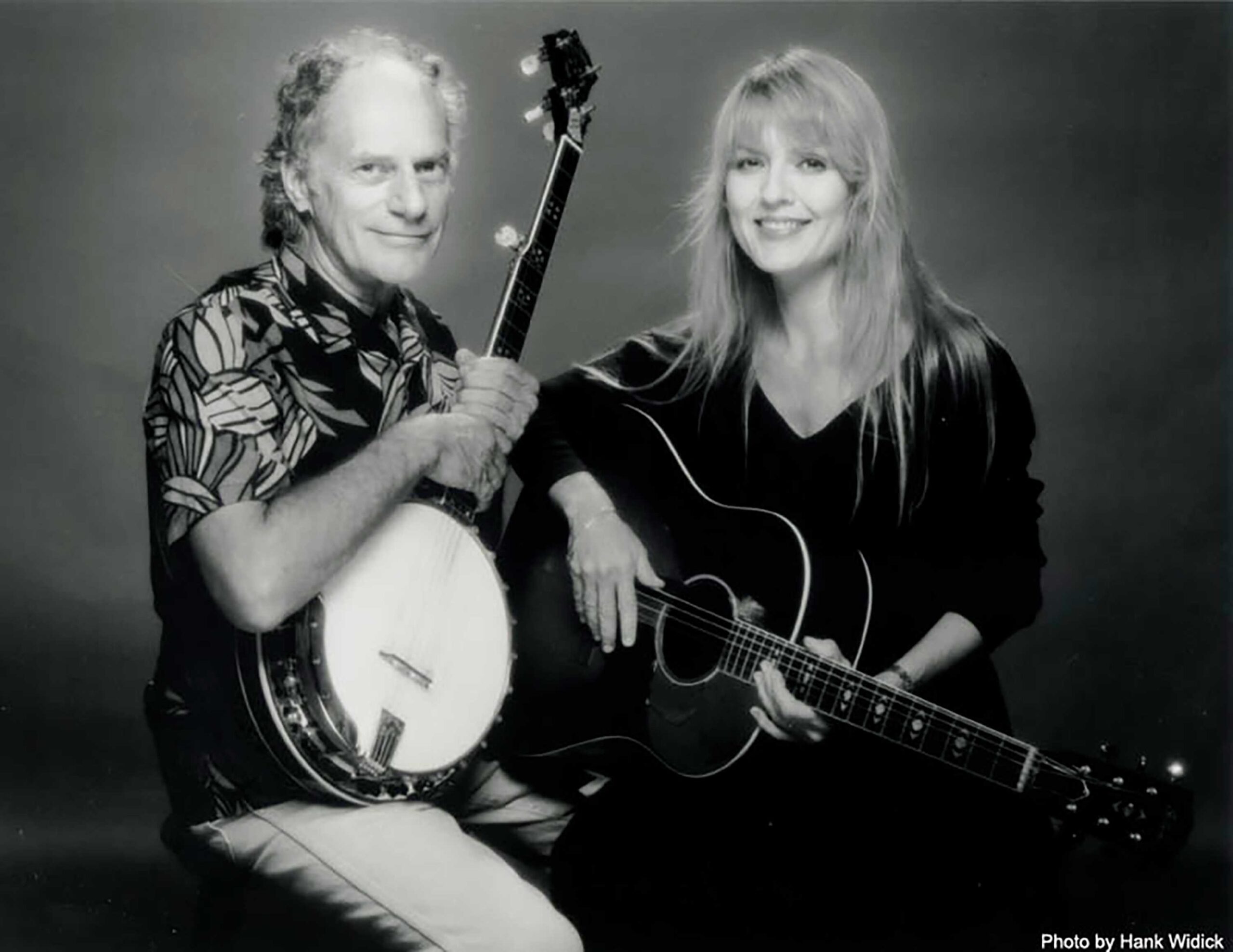
Eddie and Martha Adcock
Scottsville’s own Eddie Adcock, a pioneer world renowned star in bluegrass music, got his start on the stage of the Victory Theatre. Eddie would play his banjo and guitar and sing for the Saturday night crowd before the movie began. At an early age, he joined one of the country music bands that played the theatre. It is hoped that soon Eddie, with his wife and co-star Martha (shown at left), will be able to return to the remodeled stage where he began.
Around 1962, the Scottsville Town Council began to feel that they had a big white elephant on their hands in old Victory Hall. It was noted that the Scottsville Volunteer Fire Department needed larger quarters for its vehicles, so the decision was made to tear out the theatre seats, flatten the cement floor, and create a parking bay for the fire trucks. Also, extensive remodeling was done to the upper level, creating meeting rooms, a town office, a kitchen, and restrooms. So, in 1964, Victory Hall became known as the Municipal Building with the ground floor becoming a large garage. By the mid-1970’s, the Fire Department had built its new station in the uptown area of Scottsville, and the Volunteer Rescue Squad moved its vehicles into the parking bay. Just this past January, the Rescue Squad moved into their new, modern headquarters just outside of town.
Now it is pretty obvious that the old Victory Hall ain’t what it used to be, or even what it has been for the past three decades, but it still can claim a great deal of character and usefulness. The old stage and the dilapidated dressing rooms are still there facing a cavernous space that once was an auditorium. Fortunately for this great old landmark that has played so many roles, there is considerable interest by numerous individuals and several local organizations in turning what is left there into a modest but modern theatre suitable for plays, concerts, lectures, public meetings, and even the showing of movies.
Victory Theatre Remodeling Committee has been formed and working for several months with input from the Scottsville Council for the Arts, the Horseshoe Bend Players, the Family Players Music Studio, an architect, and other interested individuals. The committee will coordinate efforts with town officials on this project. A special fund has been started and contributions have already been received. Anyone interested in helping with the project should contact Robert Spencer, Committee Chairman, or Wyatt Shields, Town Administrative Official.
Top Image Located On: Capturing Our Heritage, CDB03 Roll3Neg20A.tif Roll3Neg20A.jpg Roll3Neg20A.psd
Middle Image Located On: Capturing Our Heritage, CDCG08 CG86cdCG08.tif CG86cdCG08.jpg CG86cdCG08.psd
The images of Sunshine Sue and Eddie and Martha Adcock were contained in the March 1999 Scottville Museum Newsletter and are part of the Robert Spencer collection at Scottsville Museum.
Laying the Masonic Lodge Cornerstone – June 17, 1914
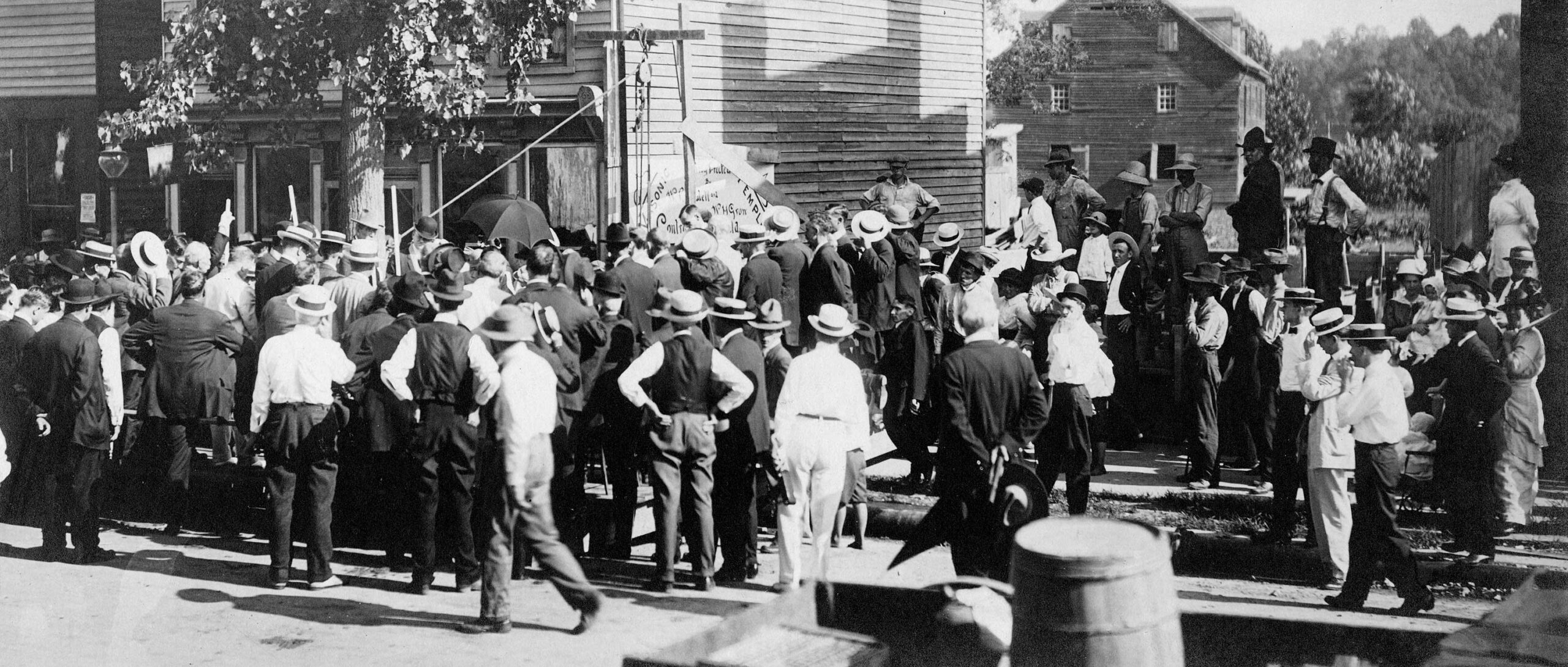
On June 17, 1914, Scottsville Masonic Lodge #45 laid the cornerstone for its current home at 137 Main Street. It was a stirring day in Scottsville with the town band marching down Valley Street, leading Lodge members from their meeting area at Beal’s Hall to the new Lodge site.
Laying the Masonic Lodge Cornerstone – June 17, 1914
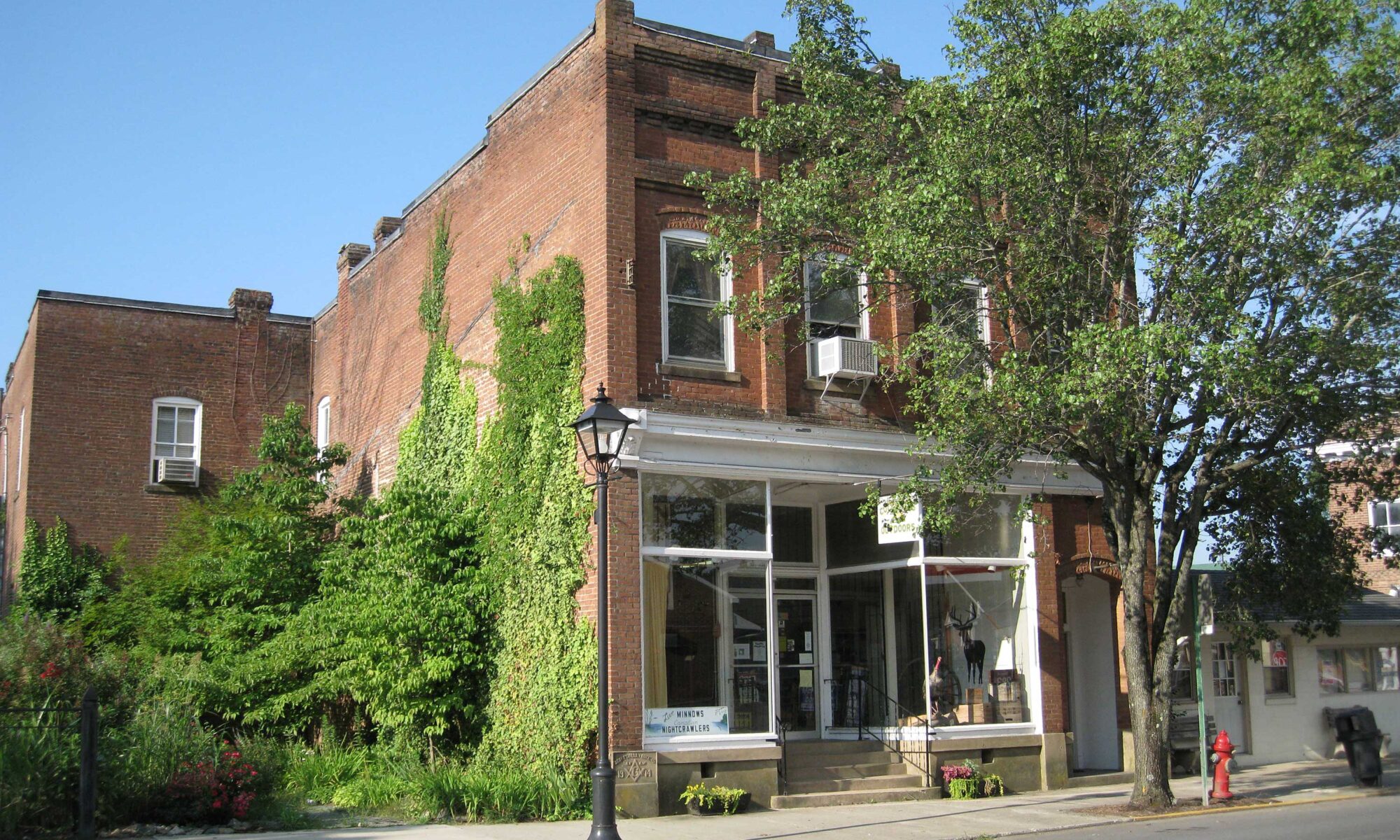
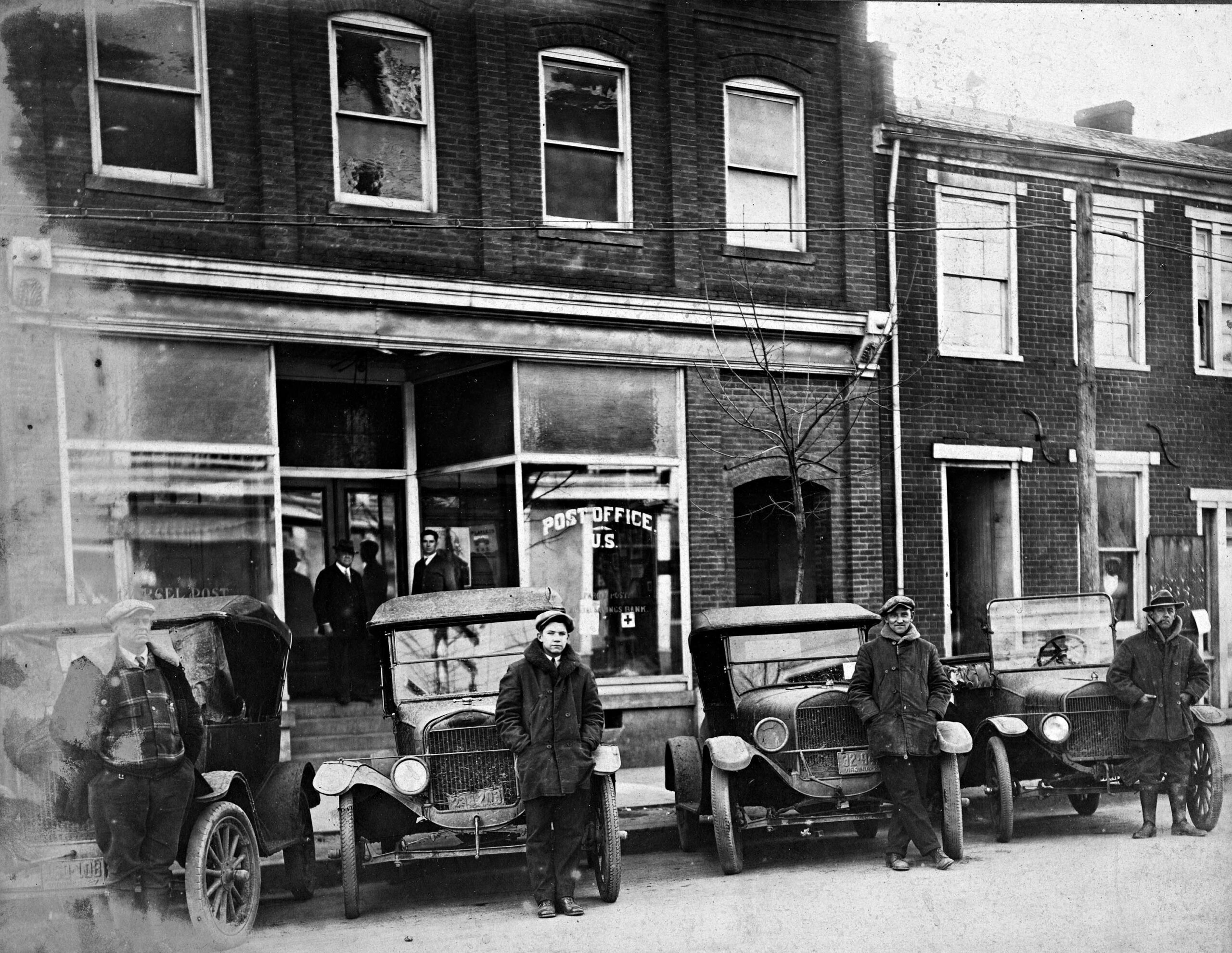
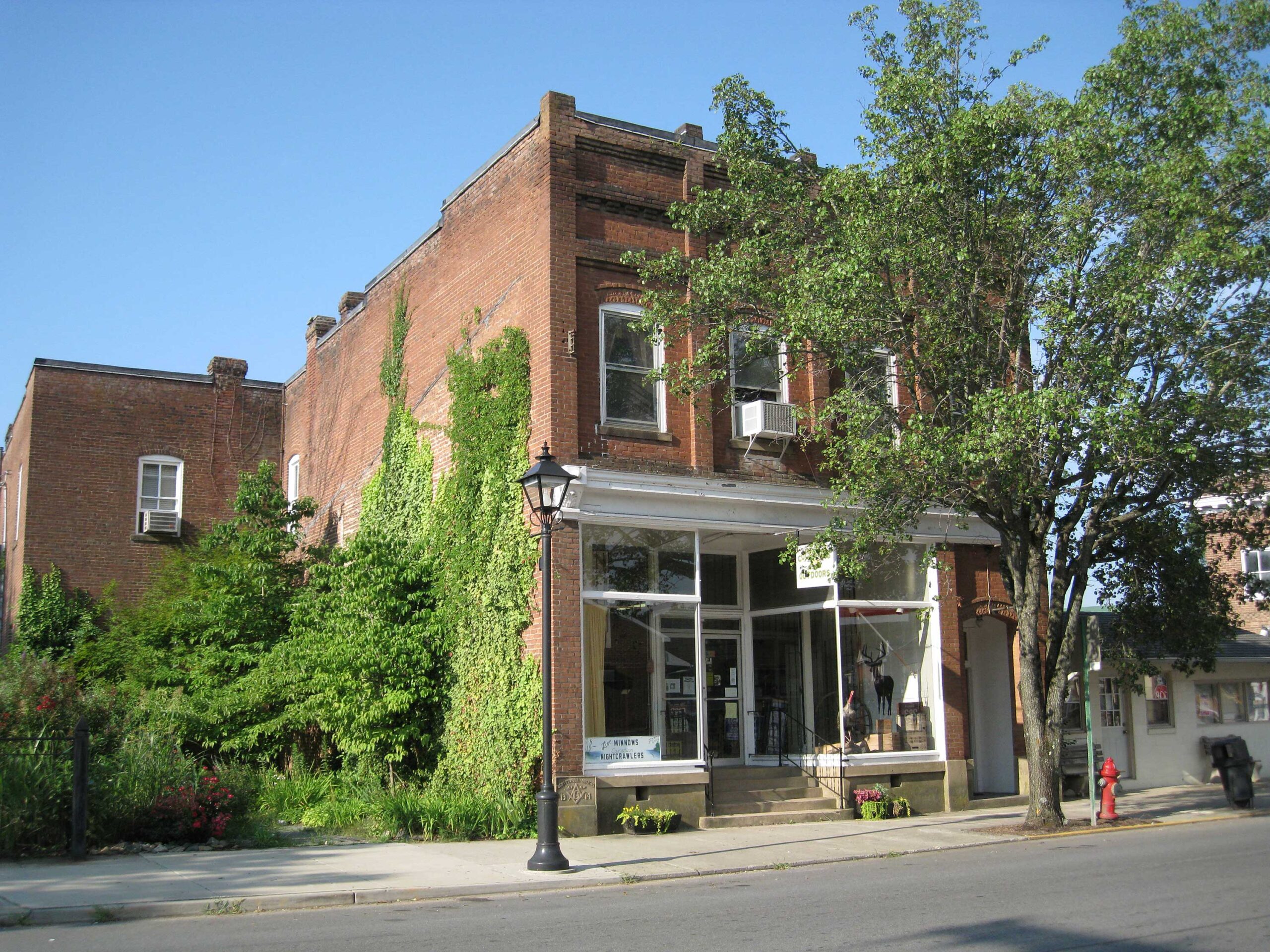
The first Lodge meeting was held in the upstairs meeting area after the building was completed in 1915 at a cost of $6000. The United States Government rented the building’s first floor to serve as the Scottsville Post Office from 1915 until the post office moved in 1964 to a new location on West Main Street. In 2010, Coleman’s Outdoors store occupied the old Post Office’s first floor.
Masonic Lodge #45 began its history in Scottsville on December 7, 1851 and received its charter at their Valley Street meeting hall on the second floor of the Beal Building. James W. Mason opened and closed the charter night exercises as the first Worshipful Master. Members present for this historic meeting were William B. Brady, Sr.; John Hickok, Jr.; James Brady; Silas W. Dawson; Charles E. Little; J.L. Brady; J. M. Wade; W. F. Crawford; James A. Forbes; J.B. Dodd; W. Donoho; and James A. Leitch.
On December 7, 1951, the Scottsville Masons celebrated their 100th anniversary with a public ceremony in front of the Scottsville Masonic Lodge. Following the public program, a social hour was held in the Banquet Room of the Lodge for the members and visiting masons. At 6:30 pm, a banquet was held in the Auditorium of the Scottsville High School which was also ladies night; the guest speaker was Past Grand Master of Masons in Virginia and then the current Grand Secretary of the Grand Lodge of Virginia.
The Scottsville centennial committee in charge of the arrangements for their 100th anniversary celebration was composed of Rt. Wor. A.R. Thacker, Chairman; Wor. W. A. and Ellis P. Jones. The History Committee was composed of Rt. Wor. F.P. Scott; Chairman Rt. Wor. J.H. Duncan; Wor. C.A. Whitted, John P. Dorrier, and T.H. Gillis. In honor of this Masonic anniversary, the History Committee authored a history of the lodge which was printed for distribution on December 7 and found records complete through the Civil War years. On the roster of members of Scottsville No. 45 were Peyton S. Coles, Grand Master of the Grand Lodge of Virginia in 1879 and 1880. There were also three Past District Deputy Grand Masters of the 17th Masonic District who were members of Lodge 45: J.H. Duncan, A.R. Thacker, and F. Pierson Scott.
In 1951 the officers of Lodge 45 were E.B. McCormick, Wor. Master; L. E. Baber, Senior Warden; Larkin Londeree, Junior Warden; J.W. Boggs, Senior Deacon; T.H. Gillis, Junior Deacon; T.A. Allison, Chaplain; C.R. Dorrier, Treasurer; C.A. Whitted Secretary; A.L. Thacker, Tiler; and J.E. Daniel, Chaplain emeritus.
– o • 0 • o –
History of Scottsville Lodge #45, AF&AM GRANTING OF CHARTER
The Scottsville Lodge, No. 45, A.F. & A.M., received its charter from James Evans, Grand Master of Masons in the State of Virginia on December 7, 1851.
Lodge meetings were held in Scottsville prior to the year of 1851. It is impossible to determine when the first meetings were held since no minutes or records were kept. It is known, however, that a group of men in and around Scottsville formed themselves into a lodge and elected James A. Leitch as their Worshipful Master. It was through his efforts that the Grand Lodge of Virginia was petitioned in order to secure a charter for the Scottsville Lodge.
At this time, James Evans was Grand Master of Masons in the state, and it became his duty to examine the petition. After due investigations and with the consent of the Grand Lodge, he constituted and appointed on trusty the following brethren:
James W. Mason, Master William B. Brady, Senior Warden John Hickok, Junior Warden
These men along with those, who were admitted to work with them, were constituted into a lodge of Ancient, Free, and Accepted Masons by the name, title, and designation of Scottsville Lodge, No. 45.
With this granting of charter, the lodge received full power to receive and enter apprentices, to pass fellow crafts, to raise Master Masons, and to perform all other works of the craft according to the ordinances and regulations of the Grand Lodge of Virginia.
The Lodge was also instructed to regulate its own dues, adopt and record its own bylaws, and keep an accurate record of the minutes of all meetings.
The full account of the granting of the charter for the Scottsville Lodge can be found in Volume No. 1, of the Minutes, as recorded by John Dove, Secretary of the Grand Lodge of Virginia.
LOCATIONS
As Scottsville Lodge, No. 45, A.F. & A.M., marks its hundredth anniversary on December 7, 1951, the brotherhood can view with pride the accomplishment of having moved locations only three times over the century.
The accomplishment is even greater with the century recalled. It was one hundred years fraught with wars and depressions, and yet Scottsville Lodge has lived and prospered.
The fascinating story opens on December 7, 1851, in Beal’s Hall, located in the center of Scottsville. The site today is the floor above Mathias’ Store on Valley Street and State Route 20. Here the Lodge met for instruction, work, and refreshment for twenty-nine years, and here the Lodge received its charter.
Charter night was an inspiring meeting. James W. Mason opened and closed the charter night exercises as the first Worshipful Master. The records record that William B. Brady, Sr., was the Senior Warden, and John Hickok, Jr., was the Junior Warden. Members present for the historic meeting were: James Brady, Silas W. Dawson, Charles E. Little, J. L. Brady, J. M. Wade, W. F. Crawford, James A. Forbes, J. B. Dodd, W. Donoho, and Right Worshipful James A. Leitch.
Twenty-nine years later in 1880, the Lodge bought the upstairs floor of the present home of Mrs. John Mayo, of Scottsville, Virginia, and paid $229 for it. This move was unique in the annals of Virginia Masonry. Not many lodges have purchased only one floor of a building for a meeting place and that property a part of a private home. This arrangement held for fifteen years. In 1895, the Lodge bought the first floor for $300, and rented it to Dr. Anderson, D.D.S., from 1895 to 1913.
The second move came in 1913 when the Lodge sold the entire building to Dr. L. R. Stinson, of Scottsville, Virginia, for $1,250, and transferred back to Beal’s Hall, the birthplace of the Lodge. This was the home of the Lodge until January 1, 1915. The first meeting in the new Lodge Hall was not held until January 29, 1915. During the occupancy of Beal’s Hall, the Lodge paid a rent of $21 for a six-month period with the exception of June, 1914, to December, 1914, when the average rent was $20 for the six-months’ period.
June 17, 1914, was a red-letter day in the life of the Lodge. On that date, the cornerstone was laid for a new building, and the present home of the fraternity. On the minutes of the Lodge is written, “The Worshipful Master informed the brethren that this special communication had been called for the purpose of laying the cornerstone in the erection of a Masonic Hall on Main Street of Scottsville, Albemarle County, Virginia. Right Worshipful H. G. Harris was called to preside in the East and filled the offices pro-tem as follows: Wor. T.E. Bruce, Sr., Warden; Wor. L. G. White, Junior Warden; S. R. Gault, Treasurer; T. M. Staples, Secretary; T. F. Robinson, Senior Deacon; Worshipful L. R. Stinson, Junior Deacon; L. H. Walton, Chaplain, and R. L Blackburn, Marshal.”
It was a stirring day in Scottsville. The Lodge led by the Scottsville Band marched down the street to the site of the new building on Main Street. The cornerstone was laid in due and ancient form. Again the line of march was formed, and the brothers paraded behind the band to Moore’s Hall. Here John B. Moon, a Past Master of Scottsville Lodge, was presented, and he in turn introduced Most Worshipful Brother R. T. W. Duke, Past Grand Master of Masons of the State of Virginia. The orator gave a forceful address.
Following the address, the brothers marched back to Beal’s Hall. Due thanks were given to Brother Duke and the Scottsville Band.
Seven months later on January 29, 1915, the Lodge met at its third and present location. It was a new, two-story brick building and had been constructed at the cost of $6,000. The contractors for the new hall were Paulett and Grove. The lower floor of the Masonic building was rented to the United States government for use as a Post Office.
It is interesting to note that today there are four pieces of the original furniture still on hand in the Lodge. The Altar is the only one of the three pieces still in use at this time. New furniture for the station officers was purchased by the Lodge.
That is the record. It is indeed a stable one and gives assurance that the Lodge will live on into a bright future.
As we pass along through this sometimes difficult life, we find that a little humor spread along here and there will often help make the pathway a little more easy to tread and apparently some members of our Lodge thought the same thing a generation ago.
In the Town of Scottsville, a few years following the Civil War, there were two newspapers printed. One was known as the “James River Clarion,” and the other one was the “Scottsville Courier.”
These two papers were printed by two brethren who were members of the Scottsville Masonic Lodge, No. 45.
One was Major James C. Hill, and the other was Mr. William B. Brady. Major Hill was a devout Christian gentleman while Mr. Brady, being all the same a gentleman, did very frequently use the wine cup, and it was not infrequent that he was seen on the streets of our town under such influence.
At that time, there was only one printing press in Scottsville so it was that Mr. Hill would print his paper one week, and then Mr. Brady would print his paper the following week, and so on… Having seen Mr. Brady slightly under the influence one morning just before printing his paper, Mr. Hill thought that he would have some fun at the expense of Mr. Brady by printing a little poem.
No sooner said than done. Major Hill printed the following article in his paper:
Between Brady and brandy There is the difference of a letter When Brady is full of brandy Times seem to be better.
No sooner than Major Hill’s paper reached the street, someone had taken a copy to Mr. Brady, whereupon the gentleman literally hit the ceiling.
The following week when Mr. Brady printed his paper, he came back with a reply to Major Hill thus:
Between Hill and hell There is the difference of a letter When Hill is in HELL Times will be better.
– o • 0 • o –
A Building That’s Seen A Lot! by Ron Smith
One of the great things about Scottsville is its obvious history. And, as visual testaments to that history are the town’s historic buildings. Glancing around one can easily imagine some historical figure with which they are familiar strolling past or into one of these structures. The Scottsville Museum’s annual Spirit Walk has provided many local residents with the opportunity to associate names that are familiar with buildings they might pass daily.
The Masonic building on East Main Street is one of these buildings. Home to Scottsville Masonic Lodge No. 45 for more than one hundred years, this building has seen a lot!
During the late 1800’s and early 1900’s Scottsville’s Beal Building on the corner of Valley Street and Bird Street was “the place” to hold events, meetings or any other reason to gather a significant number of persons together in one place for a specific cause. A fundraising dance was held there in 1902 to raise money to start the first “real” library in Scottsville.
Masonic Lodge No. 45, with its long and rich history, was chartered by the Grand Lodge of Virginia on December 17, 1851. Members met in a room on the second floor of the Beal Building until 1880 when they relocated to the upstairs of a private residence on Valley Street.
In a 2005 article by writer Ruth Klippstein, former Scottsville Mayor Raymon Thacker remembered “his family first lived on the first floor of this home after moving to Scottsville and before they moved into their own home.” The Masonic lodge actually bought the second floor of this house and then the whole house! Dr. Luther Randolph Stinson would come to own the home.
Wishing to have a building of their own, like other lodges around the country, the lodge decided to take the necessary steps to make that dream a reality. In 1914 Lodge No. 45 purchased a parcel of land on Main Street. Some records indicate the property was purchased from the town while Mayor Thacker remembered it being purchased from the county. Either way the town would soon benefit from a beautiful new building that would stand firm and tall and weather the forces of nature that would attack her in the years to come.
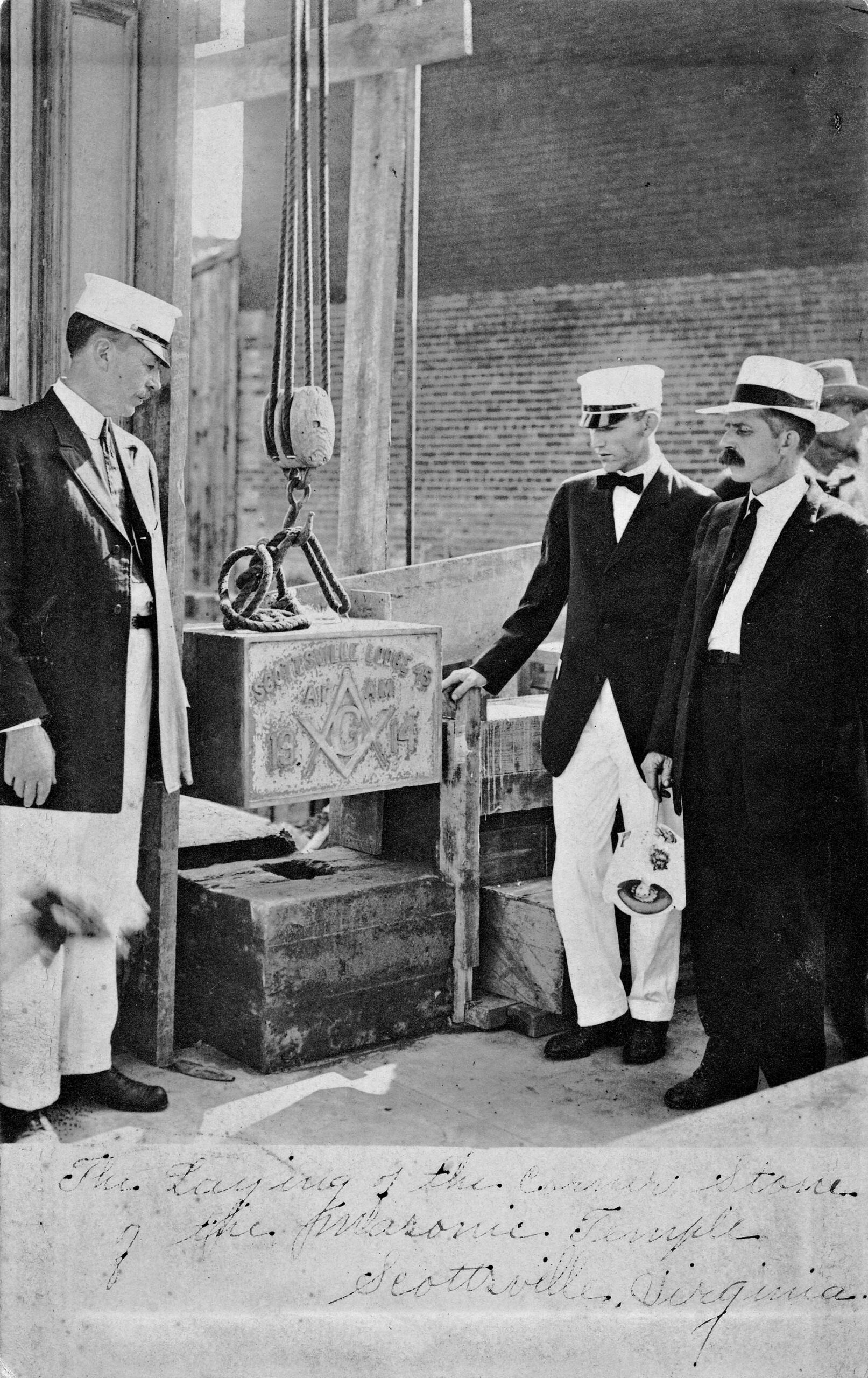
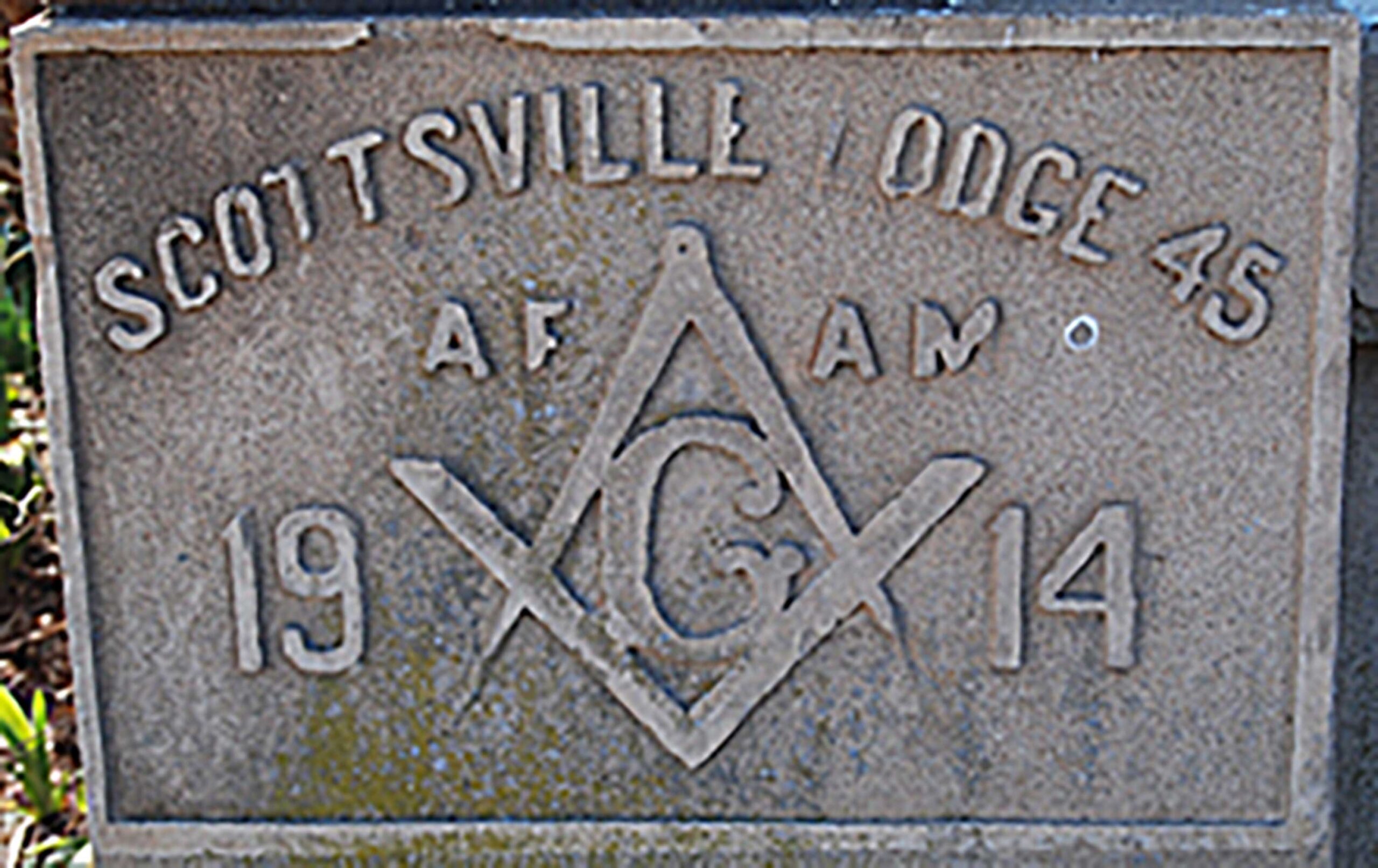
Scottsville Masonic Lodge 45 Cornerstone, 1914
Regardless from whom the purchase was made, and with a deed dated October 14th, 1914, Lodge No. 45 now had their own tract of land. The purchase price was $250, and with a $4000 loan from the town, the lodge was on its way to having its own permanent meeting place.
On June 17th, 1914, following a parade, and with speeches by visiting Masonic dignitaries and the presence of a large number of town residents, the cornerstone (shown at right) was laid and the Masonic Building we know today was, like an expected baby, about to be born into this world and the history of Scottsville.
A Scottsville firm, Paulett and Grove, two names found in much of Scottsville’s history, was chosen as the general contractor. The new two-story building had a suitable space for a business of some type on the first floor, while the upstairs would be the primary home of the Masonic Lodge.
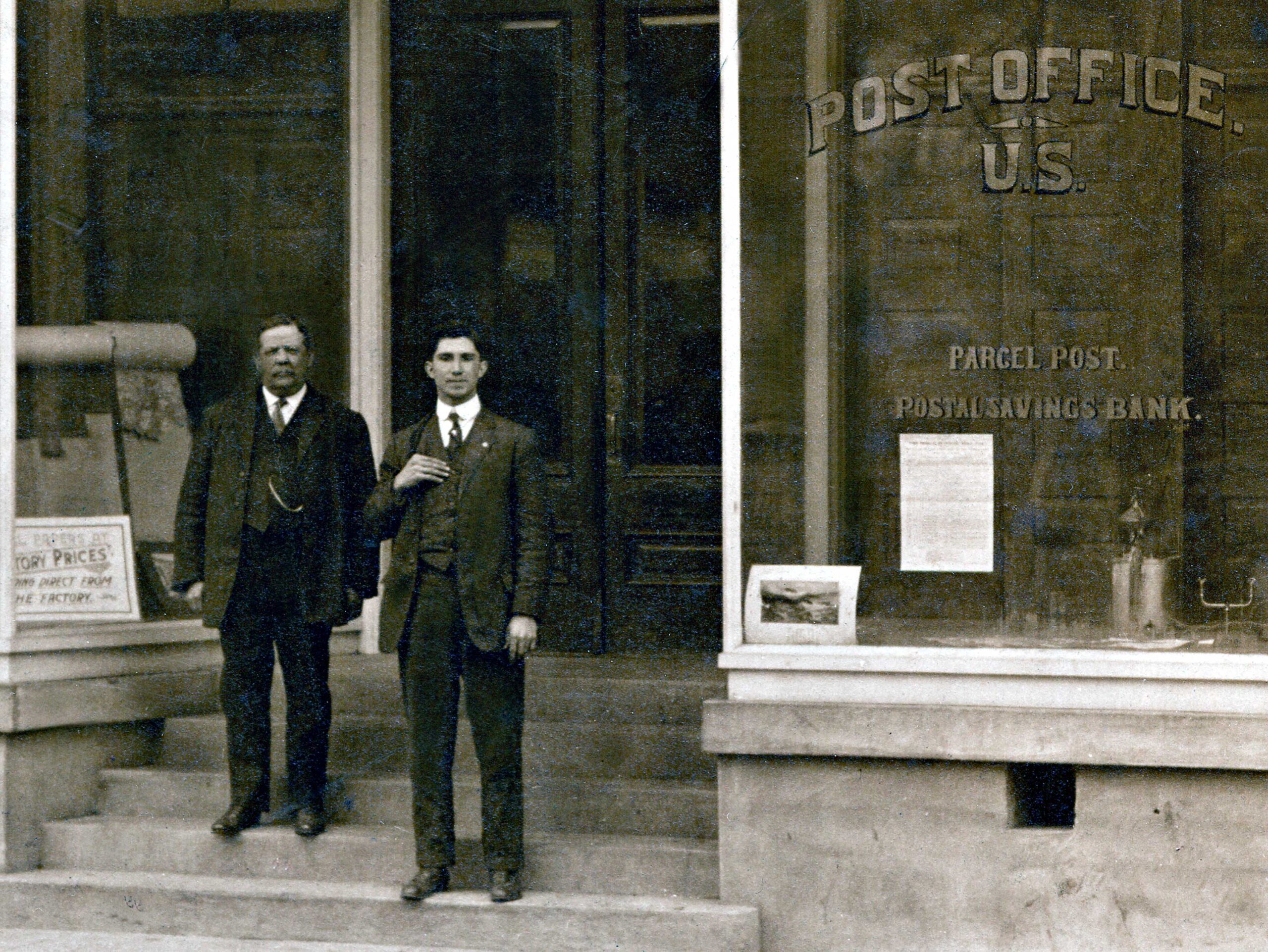
Scottsville’s postmaster, Sam Gault, was a member of the lodge. The post office was housed in a storefront on Valley Street and needed a larger space as the town continued to grow. Gault suggested the post office be relocated to the first floor of the new building. The post office moved to its new location and remained there until 1964. (Shown at left Postmaster Samuel Gault and Ashby Mayo at the Scottsville Post office in 1915) Rent generated from the post office was used by the lodge to help with building maintenance, “not for a profit” as Mayor Thacker remarked.
While no one seems to remember who the architect for the project was, many think it may have been D. Wiley Anderson who designed Victory Hall. He had relocated from Richmond back to Scottsville during the time frame that could have made him the obvious choice.
The National Register of Historic Places identifies the building as “Modified Edwardian,” and at the time of Klippstein’s 2005 article, local architect Fred Schneider and Architectural Review Board Chairman Jeffrey Plank “suggested that ‘modern commercial’ might better describe a business, rather than a domestic structure.” With its dark red bricks, the placement of windows, the white trim and flat roof, the building is similar to several other Masonic Lodge buildings that can be found around the country.
Another feature of the building is the metal ceilings. A number of buildings in Scottsville have the metal tile ceilings which became popular around 1885. The plaster work found in European buildings was attractive to people in this country. When these metal tiles came upon the scene. it offered builders an opportunity to install ceilings that looked like their European counterparts but were easier and less expensive to have. The Masonic Building incorporated this type of ceiling on each floor and those ceilings remain in place today. The metal ceilings give another hint as to Anderson being the architect as he was, from his work in Richmond, very knowledgeable on the subject of metal ceilings.
Sam Gault was a dedicated postmaster for Scottsville and actually lived in the post office! He occupied an apartment in the rear of the building. He also found it necessary to make some changes, one of which involved the post office safe.
You don’t see many businesses today that have a big bulky safe prominently in view of the public although some do exist. Like most safes of the day the safe was heavy enough to begin with, but add the contents and see what happens. The post office safe was too heavy for the floor on which it sat so Gault had an extra concrete pad made on which the safe could rest.
When Gault passed away in 1939, Mayor Thacker was asked to look for Gault’s insurance policy. He found it in the apartment, and Gault’s final expenses were taken care of. Gault rests in the Scottsville Cemetery with an appropriate memorial depicting the Masonic emblem.
Scottsville Masonic Lodge and Coleman’s Outdoors, 2010
R. W. Coleman operated his business in the Masonic Lodge building’s first floor for a number of years. In 1997 Mark Stevens purchased the business. Stevens tells of past floods and their effects on the building. The 1969 arrival of Hurricane Camille devastated much of downtown Scottsville. After the storm left death and destruction in Nelson County, it headed this way. The Masonic Building lay in its path and suffered the effects of the storm. Hurricane Agnes in 1972 had much the same effect on this building as it did on the other structures near the James River.
Stevens can relate stories of how the hurricanes damaged both the inside and outside of the building. In addition to the rear of the building’s exterior being damaged with the loading dock disappearing down the river, the storms left mud everywhere. “Inside the building mud caked everything; the electrical fixtures, the electrical panel, but fortunately the walls were not damaged as significantly as they could have been,” Stevens said in a 2005 interview.
While modifications were made inside in the 1980’s to bolster the structural integrity of the floors, the upstairs, home to Lodge No. 45, has remained relatively modest. The costs of repairs continued to be a problem particularly for a small group with a limited amount of money to spend.
When an adjacent building was demolished, the exterior wall of the Masonic Building revealed a really bad mortar job that can be seen today and was always a source of concern to Mayor Thacker.
Scottsville Supply Co., source of apiary goods, in 2018
After Coleman’s closed for business, the building’s downstairs remained vacant for a while. When negotiations were completed with a prospective new tenant and a great deal of interior renovation was completed, the Scottsville Supply Company, a business that serves those interested in beekeeping and a source for associated supplies and equipment related to beekeeping, relocated from their location on Valley Street to the Masonic Building occupying the vacant first floor.
In June of 2019, Dimitri Hasson and Lucas RVP V, LLC, having purchased property on East Main Street, the former bus depot, another Scottsville site of historic importance, appeared before town council with a proposal. They would remodel and improve the structure, and it would become a mixed use development that would consist of rental and retail. The town approved the request, and work is currently ongoing.
As with any aging structure, maintenance issues continue to be both unavoidable and costly. When you have a building over a hundred years old this is an inevitable fact. And, with fewer people joining civic and service , revenue that can be used for maintenance is hard to find.
Hasson and Lucas have basically “come to the rescue” and purchased the building. A hundred year old building having only its second owner is most likely a real estate oddity. Brian Lafontaine, a member of Lodge 45, while not going into details, said the arrangement was “really in the best interest of everyone involved.” The first floor tenant will continue to occupy that space, and Lodge 45 will continue to have their space on the second floor.
The next time you stroll down Valley Street or Main Street or you pass one of Scottsville’s historic residences, with a little imagination you might visualize one of the Jeffersons, Teddy Roosevelt, or some other historical figure going in or coming out of one of the buildings you are passing. The Masonic Building has seen a lot. And, with a new lease on life is sure to see much more!
In the February 21, 2020, edition of the Scottsville Monthly, Ron Smith authored the following article about the current status of this Masonic Lodge building in 2020:
– o • 0 • o –
Scottsville’s Masonic Building Sold! By Ron Smith, Correspondent
The cornerstone reads 1914. The building’s architecture is similar to many buildings from that time period found around the country. This Scottsville building has been the meeting place of Scottsville Masonic Lodge No. 45 since its construction. And, it’s only the third location the lodge has called home since being chartered by the Grand Lodge of Virginia on December 17, 1851.
The Beal Building at the corner of Valley and Bird Streets was the social hub of Scottsville in the town’s early days. It was large enough to accommodate a sizeable number of persons for meeting, a dance, or some other social event. Being referred to as Beals’ Hall, the Lodge met regularly on the second floor.
In 1880, Lodge No. 45 moved to a private residence on Valley Street and actually purchaseded the second floor of that structure. In a 2005 Scottsville Monthly article by Ruth Klippstein, Scottsville’s former mayor, Raymon Thacker, related how his family “lived on the first floor of this home when they first moved to Scottsville before moving to a home of their own. In 1913, the home on Valley Street would become the residence of noted Scottsville physician, Dr. Luther Randolph Stinson.
In 1914, Lodge No. 45 purchased a parcel of land on Main Street for $250 dollars. With a loan from the town of $4,000, the Lodge was into what was expected to be a $6,000 project. On June 17, 1914, the cornerstone was laid after a parade and speeches by Masonic dignitaries including a past Grand Master of the Lodge of Virginia.
D. Wiley Anderson was a well-known architect. He had been responsible for a number of large projects in Richmond and had relocated to Scottsville in 1913. While it is not known for sure who the architect for the project was, it is suspected that it was Anderson. What is known for sure is that the contractor for the project was the Scottsville firm of Paulett and Grove. Anderson would later design Scottsville’s Victory Hall.
The National Register of Historic Places describes the building as “Modified Edwardian” based on the pattern in which the bricks are laid, the flat roof, and the window placement. Metal ceiling tiles had become popular in 1885, and this building incorporated them as it was a more economical way to replicate pricier plaster designs then favored in European architecture.
The building has survived a number of floods caused by Hurricane Camille in 1969 and Agnes in 1972. The hurricanes wreaked a lot of damage to the town, and some to the building. There have been some structural changes over the years mostly in areas not seen by the public. The Masonic Lodge has continued to occupy the second floor while the first floor has seen three different occupants.
After completion of the building, the Scottsville Post Office, under the guidance of Postmaster Sam Gault, occupied the first floor until a new post office was built and opened in 1964. Coleman’s, an establishment offering hunting, fishing, and other outdoor related merchandise and services, followed the post office as a tenant until that business closed a few years ago. Now the space is occupied by the Scottsville Supply Company which offers beekeeping supplies, information, and instruction. In the 2005 article, Thacker stated, “We used the rental income not for profit, but to help with the routine maintenance of the building.”
Like a lot of organizations, the Masonic Order has seen a decline in membership. Members get older, and due to health issues or death, membership declines. And many younger individuals do not have either the time or the interest in becoming a part of a service or fraternal organization. Buildings get older, and maintenance costs increase. And with older buildings, maintenance issues arise more frequently.
Last year, Lucas RVP V. LLC and Dimitri Hasson purchased the property on East Main Street that had once been the Scottsville Bus Company. Plans for that property include mixed use, rental, business, retail, and a restaurant. The Town of Scottsville approved the plans, and work is currently progressing on the site.
This company has now made it possible for Masonic Lodge No. 45 to keep their home so to speak as they have worked out an agreement with the Lodge and purchased the Masonic Building. According to Lodge member, Brian LaFontaine, it was “a deal that really made us (the Lodge) happy. We will be able under the agreement to continue to use the upstairs as our meeting place for the foreseeable future.”
One of the great things about Scottsville is its history. Not just the fact that many notables walked the streets, came through town, or lived here. It is the historical significance of the buildings we see every day. Next time you walk down Valley Street or through an adjacent neighborhood, just look around and think about what or who was there before you.
– o • 0 • o –
On January 25, 2021, Evelyn Edson, President of Scottsville Museum, sent the following history email to our readers:
The Masons Are Moving! By Evelyn Edson
The Scottsville Lodge of the Ancient, Free and Accepted Masons has sold its building on Main Street and is moving its meetings to the Taylor Masonic Lodge in Centenary, VA. With only thirty members left in Scottsville, maintaining the building became just too costly. We joined Brian LaFontaine last week as he was cleaning out over a hundred years of documents, furniture, and pictures and contents of a large antique safe.
Freemasonry has its roots in the stonemasons’ guilds of the Middle Ages. In the 18th century, it developed an interesting life of its own, dedicated to Enlightenment ideals such as liberty, equality, religious toleration, and thirst for knowledge. The first Masonic Lodge was opened in America in the 1730s, and in 1755 the young George Washington joined the order. Because of its secret rituals, the Masonic order became a target for conspiracy theories. During the French revolution, the Masons were thought to be plotting the downfall of the monarchy, and in America, they were suspect for their revolutionary views. In 1828, a short-lived Anti-Masonic Party was organized to combat a supposed conspiracy.
William F. Paulette (right) stands with two Masons as they prepare to install the cornerstone of the Scottsville Lodge #45 on June 17, 1914.
The first Scottsville lodge was established in 1851, and over the years many prominent citizens (mayors, ministers, and businessmen) have been members, including Sam Gault, Raymon Thacker, C.R. Dorrier, T.E. Bruce, Thomas Staples Martin, and Dr. Ruebin Stinson. The Lodge met in several places in town, and finally laid the cornerstone of its own building in 1914. The Masons met upstairs, and the street floor was rented to the Post Office. In 1951, the Lodge celebrated its 100th anniversary, “A Century of Faith, Hope, and Charity.”
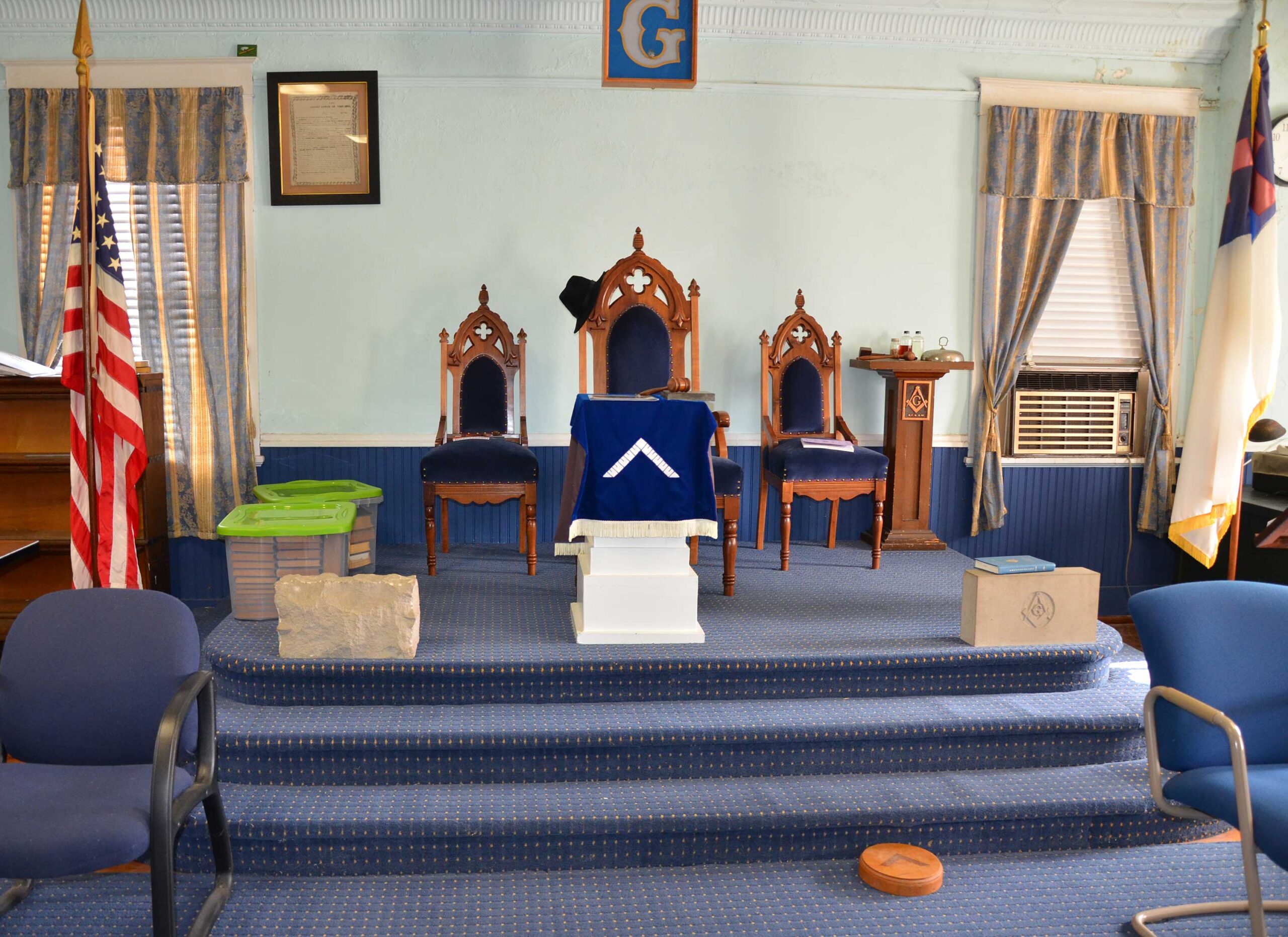
Scottsville Lodge 45’s dais on upper floor of Masonic building
Above is the Scottsville Lodge 45 dais on the upper floor of the building. At the left of the dais is an unpolished ashlar stone, and at the right is a polished stone.
Brian showed us two stones on either side on the dais: one a roughcut ashlar and the other a polished stone with the masonic emblem on it; see above photo. They represent, he said, the rough cut of a new member and his polished state after years of membership. Membership is for men only, but there is an auxiliary order for women, the Daughters of the Eastern Star. Prince Hall, a Masonic Lodge for African-American men, was established in Boston in 1784 as the lodges were then segregated, but local chapters are now open to men of all races.
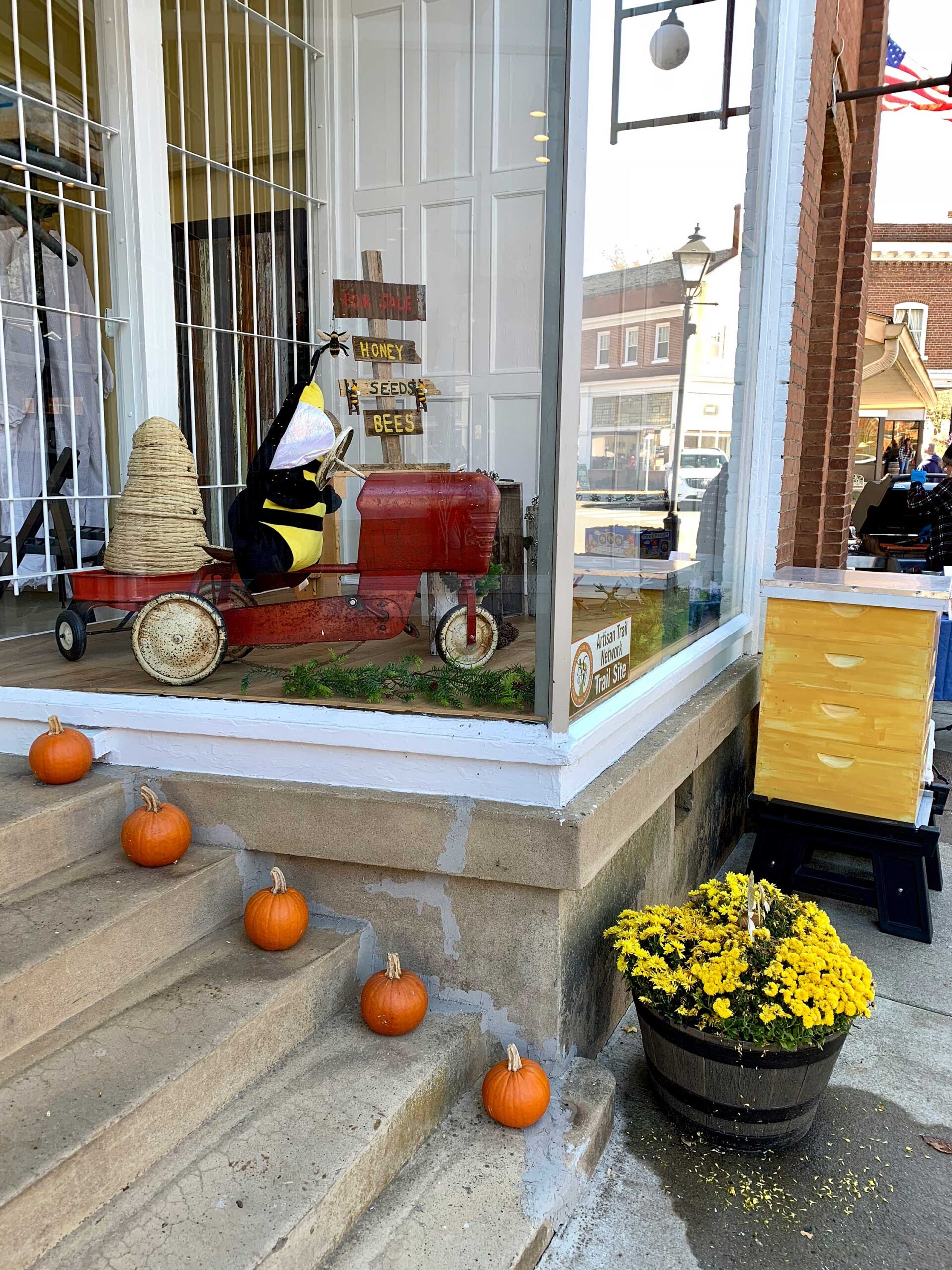
The Shriners, an upper level of the Masonic order, we know from their zipping around in little cars at Scottsville parades, have established and maintain children’s hospitals throughout the U.S. Local honey-lovers will be pleased to hear that Taylor Schmidt, the purchaser of the Masonic building, intends to continue the lease of Scottsville Supply (the ‘Bee Store’) on the ground floor.
References: A. Scottsville Lodge #45 AF & AM history review for their centennial celebration on December 7, 1951; see www.lehansales.com/masons/scottsville.htm B. Scottsville Sun, Thursday, November 29, 1951, p. 1. Courtesy of Scottsville Museum, Scottsville, VA. C. Https://scottsvillemasoniclodge45.com D. “Scottsville’s Masonic Lodge Building Sold!”, by Ron Smith; Scottsville Monthly, February 21, 2020 – March 19, 2020, pp. 12-13; Valley Publishing Co., Palmyra, VA.
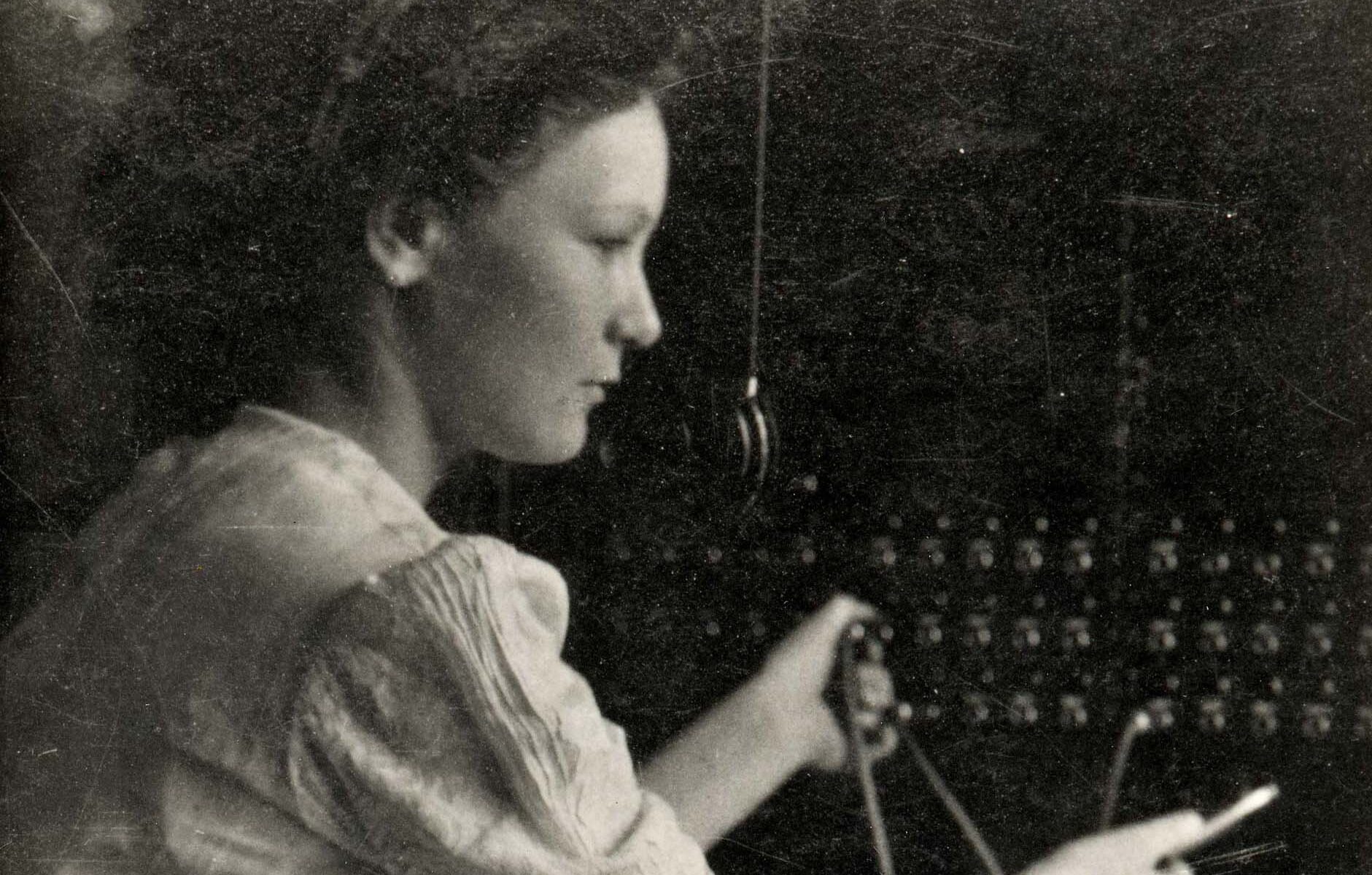
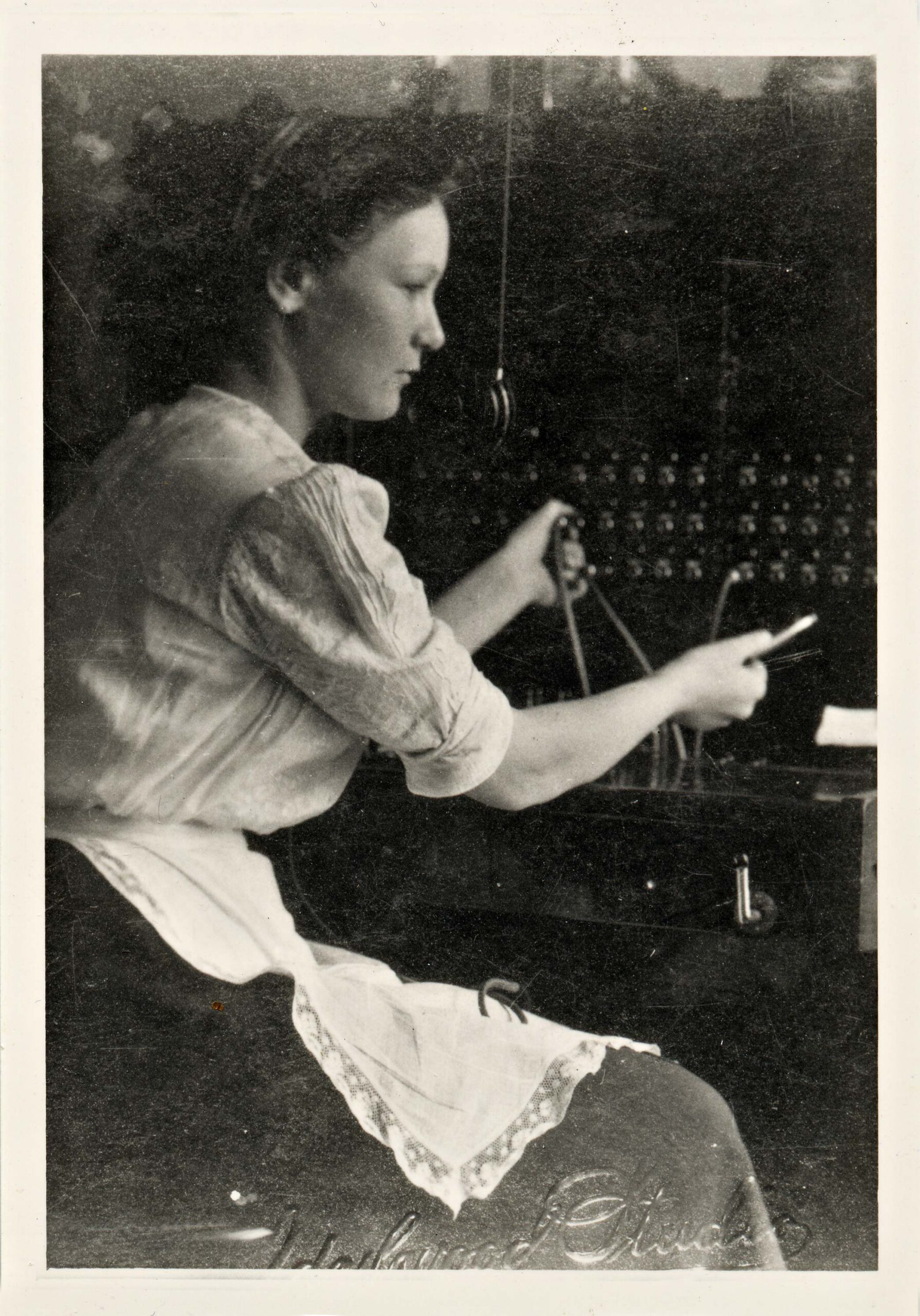
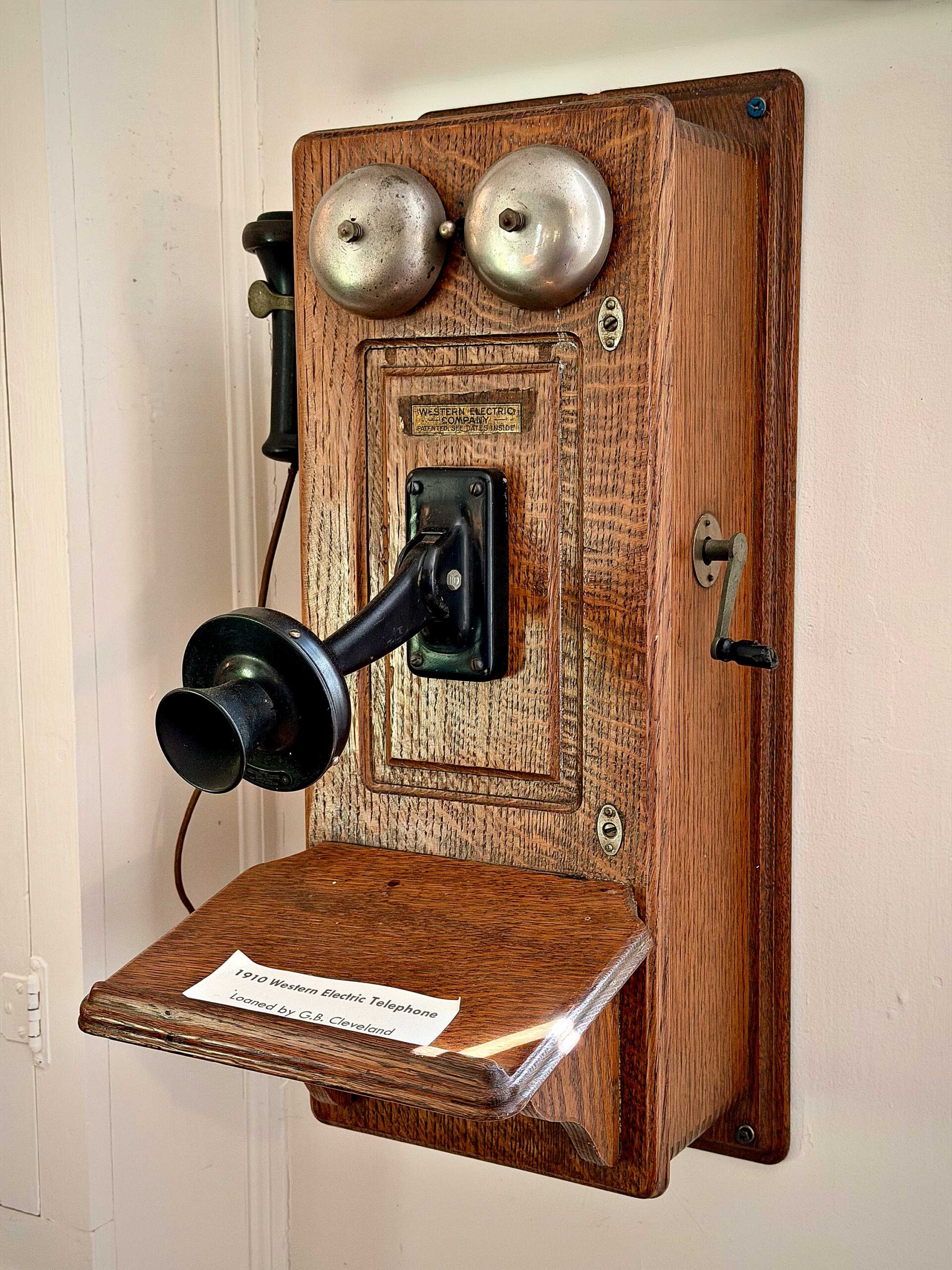
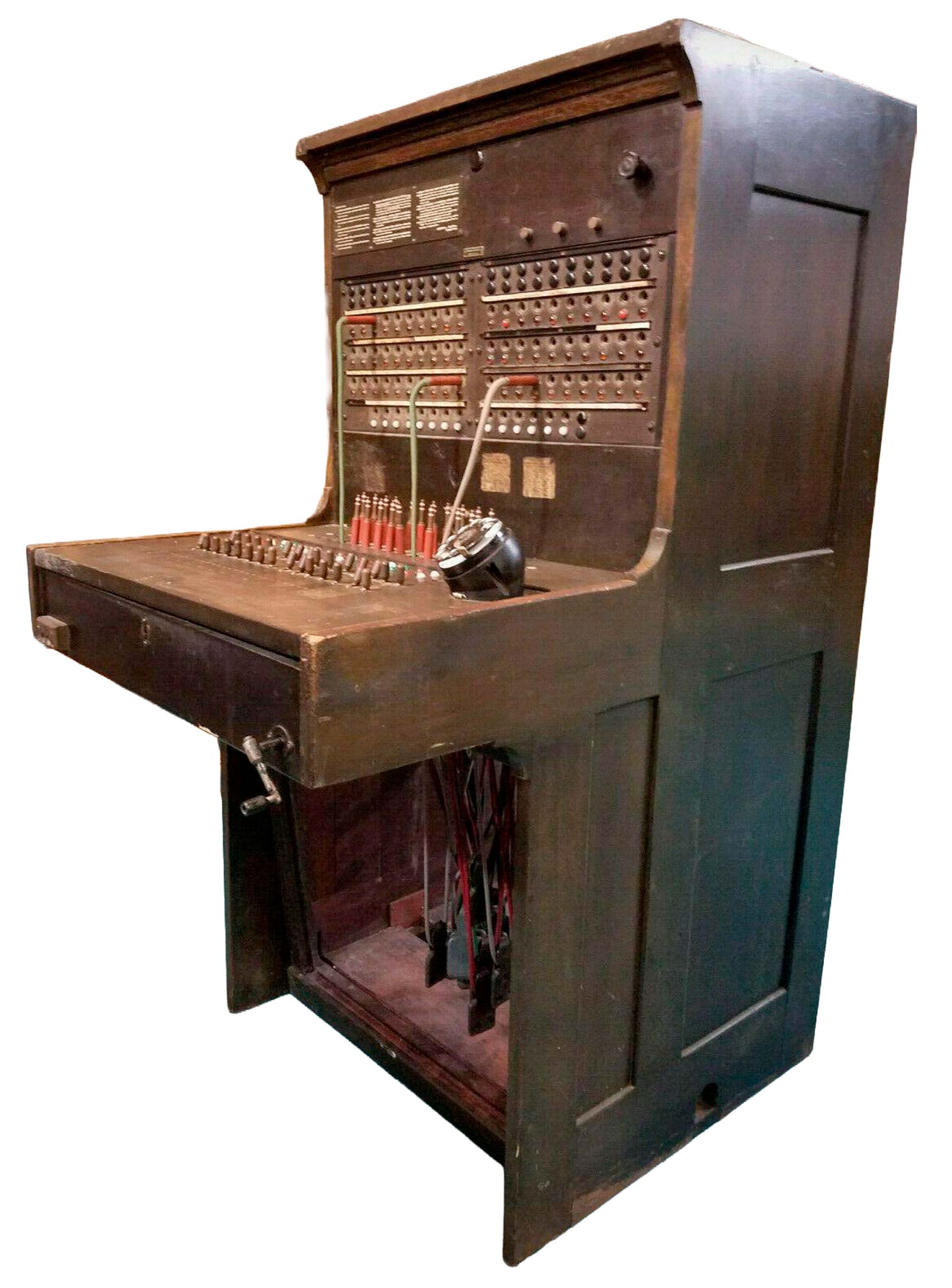
Edith Taggart served as Scottsville’s central telephone operator from 1911 until her retirement in 1950. She was our ‘Central.’ Every Scottsville telephone call outside a subscriber’s party line was placed through her. A caller turned the crank of a magneto telephone and generated a ringing current at Edith’s switchboard. Edith would tap into the calling line and ask, “Number, please?” “Ring up Jim Tindall for me.” Edith knew the phone numbers of everyone and connected this caller by plugging a cable between those two phone jacks on her switchboard. Next she rang up Jim Tindall’s phone with one long ring and four shorts: R-I-N-G, ring-ring-ring-ring. Once someone at the Tindall home picked up the phone receiver and said, ‘hello,’ Edith’s work was done for that call.
1913 Western Electric magneto wall phone similar to those used in Scottsville homes.1914 Western Electric switchboard similar to the one used by Edith Taggart.
Despite being crippled by polio as a child, Edith excelled in her role as our Central. She stayed on call 24 hours a day, seven days a week for thirty-nine years. Her hands flew across the switchboard, making connections. Edith always knew what was happening in Scottsville, and often townspeople would call her to get ‘the news’ or leave messages. “If you see my husband, tell him to call home – his dogs are fighting again.” Edith peered out the window from her Central Office vantage point on Valley Street and spied the husband walking into a store. Turning back to her switchboard, Edith told the caller, “Oh, he just went into Omohundro’s Hardware. I’ll connect you over there.” During World War II, Edith only needed to know a soldier’s name and the state in which he was posted to connect a call to him. Her employer, Virginia Telephone and Telegraph, rated Edith as their company’s best operator. Scottsville certainly applauded Edith for that well-deserved plaudit, but they knew their Central meant even more to their community.
Edith’s personal relationship with Scottsville was unique — she carried the whole town in her mind and in her heart. She was beloved in Scottsville. Some folks called Edith when they were lonely, just to hear her familiar voice. “Hello, Central.” When Edith responded, the caller believed that ‘home’ was still in good hands. One resident, Nell Bolling, named her daughter, Edre, after Edith – not unlike the central character in Mark Twain’s A Connecticut Yankee in King Arthur’s Court, who was inspired similarly by his telephone operator and named his daughter, ‘Hello-Central.’ Children and adults enjoyed Miss Edith’s company and sought her out. She knew interesting people and, of course, ‘the talk of the town.’ But even greater attractions were Edith’s quick wit, good humor, love of people, and demonstrated ability to excel despite her physical infirmities.
How did Edith get her start? She was born on September 17, 1898, to Martin and Nella (Payne) Taggart of Buckingham County. Her father worked as a salesman in the county’s Slate River District and died before 1910, leaving Nella to raise their three children, Melvin, Edith, and Gladys. To make ends meet, the family moved in with Nella’s mother, Mary E. Payne. Then a polio epidemic struck their Buckingham community, leaving five children afflicted with polio, including Edith and her cousin, Bolling Skidmore.
When she was eight years old and in the third grade, Edith was stricken with polio. Her mother called Scottsville’s Dr. Bowles to their home to check on Edith’s medical condition. Completing his examination, Dr. Bowles pulled the sheet back up to Edith’s neck and turned to her mother with his diagnosis: “This one is a goner!” Even years later, Edith remembered the terror she felt upon hearing those words. She credited her uncle, Samuel ‘Sammy’ Payne, for pulling her through that night. First Uncle Sammy comforted her and then concocted a big batch of mentholated salve to help her breathe. He put the pan of salve under her bed sheet and asked her to pull the sheet over her head and breathe deeply to help clear her breathing passages. Edith trembled helplessly with fear, and so Uncle Sammy hopped under the sheet with her. All night long he held that sheet up to form a tent filled with mentholated vapors that helped Edith breathe. In the morning, her breathing was better, and Edith would survive her bout of polio. But polio left Edith unable to walk without heavy braces on her legs and crutches.
In this 1908 photo of the corner of West Main and Valley Streets, the Dorrier building is the two-storied building at left.
In 1911, the Taggarts’ second floor apartment in the Dorrier building overlooked Valley Street. To make ends meet, Nella Taggart began working as Scottsville’s telephone operator. She moved her family into an apartment above Dorrier’s Store (280 Valley Street). This building stood at the southwest corner of West Main and Valley Streets, and Nella’s switchboard sat at a second story window with a full view of Valley Street. Edith played nearby and watched her mother work. Homebound and unable to attend school, Edith perhaps viewed her mother’s switchboard as a welcome connection to a more interesting world than four apartment walls afforded. Edith quickly learned telephone operator’s skills and began working the switchboard full time in 1911. She was 13 years old, and next to her switchboard was the cot on which she slept. About 2AM, Edith would take off her braces and go to bed. If the switchboard buzzed in the middle of the night, it might take Edith a minute or two to get there from her cot. But she’d answer the call and make the desired connection. The role of Central for Edith was a 24-hour a day business.
In the early 1900’s, telephones were really in a primitive state. There were all kinds of crackling and clicking noises on each party line, which was shared by six to eight families. For two people to actually conduct a conversation, a friendly operator was needed to make the experience less worrisome and annoying to the subscriber. Edith developed a jolly, jovial line of patter that endeared her to local phone users. Several longtime Scottsville citizens remember how good it felt when they were traveling just to call our Central and hear a familiar voice from home.
Edith knew her local phone subscribers and did her best to handle every situation calmly and effectively. During her freshman year at college, Virginia Tindall remembered calling her mother in the middle of a terrible thunderstorm. “We were cut off, and I called back and told Miss Edith, ‘I want to speak to my mother.'” Invoking her most reassuring tone of voice, Edith told Virginia, “Your mother is perfectly fine.” Edith knew it was late and that the Tindalls had one phone downstairs and none in Mrs. Tindall’s bedroom. So she continued her logical assessment of the situation with “And I’m not going to call your mother back because she’s gone to bed.” But Virginia insisted, “Well, I WANT to talk to my mother to see if she’s alright.” Edith finally called Mrs. Tindall and let Virginia talk to her mother. When they hung up, Virginia said she realized she’d made her mother walk all the way downstairs in the dark to answer the phone. “And Edith was trying to tell me that.”
Some locals called Edith and engaged in humorous exchanges. Virginia Lumpkin recalls one such story about a man who got drunk in Buckingham and called Scottsville’s Central. Edith had taken off her braces and gone to bed when the switchboard rang. Although she had just dozed off, she answered the call. It was Luther Baber, who said, “Miss Edith … get me …” He mumbled the name of the person he wanted to call, and so Edith asked, “Who are you calling?” “I want to call Heaven!” Figuring that she was still half asleep and not hearing him correctly, Edith restated the question, “Who do you want to call?” “I want to call Heaven!” “And who do you want to speak to?” she queried. The drunk said, “Jesus.” Edith replied firmly, “Luther Baber, if you don’t get off that phone, I’m going to give you Hell!” And she hung up on him. The caller reportedly got so mad that he threw his phone out in the middle of the road, an act he surely regretted the next morning.
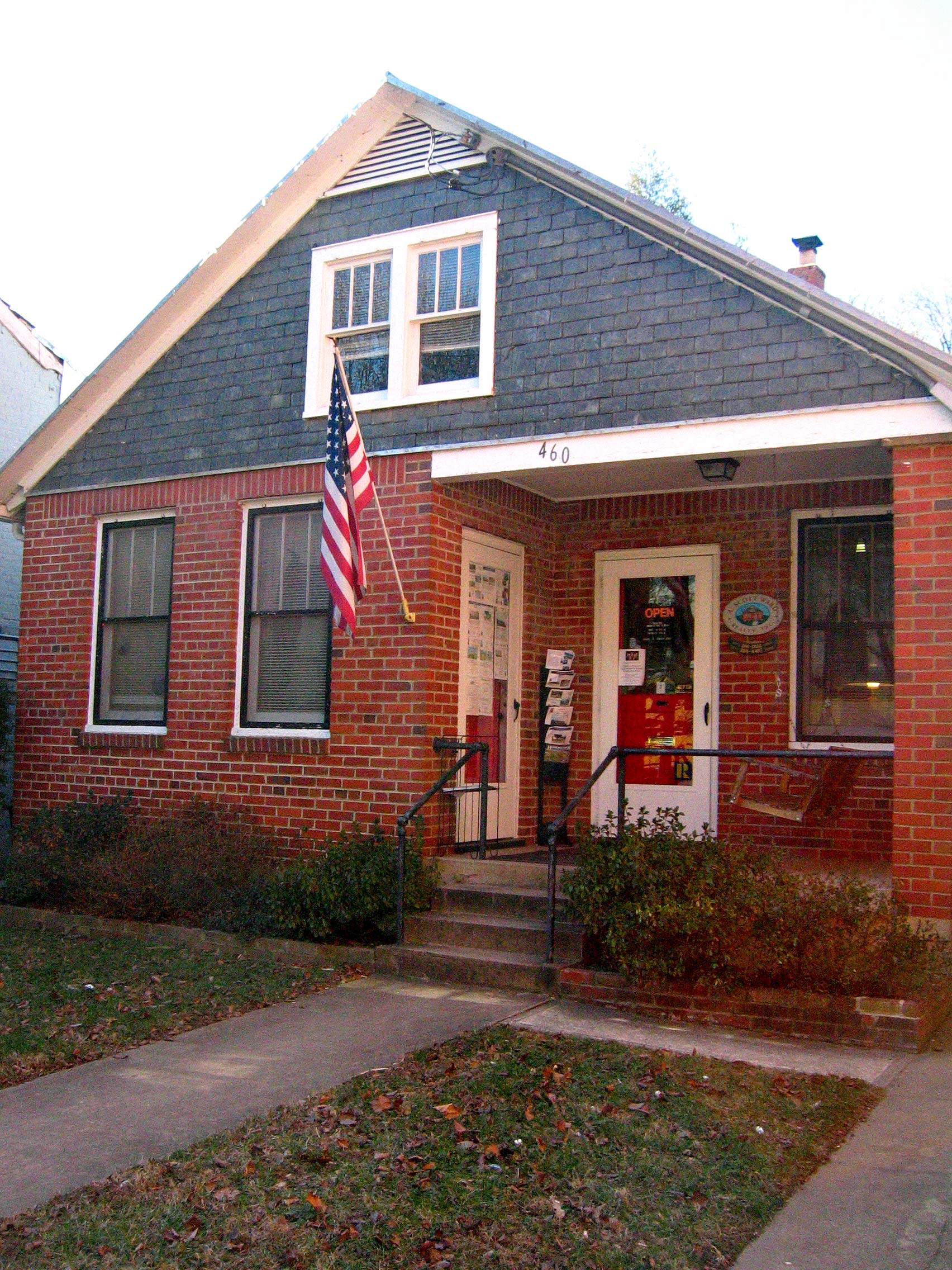
Central telephone office in Scottsville during 1940-1950’s (460 Valley St.)
By the mid-1930’s, Dr. Luther Stinson built a small brick house up the street at 460 Valley Street to serve as the central telephone office and home for Edith and her mother. Its one floor design better accommodated Edith’s infirmities. The Kirk Spencer family lived nearby with their young son, Bobby, and were good friends of the Taggarts. Today, Bobby recalls spending many hours playing by Edith’s switchboard as his mother visited in the Taggart home. He says that Sunday evenings at the Taggarts were particularly enjoyable. As Miss Edith worked the switchboard, her mother would sit in the adjoining room, listening to radio programs on her big console radio or playing their piano.
Edith always dressed for work. Each morning she got up and painstakingly fixed her hair and donned a long tailored dress to hide her heavy leg braces. Over the years, she received many presents of costume jewelry from her friends in the community. Invariably, Edith would don earrings and sometimes a pin or necklace to ensure she was properly dressed for the job. When she began each work day as Central, Edith was dressed for success.
Edith enjoyed taking the afternoon off when a temporary operator would spell her for several hours. Some of the operators, who helped with Edith’s switchboard duties, were Frances Faulconer, Frances Maupin, Joyce Mason, and Annie Pearl Moore. Edith first would rest for about an hour and then go down to Bruce’s Drugstore in her wheel chair for a cherry coke. She would sit at a soda fountain table, smoke cigarettes, and talk with others in the store. Edith always used a long cigarette holder, which some felt made an elegant statement in those days when smoking was more commonplace. As teenagers, Bob Spencer and his good friend, Pete Deane, often visited with Edith because she was so jolly and told great stories. Pete nicknamed Edith ‘the Dragon’ because she blew smoke much like he imagined a dragon might. When these two young men needed a break from their studies, Pete would say to Bob, “Let’s go down and talk to The Dragon!” And off they would head to find Edith.
By 1950, the Scottsville party line phone system had grown immensely and was headed to a dial phone system by 1952. Many in the community rued the passing of a system in which Edith’s personal touch enabled callers to leave messages and divert calls. However, the days of Central everywhere were numbered. In Scottsville, the new dialup equipment required a new plant, one that could no longer house our Central. Edith would soon be both jobless and homeless.
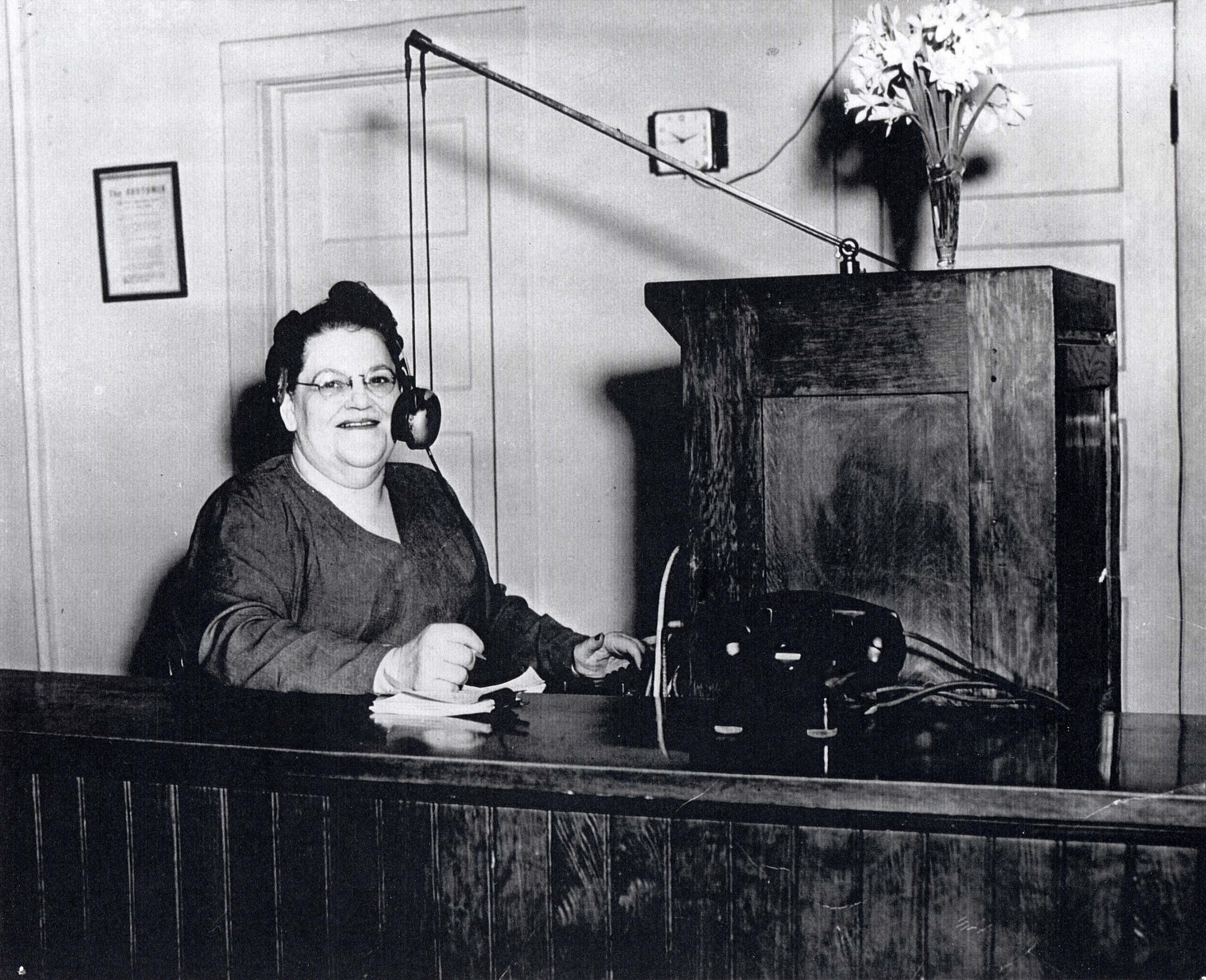
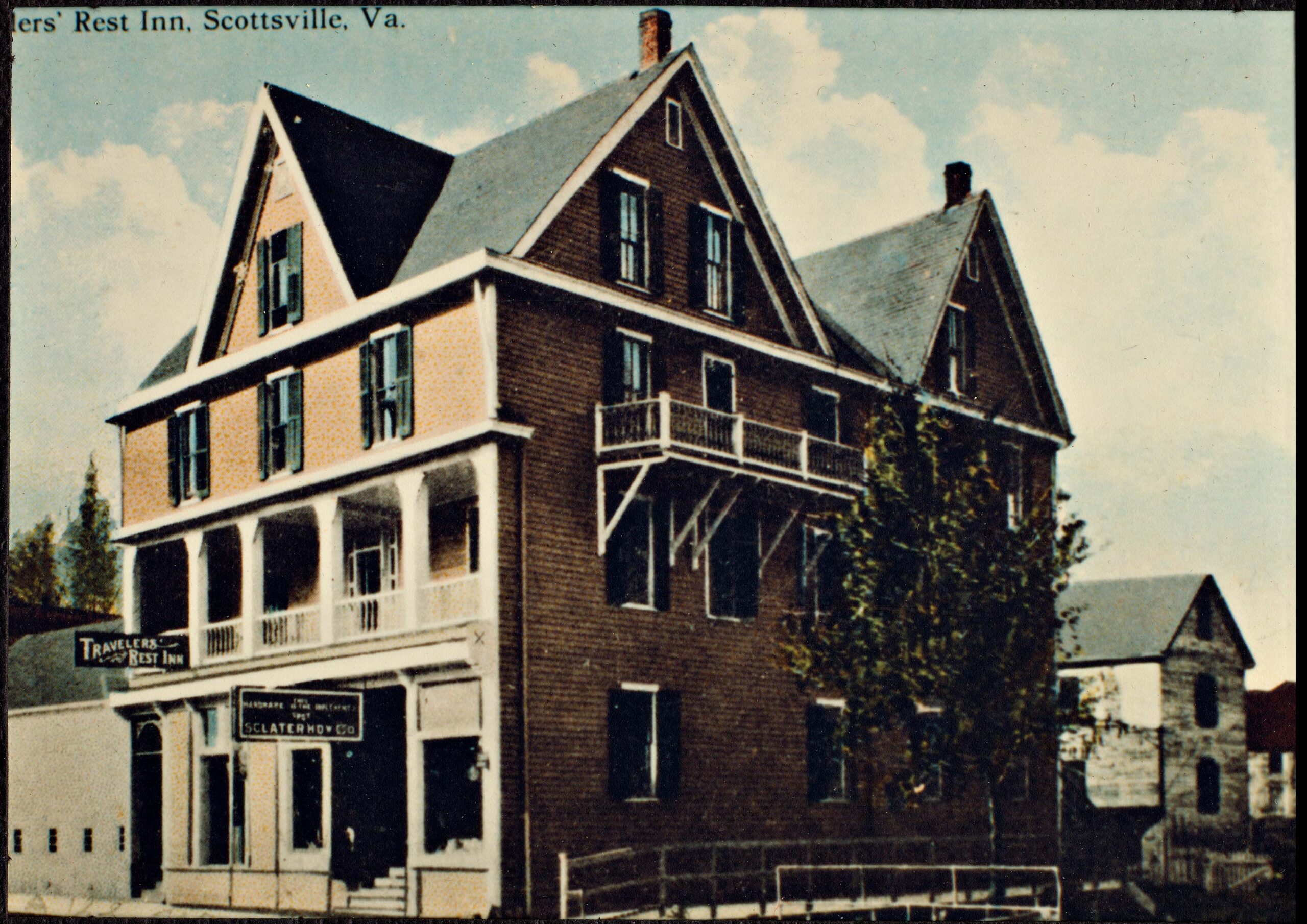
The superintendent of the phone company met Edith at the Traveler’s Rest Hotel and advised her that her services as Central were no longer required. Edith asked her boss, “Well, how am I going to make a living? I’ve worked for this company for thirty-nine years and am not old enough to draw social security.” He replied matter-of-factly, “Oh, we got you a job, but you have to walk up 14 stairs.” With a tear in her eye, Edith realized she was physically unable to do that and told the man that she had no choice but to retire. Virginia Lumpkin, Edith’s good friend and owner of the Traveler’s Rest Hotel, grabbed the superintendent’s elbow and escorted him quickly out of Edith’s hearing. Virginia recalls telling him firmly, “I’m sorry, you might have a better job, and you might be rich, you might have authority, but I want you to leave here now. Anybody who would talk to someone in a wheel chair that has done so much for the telephone company as Edith has … well, I don’t need you here. And I don’t need you to take care of Edith.” Edith retired soon after that conversation and is shown below on her last day of work as Scottsville Central in May 1950.
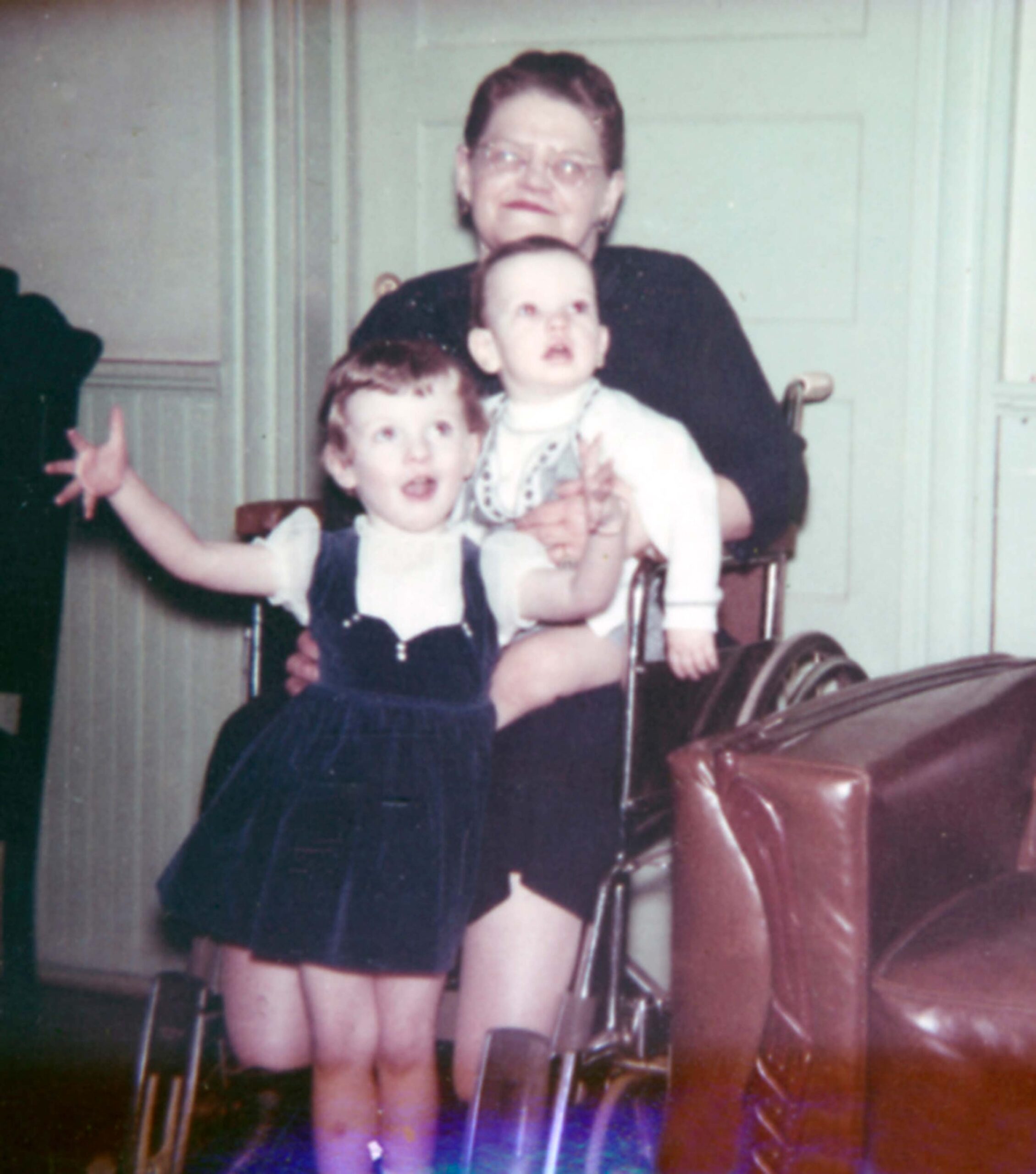
Edith Taggart on her last day of work as ‘Central’ in 1950. Edith Taggart with Marlean and Hollis Lumpkin, ca. 1955
In retirement, Edith was ineligible for social security benefits and had meager savings, no home, and no family in the area. Her mother, Nella, was deceased, and her brother, Melvin, lived far away in Baltimore. So Edith moved to the Traveler’s Rest Hotel where her good friend, Virginia Lumpkin, gave her free rent and meals for the next 18 years.
Traveler’s Rest Hotel, formerly on the corner of Valley and Main Street.
Edith sewed her own clothes and babysat Virginia’s children, Hollis and Marlean Lumpkin (shown at right). She also earned some money for personal expenses by altering clothes for the Scottsville community. But Mrs. Cohen, Dr. Stinson, Dr. Moody, and others in the community voluntarily supported Edith with small financial contributions. Edward Dorrier would visit Miss Edith monthly and, without a word, slip a few dollars under her dresser scarf as he rose to leave. Scottsville took care of its Central, a woman who unselfishly had worked and cared for the town since 1911.
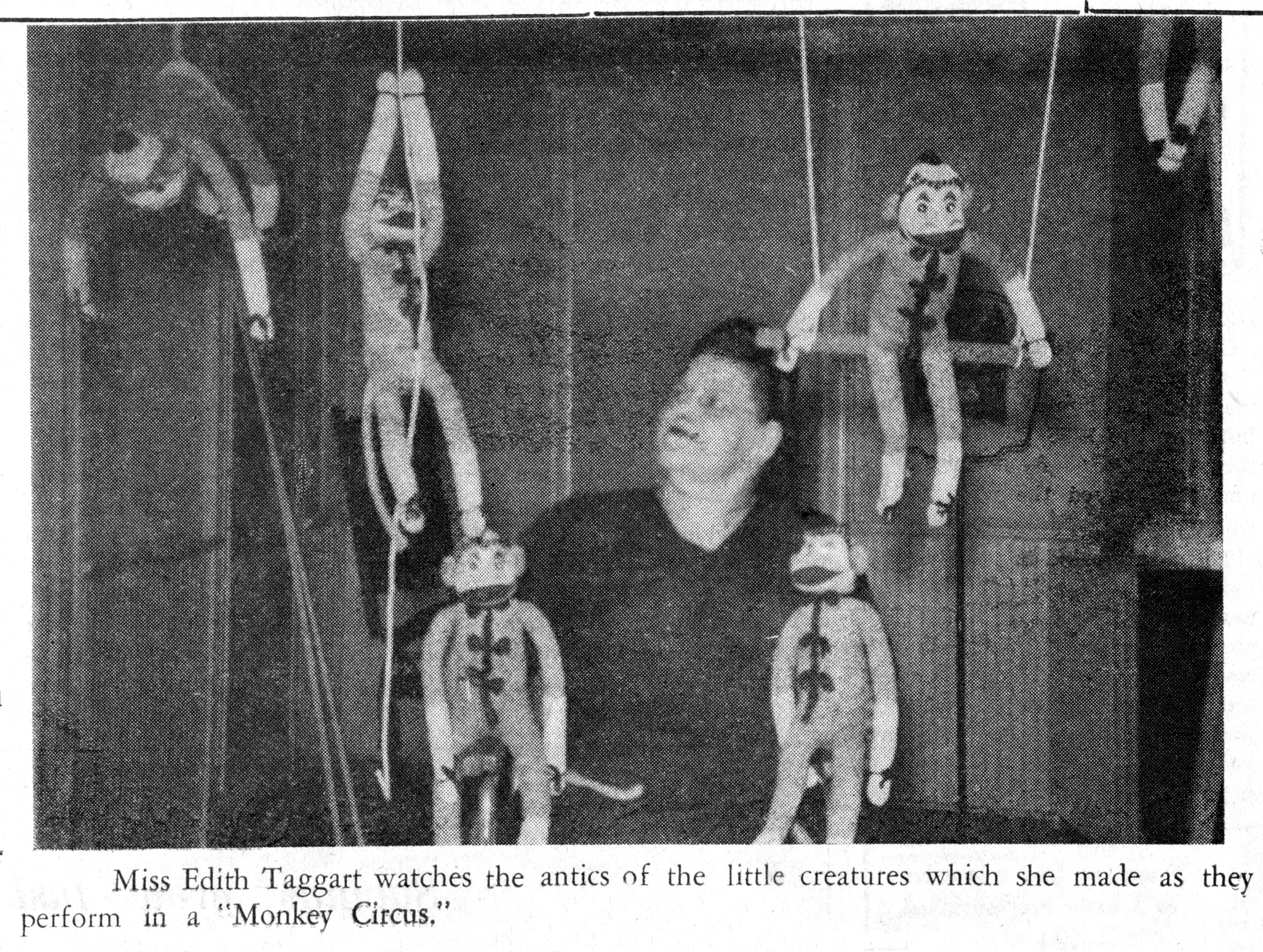
In March 1954, Edith created her first handstitched sock monkeys and gave them away to area children as toys. Her hobby soon grew into what she termed ‘monkey business,’ as novelty stores in New York, Washington, and White Sulphur Springs began marketing them as children’s toys. Edith spent about four hours creating each monkey from a blue or brown kneelength sock. The sock’s white toes formed the monkey’s mouth, and the white heel, its bottom. The monkeys were about twenty-two inches in length, and every face had a seemingly different expression with glass eyes, protruding lips, rosette mouths, and a little cap on their heads. These monkeys brought her much enjoyment, and the photo at right of Edith and a ‘monkey circus’ appeared in The Scottsville Sun on July 8, 1954. The accompanying article added that “Miss Edith has sent one of her monkeys to Dave Garroway, star of television’s program, Today, so that Garroway’s monkey sidekick, J. Fred Muggs, will have a playmate.” A few of these treasured monkeys can still be found today in Scottsville toy chests as fond childhood mementos.
Beginning in the 1940’s, arthritis became a health issue for Edith. She found a chiropractor on Franklin St. in Richmond, whose treatments provided her some much welcomed relief from arthritis pain. The chiropractor was located near the posh Jefferson Hotel, and Raymon Thacker of Scottsville, an old friend of its owner, arranged for Edith to stay at the Jefferson during her treatments for only $1.50 a day. After Edith retired, she would save up her money and go to Richmond for treatment when she could afford it. Often the Lumpkins would drive Edith there and pick her up at the end of her stay at the Jefferson. Edith also helped the hotel run its phone switchboard and took on sewing tasks, too. According to Bob Spencer, Edith met some very interesting people while working the Jefferson switchboard, including Clyde Beatty, the lion and tiger tamer; Mantovani, the famed British conductor; and others.
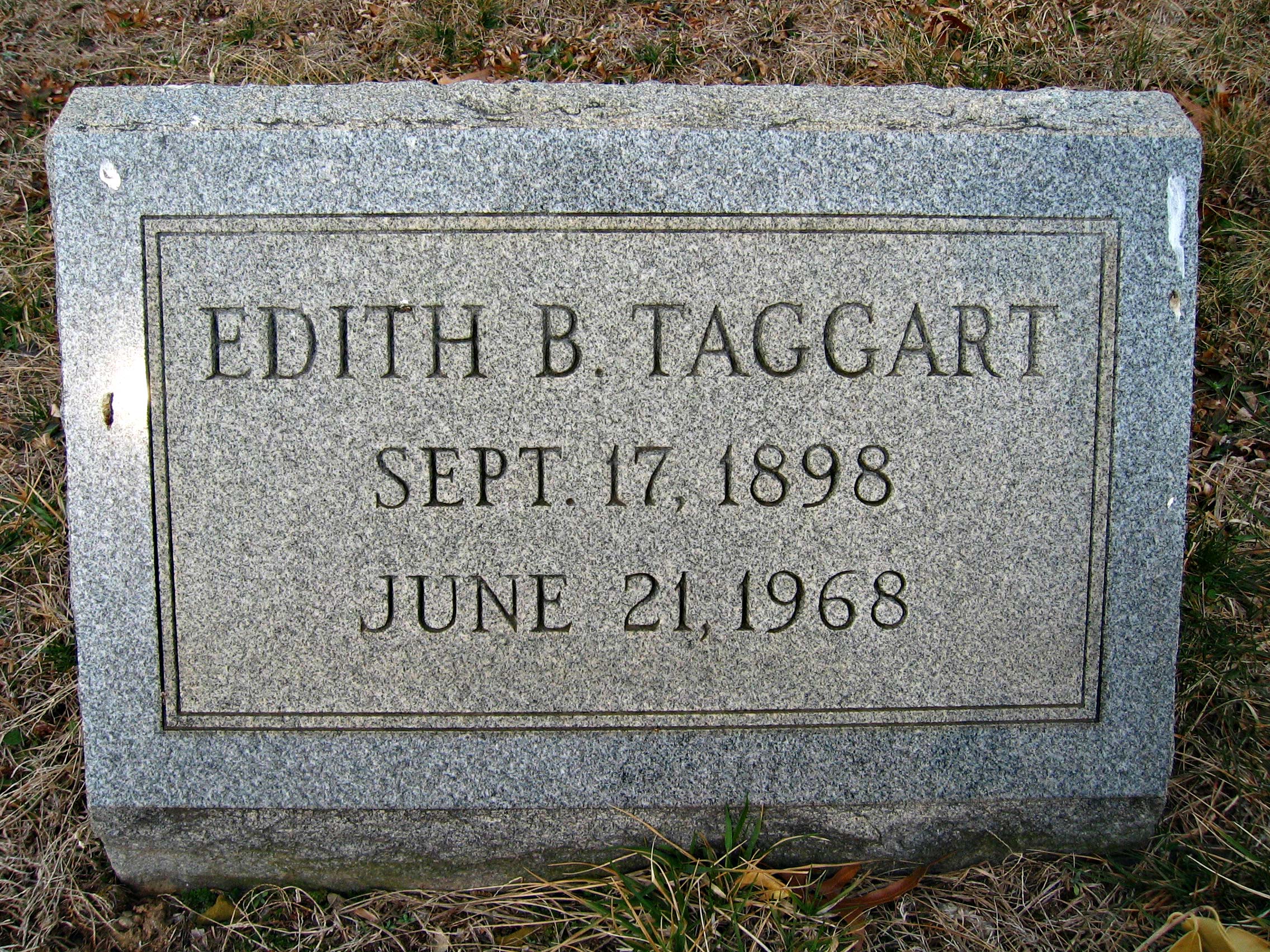
Edith’s gravestone at Scottsville Cemetery
During one of her Richmond visits in April 1968, Edith suffered a stroke and further paralysis. She called for her friend, Virginia Lumpkin. “Virginia, I don’t want to be buried in Buckingham with my parents. I want to be buried in Scottsville near you and Nelson.” At that time, Virginia said that the Lumpkins didn’t own cemetery plats, but she knew she had to work fast to accomplish such plat ownership before Edith passed away. Mrs. Lumpkin drove back to Scottsville and worked to resolve that situation with Raymon Thacker, an undertaker and Scottsville’s Mayor. The Lumpkins bought three plats so Edith could be buried next to them at Scottsville Cemetery. It gave Edith great peace of mind when Virginia told her they would all be together at the cemetery. A short time later, the State of Virginia placed Edith in a State nursing home where she died on June 21, 1968. Virginia Lumpkin arranged for her friend’s funeral in Scottsville. Bob Spencer, her good friend, officiated at Edith’s funeral, and her pallbearers were Charlie Lenaham, Nelson Lumpkin, Dr. Moody, Milton Cohen, Gene Johnson, and two of Edith’s cousins. Edith had saved enough money in the bank to pay for her funeral.
Today, thirty-five years after her death, Scottsville still talks fondly about the impact Edith had on our town. A musical history of Scottsville, written recently by Langden Mason and performed at Victory Theater, included a piece on Edith Taggart. Anne Condon of Scottsville starred as the musical’s character, Edith, and sang a song entitled Talk of the Town: “…it’s not really gossip, it’s talk of the town….” Indeed, our Edith Taggart was a ‘character’ and a much cherished member of our community.
Memories of Edith Taggart
A. Scott Ward, October 09, 2004: “My very first phone call was through the Scottsville Switch Board. My mom, Ellen Ward, was sick, and she said, “Alex, please go get Aunt Elizabeth Napier.” So I walked across the old James River Bridge, and as I was passing Pitt’s Chevrolet Garage, I thought, “Why not call her?” So I went into Pitt’s Garage (actually the show room) and asked to use their phone. They handed it over the counter, and I cranked away. Miss Edith came on the line, and I told her that I wanted to speak to my Aunt Elizabeth Napier. She said, “Hold on, Son!”, and the phone rang. I saved myself a mile of walking. I was only 6 years old at the time!”
Robert K. Spencer, September 18, 1985: A Time To Remember: Miss Edith, “The Voice of Scottsville”, Published in The Central Virginia Leader, Vol. 11, No. 33, p. 1 and 5: “Even small towns have certain persons who become legends in their own lifetimes, and there are few whose legends live long after they are gone. This week’s file photo (see above photo of Edith Taggart as ‘Central’ at her switchboard on her last day of work in 1950) will cause most longtime residents of Scottsville and environs to remember fondly one who in the past provided an invaluable and vital service to the people of this area, and newcomers will learn about a truly legendary personality in the history of our town.”
“Edith Bolling Taggart, better known as “Miss Edith,” would be eighty-seven years of age on September 17, 1985, if she were still with us in person, but to most who knew here, she is timeless and a part of the spirit of Scottsville whose voice may still be heard echoing on the telephone lines around the town. In her thirty-three years of faithful, efficient service, day and night, as chief switchboard operator “Central,” before dial phones came into use in the area, she rightfully gained the title of “The Voice of Scottsville.” Her strong, clear, well-modulated voice compared favorably with any big city operator’s of that era, and she could get you through to anywhere in the world that there was a telephone. It is said that at one time an inebriated caller asked her to give him Heaven, whereupon she promptly offered to give him another equally well known place if he didn’t get off that line at once!”
“Miss Edith learned to be “Central” from her mother, Nella B. Taggart, who held the position before her. Stricken with polio at the age of eight, Miss Edith was confined to a wheelchair most of the time but nearly every day walked some with the aid of crutches. In fact, one of her favorite daily activities was an afternoon stroll down to Bruce’s Drug Store on the Corner, where she would enjoy a large Cherry Coke and sometimes a dish of ice cream. (Until the early ’50’s, Bruce’s had a soda fountain with seats.) Miss Edith trained assistants to relieve her for several hours in the afternoon.”
“At the switch board, besides performing her regular duties of putting through all calls, Miss Edith was like a receptionist for every professional and businessman in town and the entire area. If a doctor was making a house call, she knew exactly where he was and when he would return to his office. A lawyer or a politician, in Charlottesville or Richmond for the day, could be reached by her if need be. She knew where electricians, plumbers, carpenters, and farmers were working on any given day. So well did she know the lifestyles of everyone served by her switchboard that she knew how to contact almost anybody at anytime. She did not hesitate to interrupt lengthy conversations on party lines for emergencies. There were few, if any, “crank” calls other than turning the crank in those days because Miss Edith knew who was responsible for any number plugged in, and she was known to have an adequate vocabulary to quell any abuse of the telephone. In short, she gave the ultimate personal touch to telephone communication of an earlier time.”
“In May 1950, Miss Edith retired from her post, probably realizing that soon the dial system would replace her. (The dial system was inaugurated here in July 1952.) She then moved to the old and well known Traveler’s Rest Hotel, which was then operated by Virginia McGrow (now Mrs. Nelson Lumpkin, proprietor of Lumpkin’s Restaurant). (The old hotel was destroyed by fire several years ago.) In retirement, Miss Edith resided part of the time in the famous Hotel Jefferson in Richmond, where she sometimes worked the switchboard. She loved to meet people, and there she got to meet and take messages for many personalities, including Marge and Gower Champion, Betty Hutton, Mantavanni, Gene Autry, and Clude Beaty.”
“Virginia Lumpkin did so much to make Miss Edith’s retirement years pleasant ones, and she saw that she was cared for during her final illness. They say Miss Edith died on June 21, 1968, but some of us like to think “The Voice of Scottsville” may still be on the line.”
The above photos are part of the Raymon Thacker, Robert Spencer, and Virginia Lumpkin collections at Scottsville Museum. All three donors resided in Scottsville and were dear friends of Edith Taggart.
Top Image Located On: Capturing Our Heritage, CDB25 B264cdB25.tif B264cdB25.jpg B264cdB25.psd
1908 Image of Dorrier Building Located On: Capturing Our Heritage, CDB18 B06cdB18big.tif B06cdB18big.jpg B06cdB18big.psd
2004 Image of Taggart Home/Central Office, 460 Valley Street, Located On: Capturing Our Heritage, CDCG02 cg22cdcg02.tif cg22cdcg02.jpg cg22cdcg02.psd
1950 Image of Edith Taggart on Her Retirement Day Located On: Capturing Our Heritage, CDRS04 RS16cdRS04.tif RS16cdRS04.jpg RS16cdRS04.psd
Ca. 1955 Image of Edith Taggart with Marlean and Hollis Lumpkin Located On: Capturing Our Heritage, CDVL01 VL01cdVL01.tif VL01cdVL01.jpg VL01cdVL01.psd
The Dorrier Building, located at 280 Valley Street, was built in 1912 by William Dorrier as a general merchandise and feed-grain store. William’s son, Charles Richard Dorrier (1885-1966), operated this store for fifty years under the name, C.R. Dorrier and Company. The second floor of the building was used as a storage area and apartments.
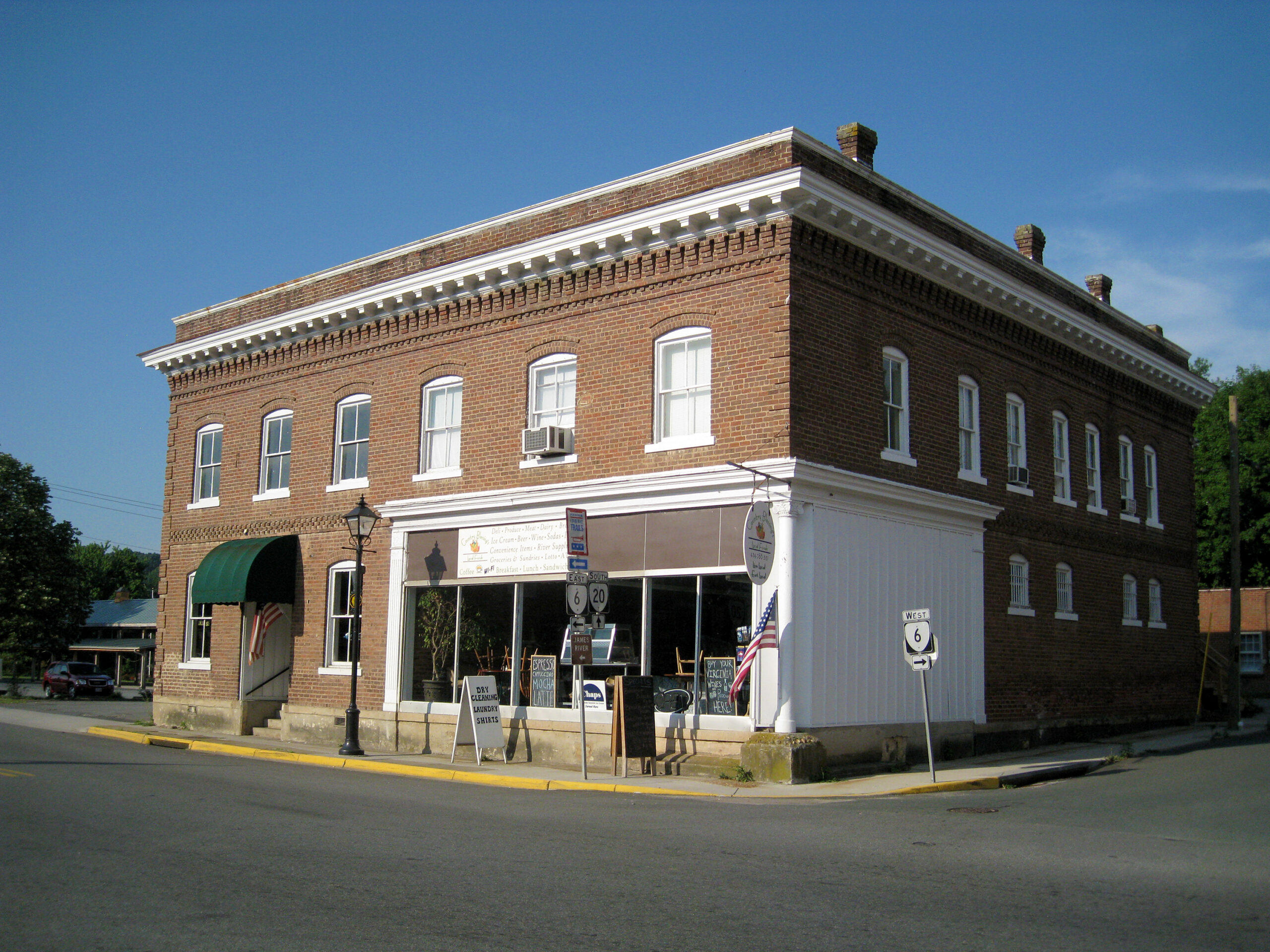
Dorrier Building as Country Blessings Market prior to restoring the original entrance.
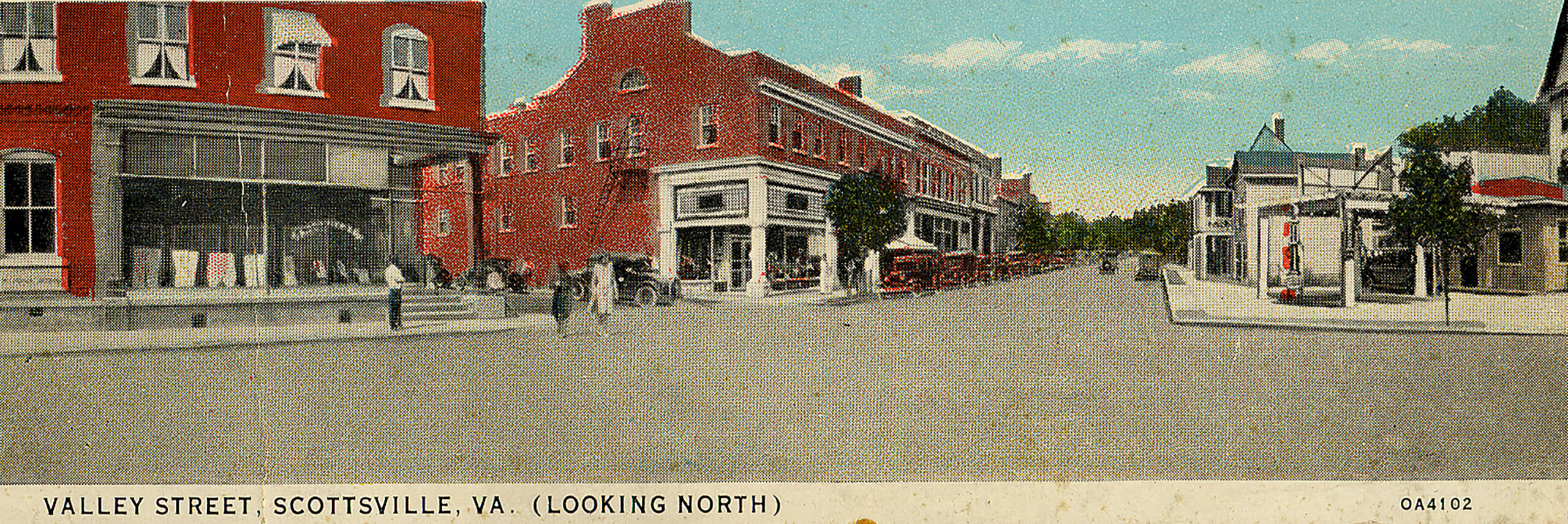
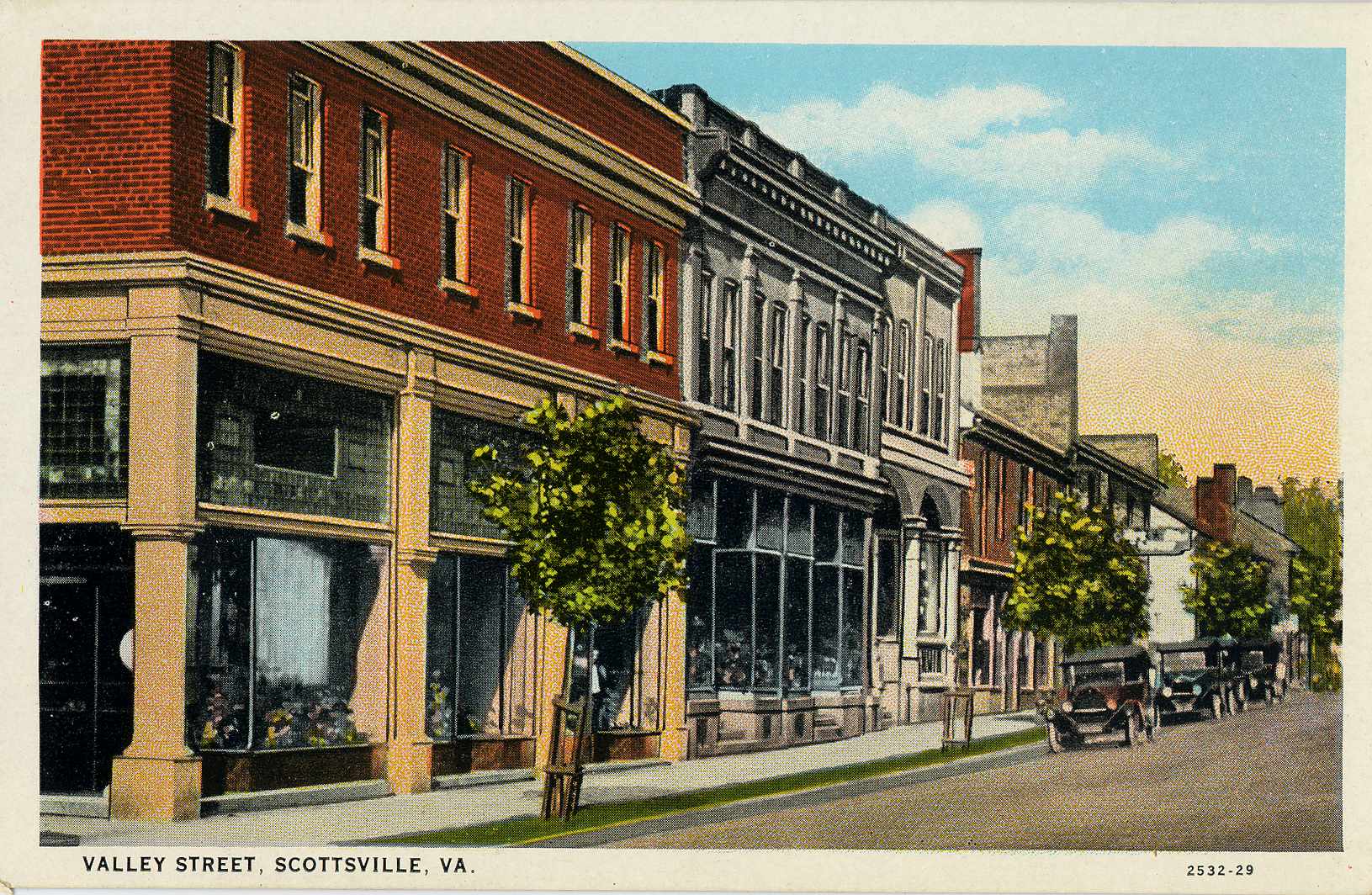
Shown below is a circa 1929 postcard that shows the C.R. Dorrier store at photo left with a view of Scottsville looking north up Valley Street:
Dorrier Store and Valley Street, ca. 1925
Former Scottsville Mayor, Raymon Thacker, fondly remembers a day in his youth circa 1920 when C.R. Dorrier asked him for some help. “Raymon, if you tell a bunch of people to come down here to the store about 3 o’clock, we’ll entertain them with something entirely new.” He wouldn’t say what was going to happen, but Raymon went out and passed this news to every person on Valley Street that he could find.
About 3 pm, the store held 20-30 people, and Mr. Dorrier set out a little box just full of glass bulbs. He stretched a wire out of the box and pulled it out all over the store. Then Mr. Dorrier hooked the box up to electric current and began fiddling with its little dials.
Raymon vividly describes what happened next. “First thing you know, here comes some voices…and we stood there, and we looked and looked and waited. Our eyes got bigger and bigger as the voices became clearer. Finally Mr. Dorrier had the box tuned just right, and low-and-behold we were listening to New York City! They were talking about a World Series game that was going on. It was a MIRACLE that you could hear people talking from New York City clear into Scottsville. Nobody could understand it!
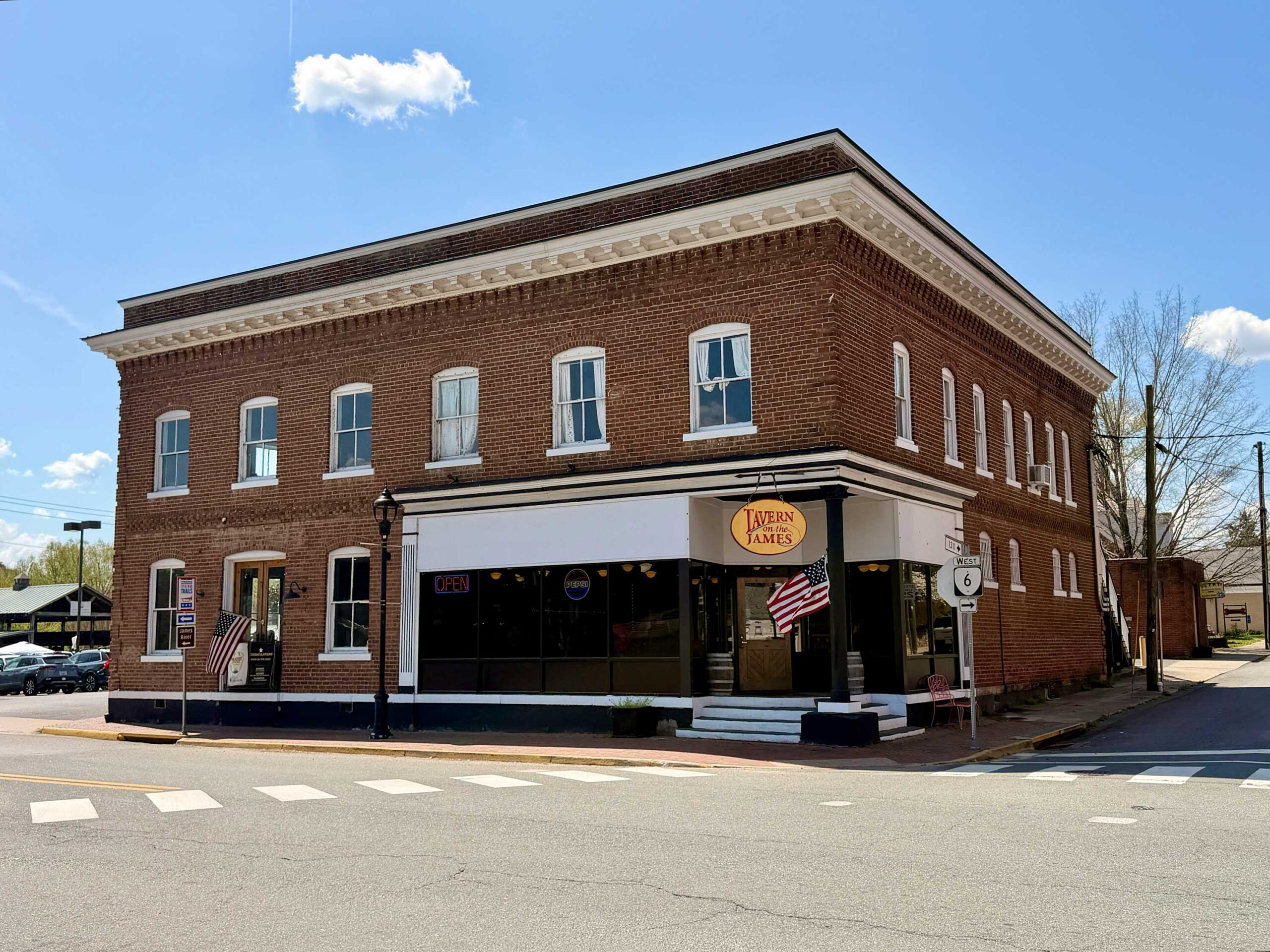
In 2010, the Dorrier building hosted Country Blessings, a grocery and delicatessen. As of this writing in 2026, it is home to Tavern on the James.
For many years, a resident on the second floor was Edith Taggart. Edith was the sole telephone switchboard operator for Scottsville from 1911 to 1950. Known to many simply as “Central” for her familiar voice on the line, “Hello, Central.” Despite a bout with polio at age eight that left her crippled, she survived, and stayed on call 24 hours a day, seven days a week for thirty-nine years.
She was far more than a switchboard operator: she tracked doctors on house calls, knew where every farmer and tradesman was working, and during WWII could connect callers to soldiers overseas with just a name and a state. People called her just to hear a familiar voice, and her sharp wit was legendary — when a drunk caller demanded she connect him to Heaven to speak with Jesus, she replied, “Luther Baber, if you don’t get off that phone, I’m going to give you Hell!”
When dial phones arrived in the early 1950s, Edith was left jobless and homeless. Her employer’s offer of a replacement job, which would require climbing 14 stairs, was cruelly impractical for a wheelchair user. Her friend Virginia Lumpkin stepped in, giving Edith free rent and meals across the street at the Traveler’s Rest Hotel for the next 18 years.
In retirement, Edith took up making hand-stitched sock monkeys that eventually sold in novelty stores in New York and Washington. She died in 1968, beloved by a town she had carried in her mind and in her heart for nearly four decades.
– o • 0 • o –
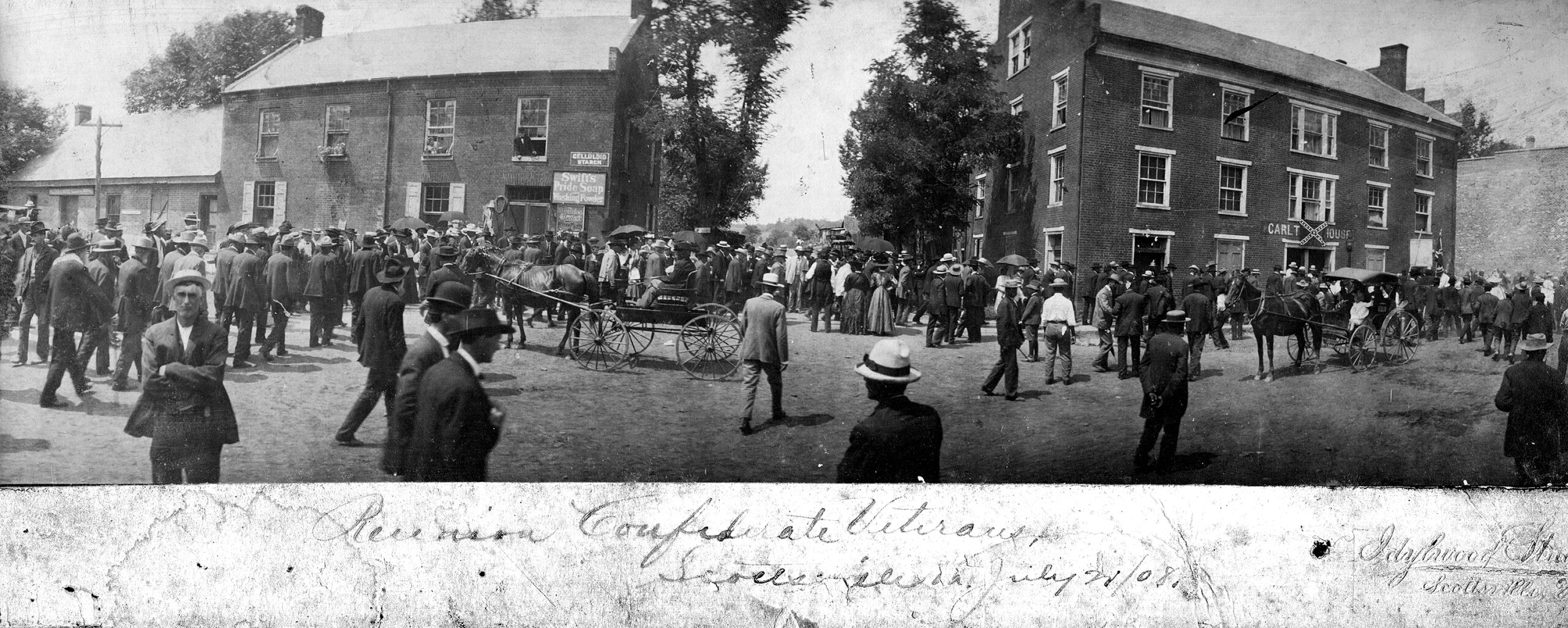
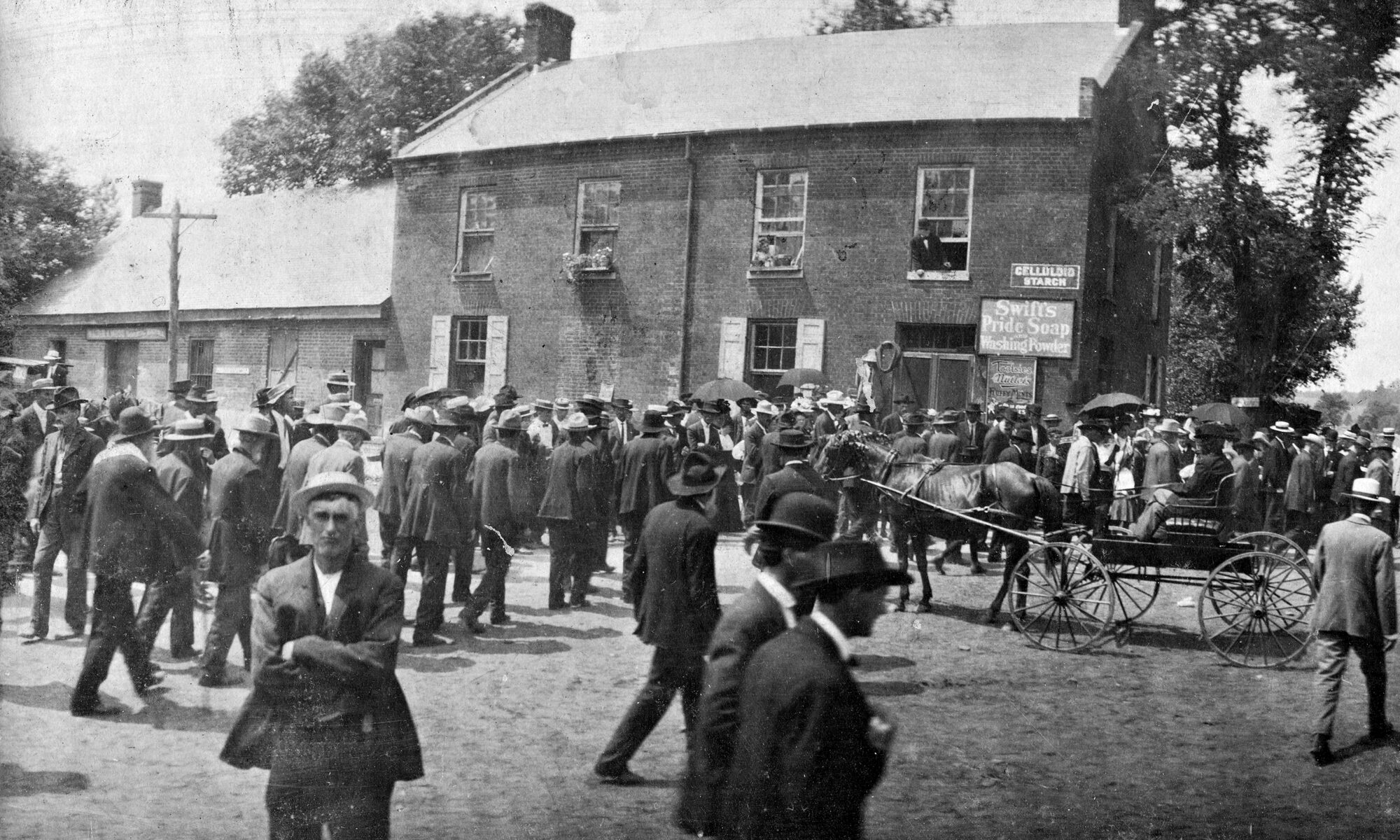
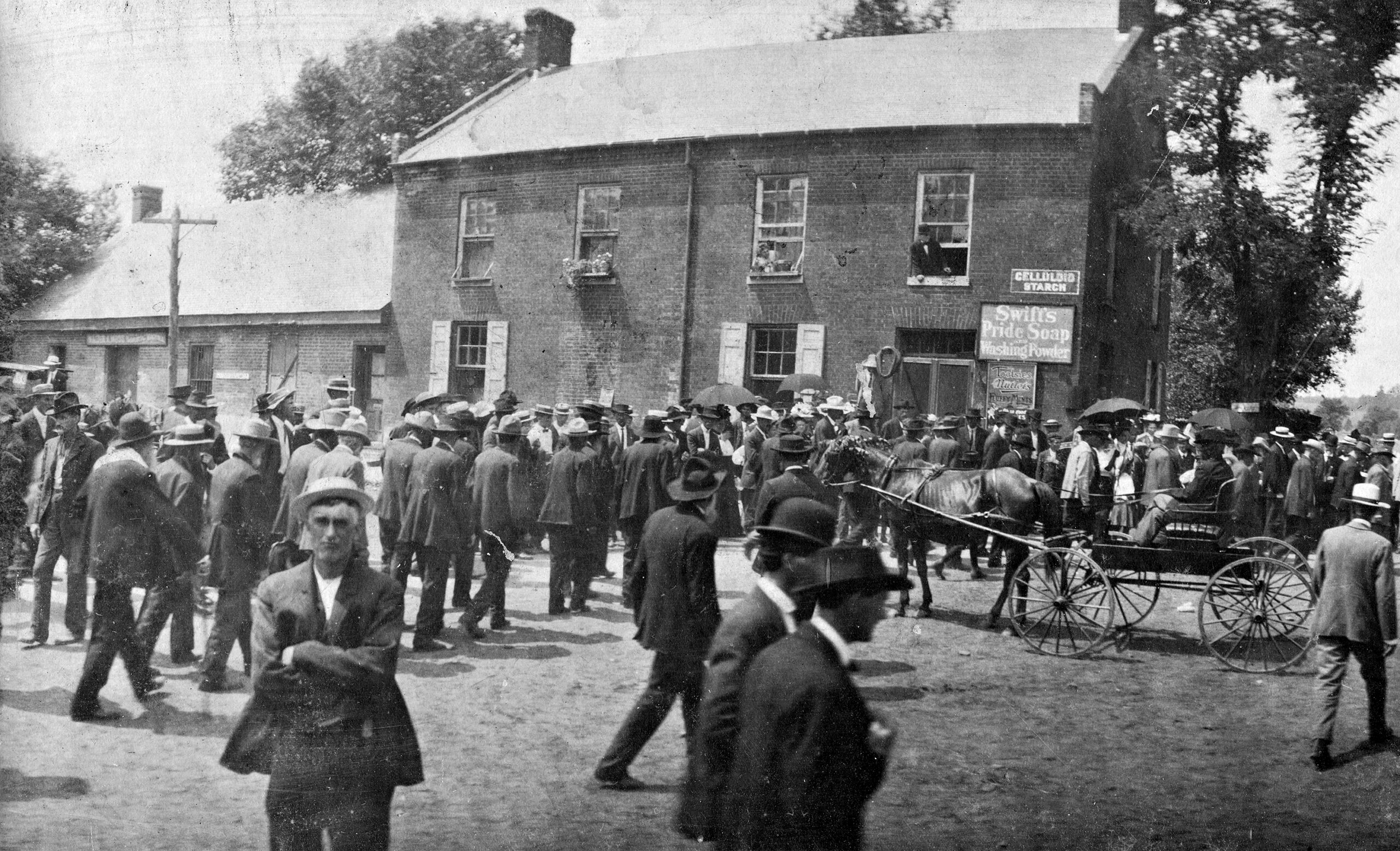
Prior to the Dorrier Building, an earlier structure stood on this site. It can be seen on the left in this panorama, taken in 1908 by local photographer William Burgess during the Reunion of Confederate Veterans. The photo was shot from the intersection of Valley and Main, looking up West Main Street.
Constructed around 1910 by J.L. Pitts, this was the site of the Scottsville Drug Company, started by Thomas Ellison Bruce, the first pharmacist in Scottsville.
Many businesses have operated at this location over the past 100 years, including general mercantile and several restaurants. From 2010 to present (2026) it has been home of Farmstead Ferments, an active supporter of the farmers market and the local community.
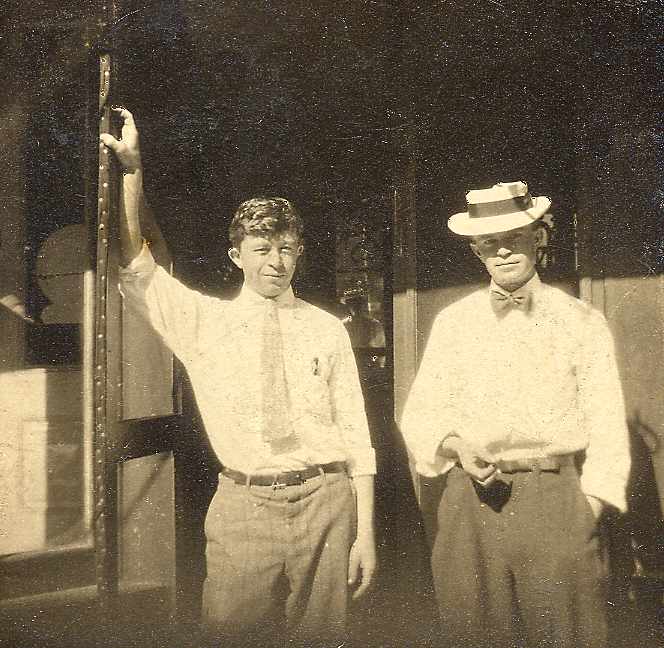
The Pitts Building at 330 Valley Street in 1912, as Scottsville Drug Company. T.E. Bruce standing the doorway.Postcard of Valley Street from the corner at Main Street in 1928. Pitts building in the center.T.E. Bruce, left, with his brother in 1913
The Scottsville Drug Company operated here for several years before moving next door as Bruce’s Drug Store. The history of the pharmacy and T.E. Bruce can be found at this link:
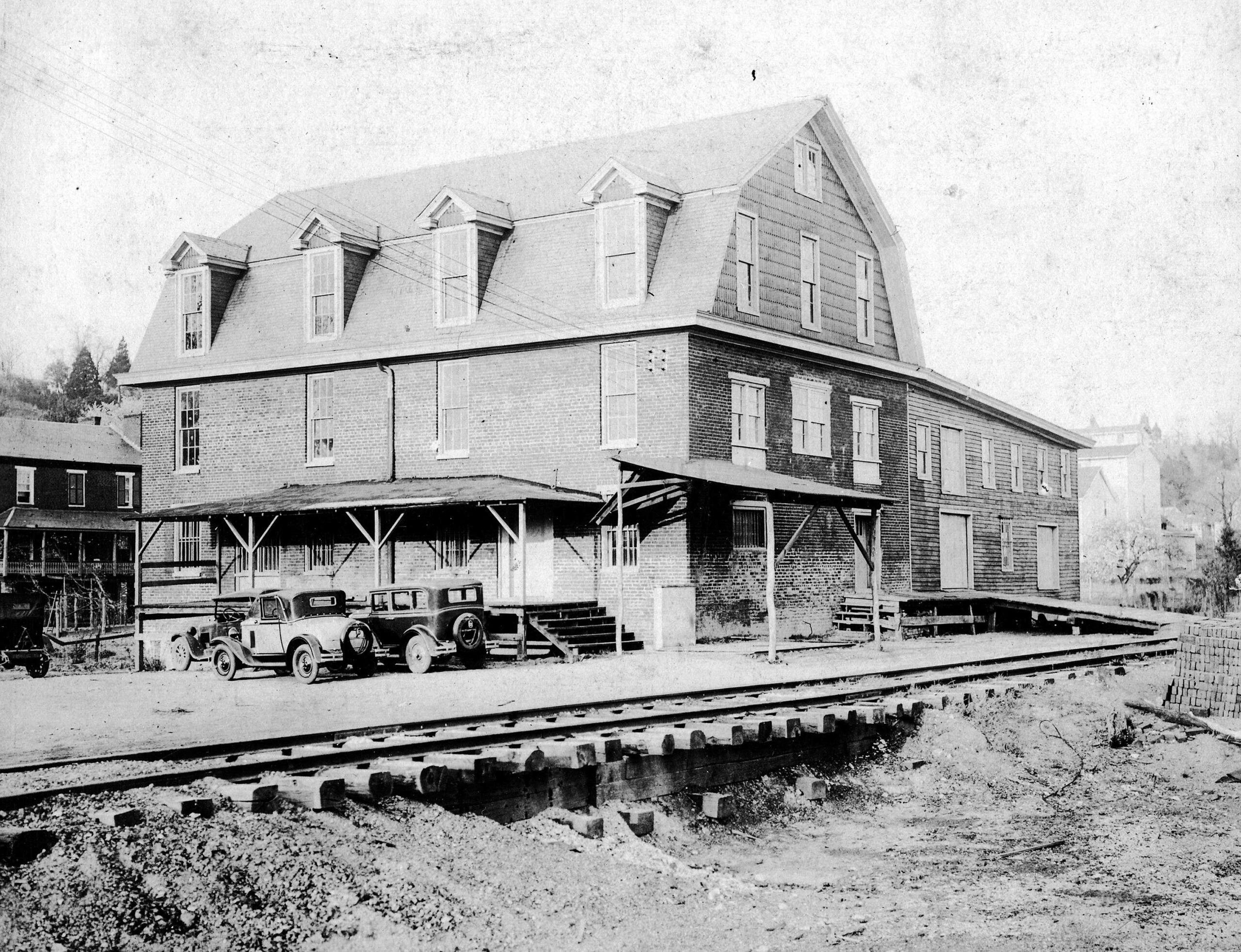
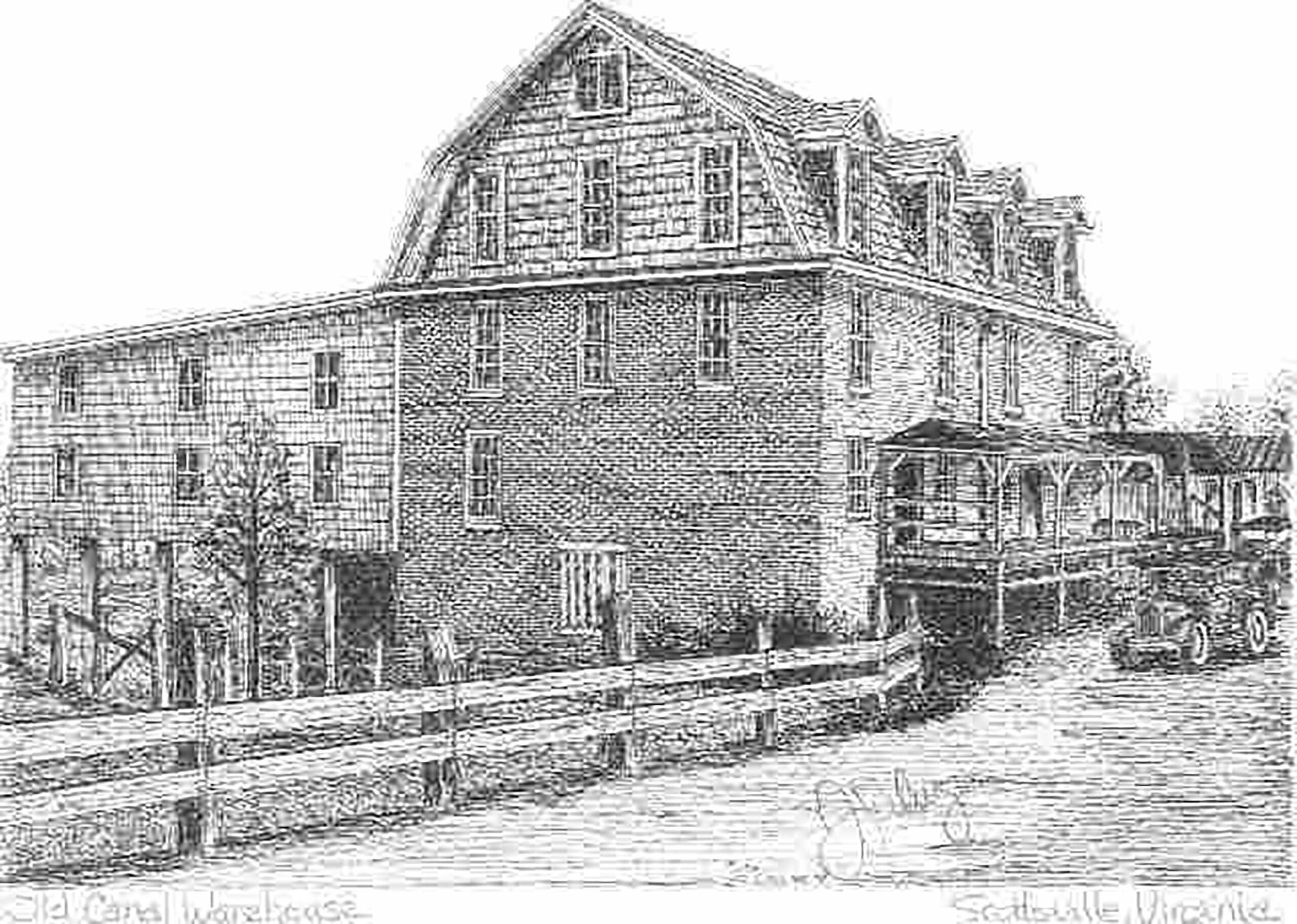
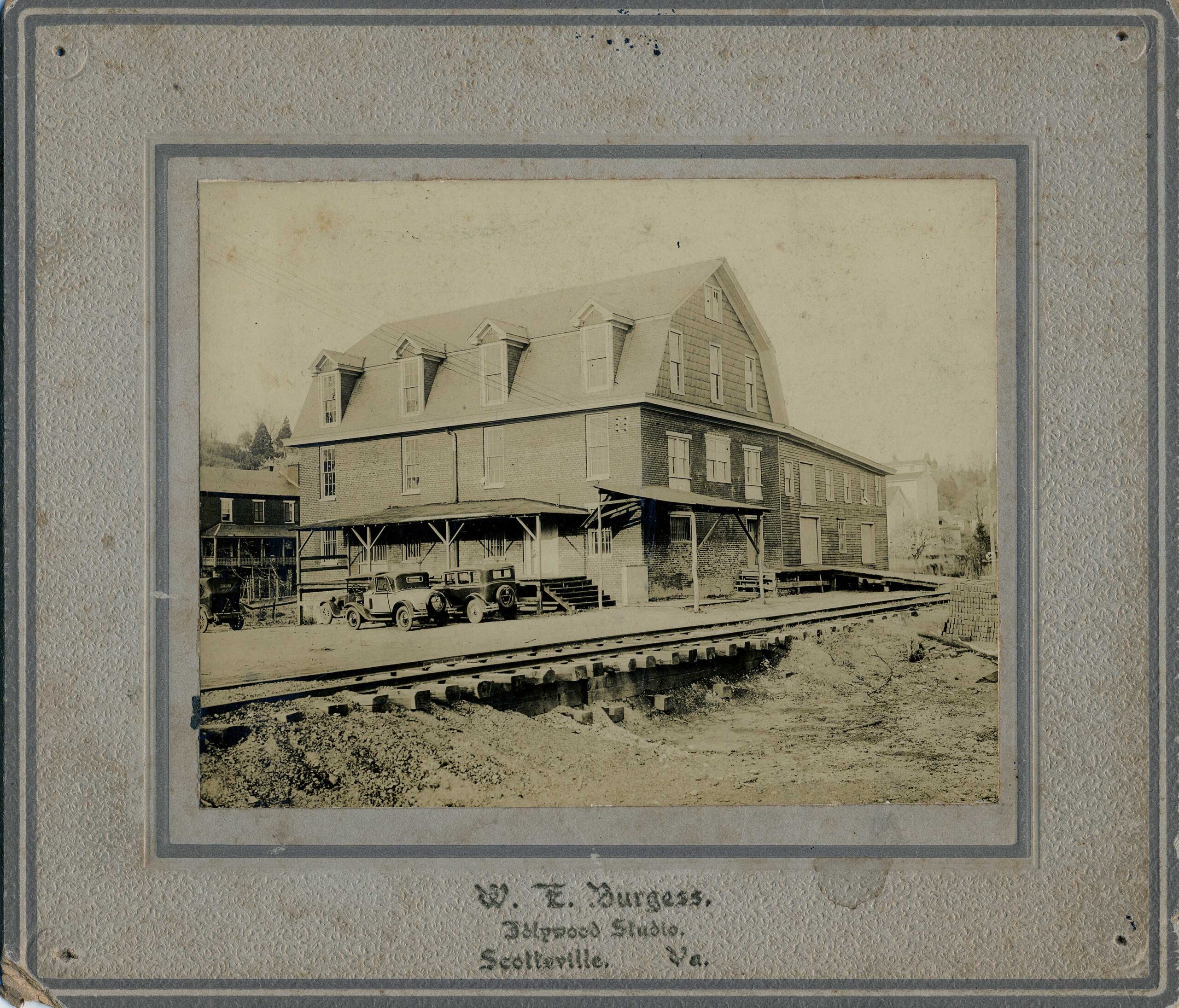
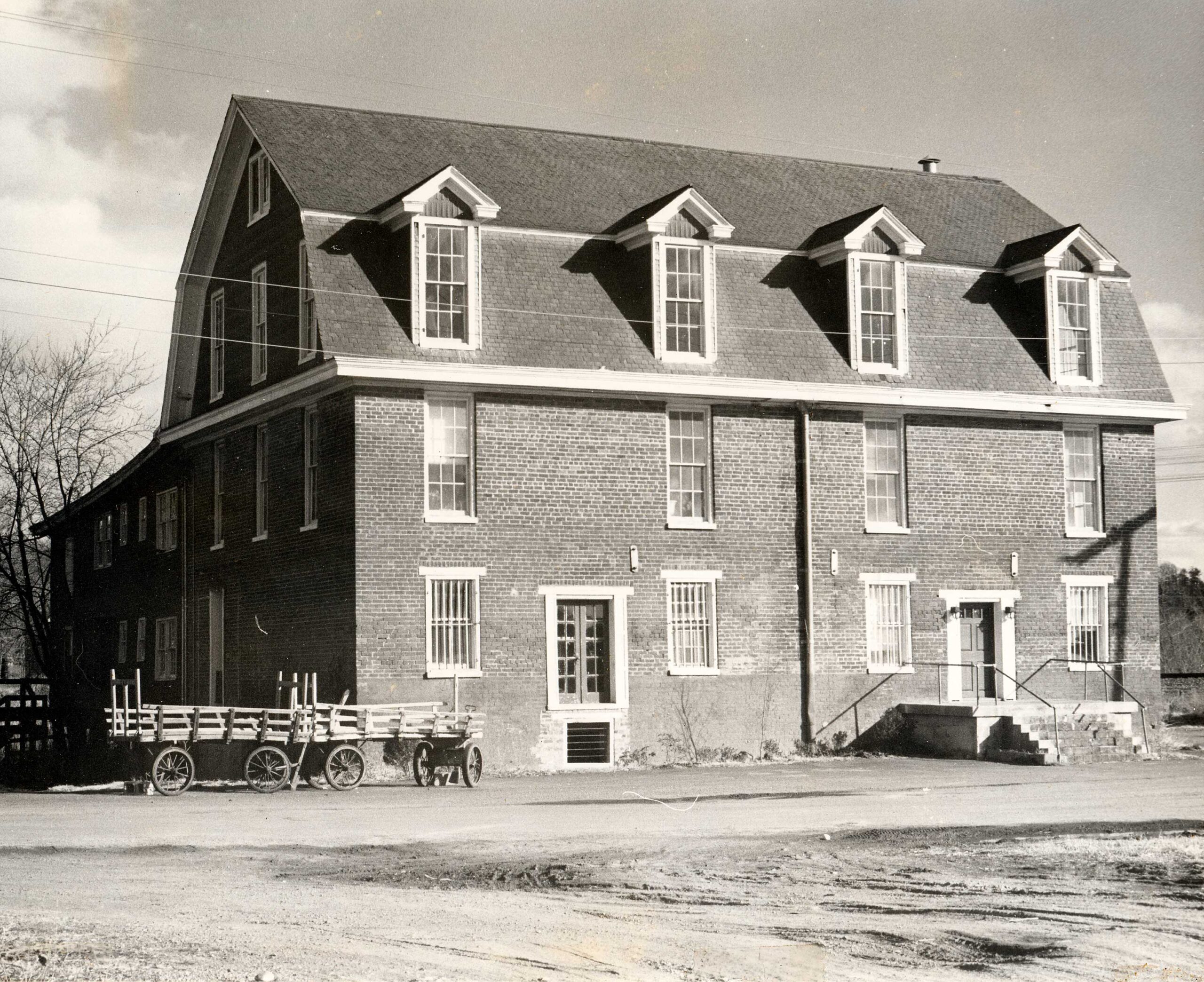
Name: Old Canal Warehouse. Date: ca. 1925-1930 Image Number: B35cdB14
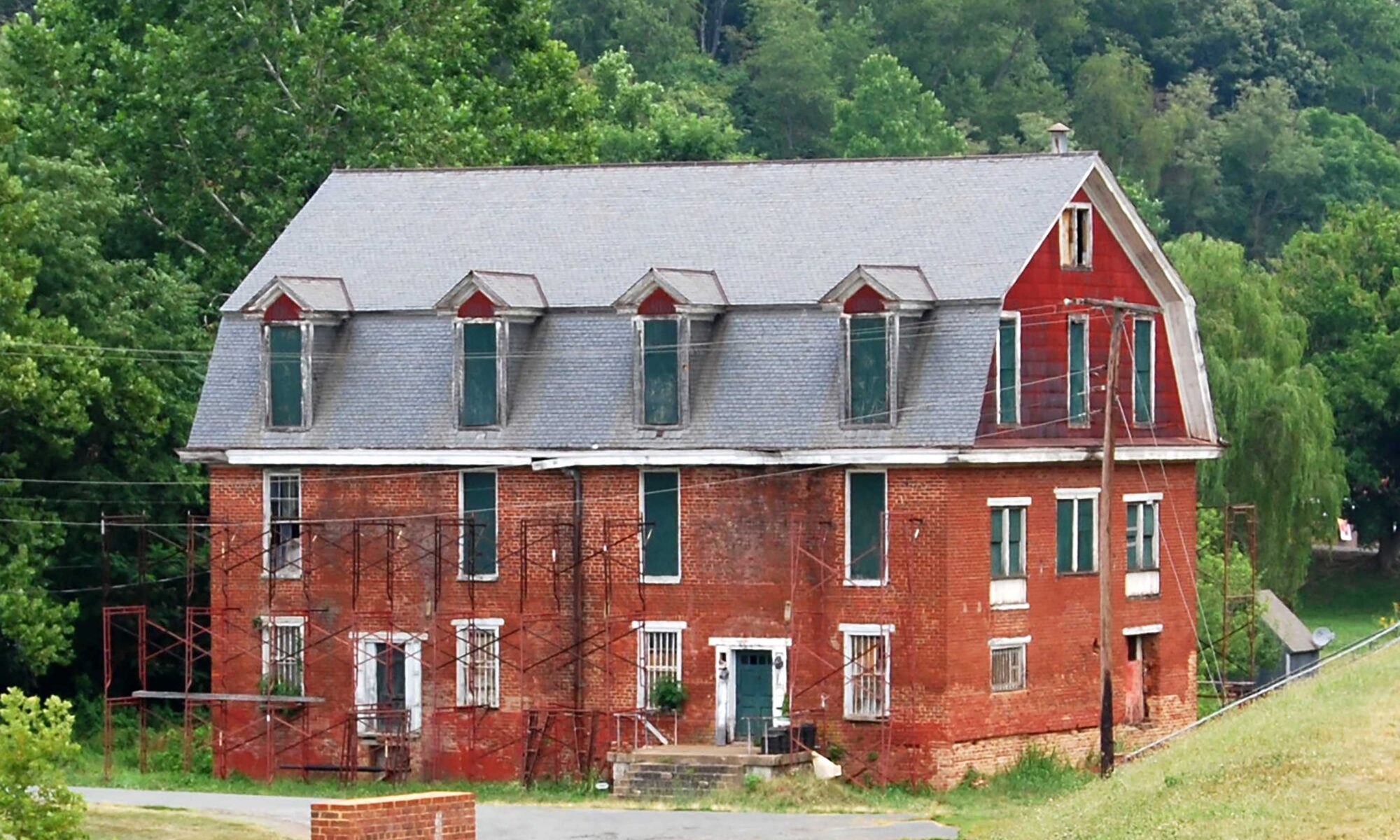
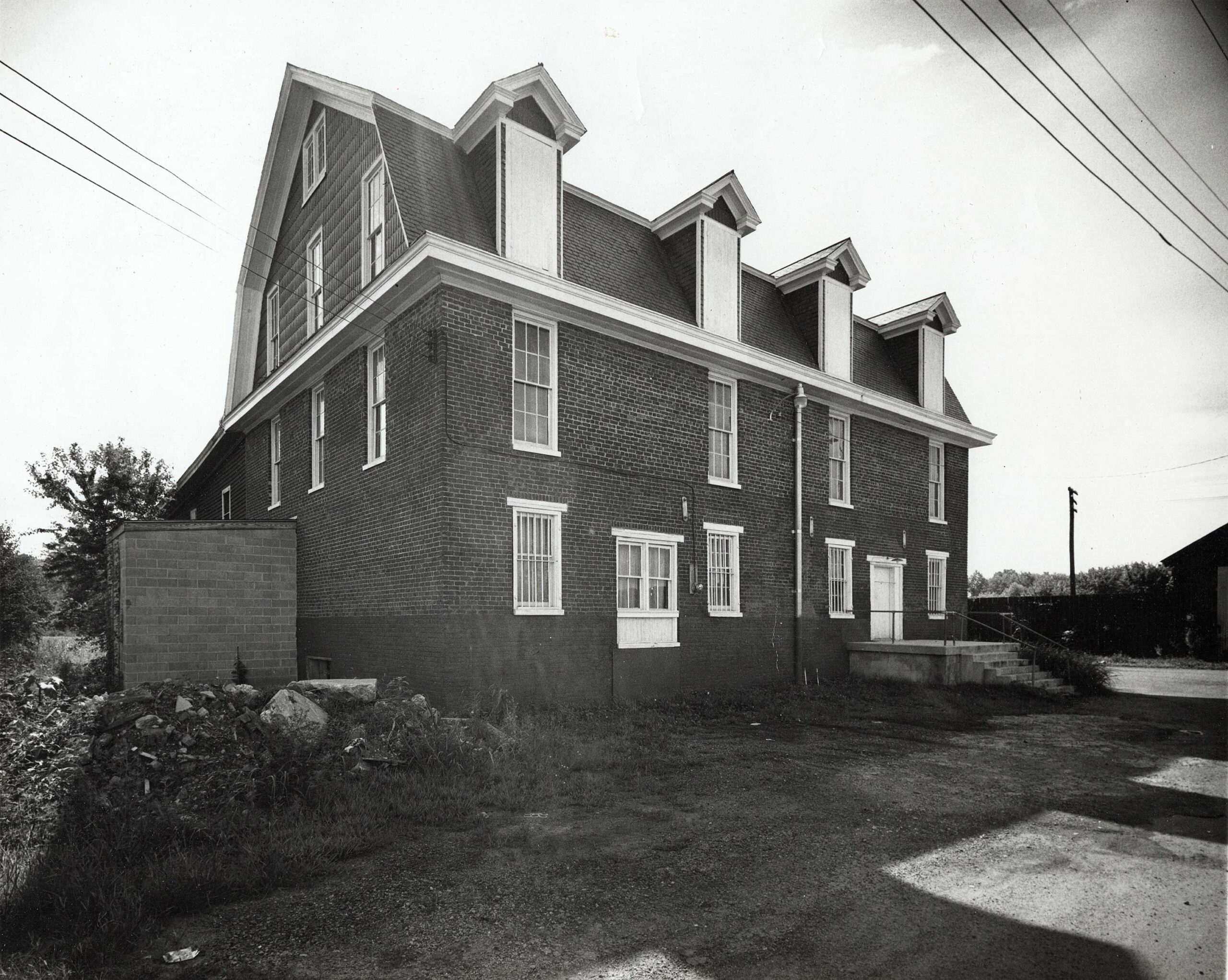
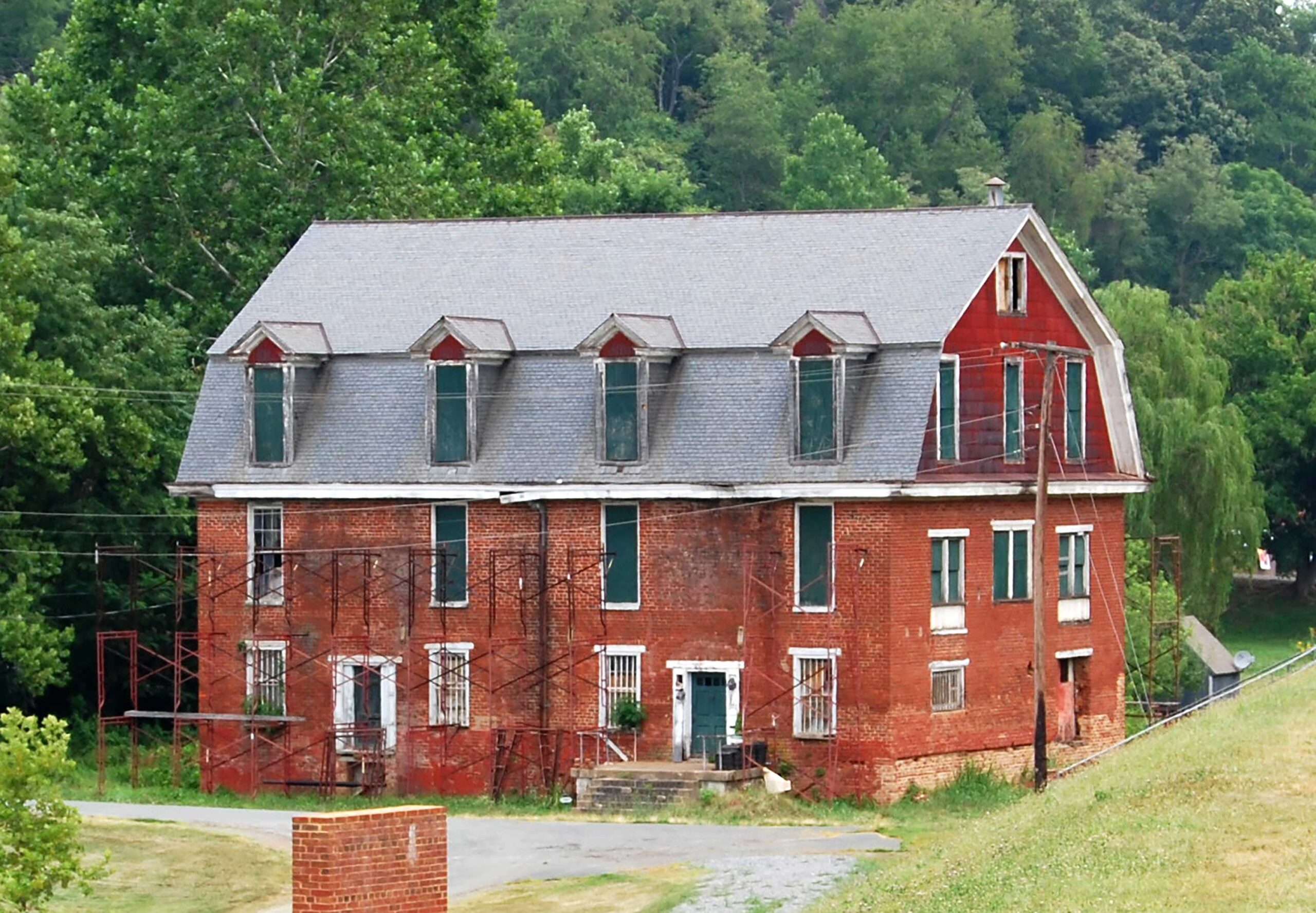
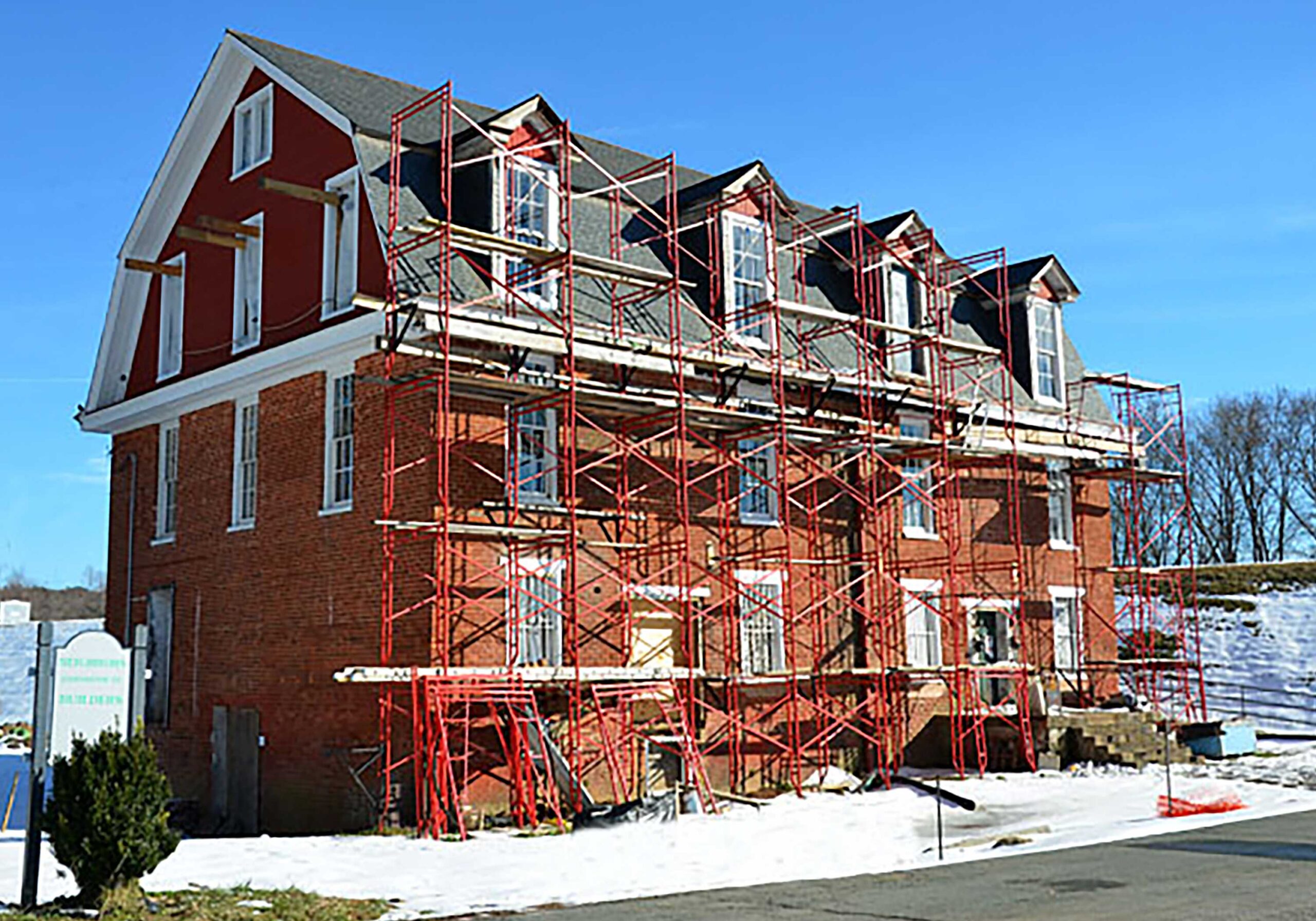
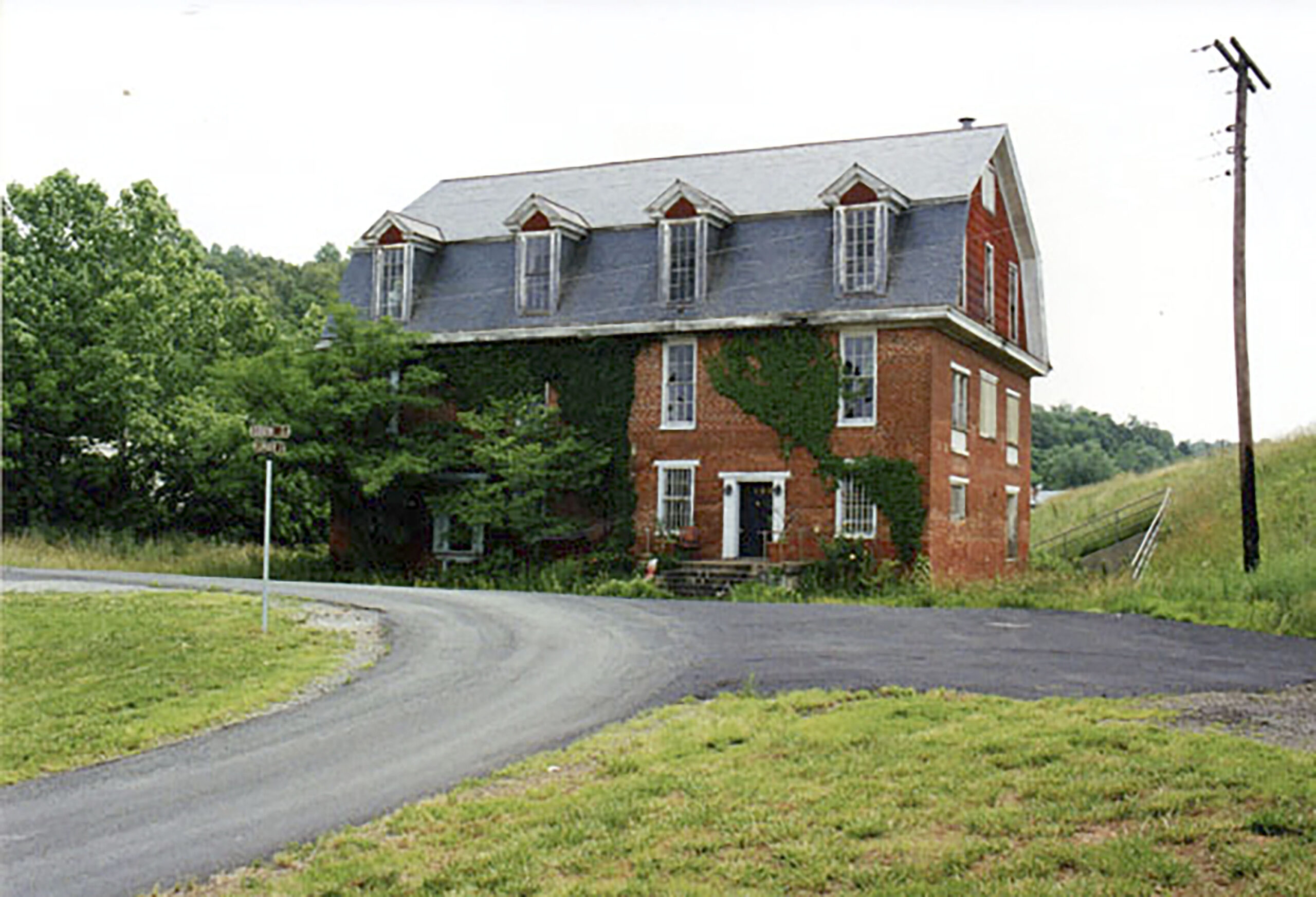
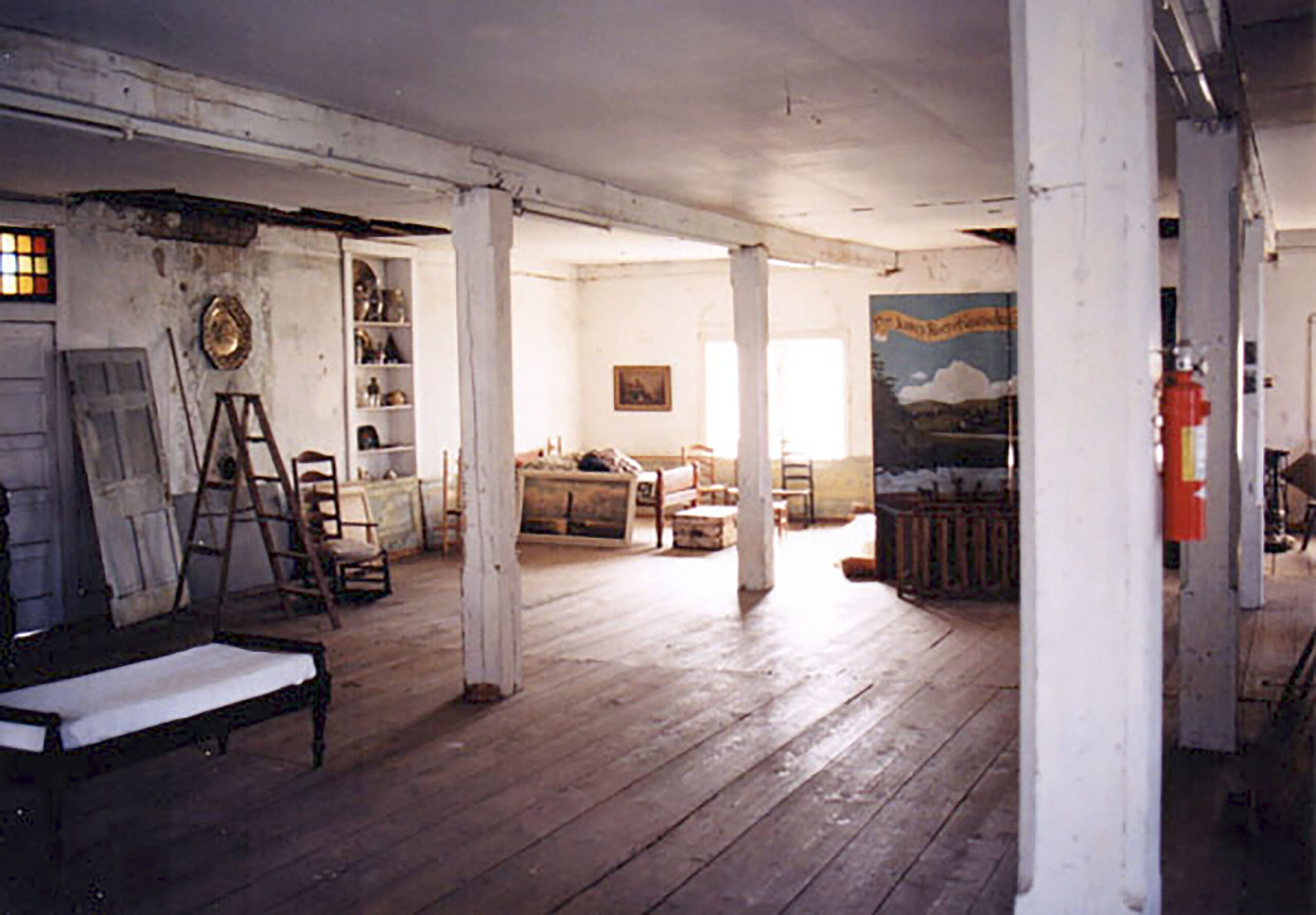
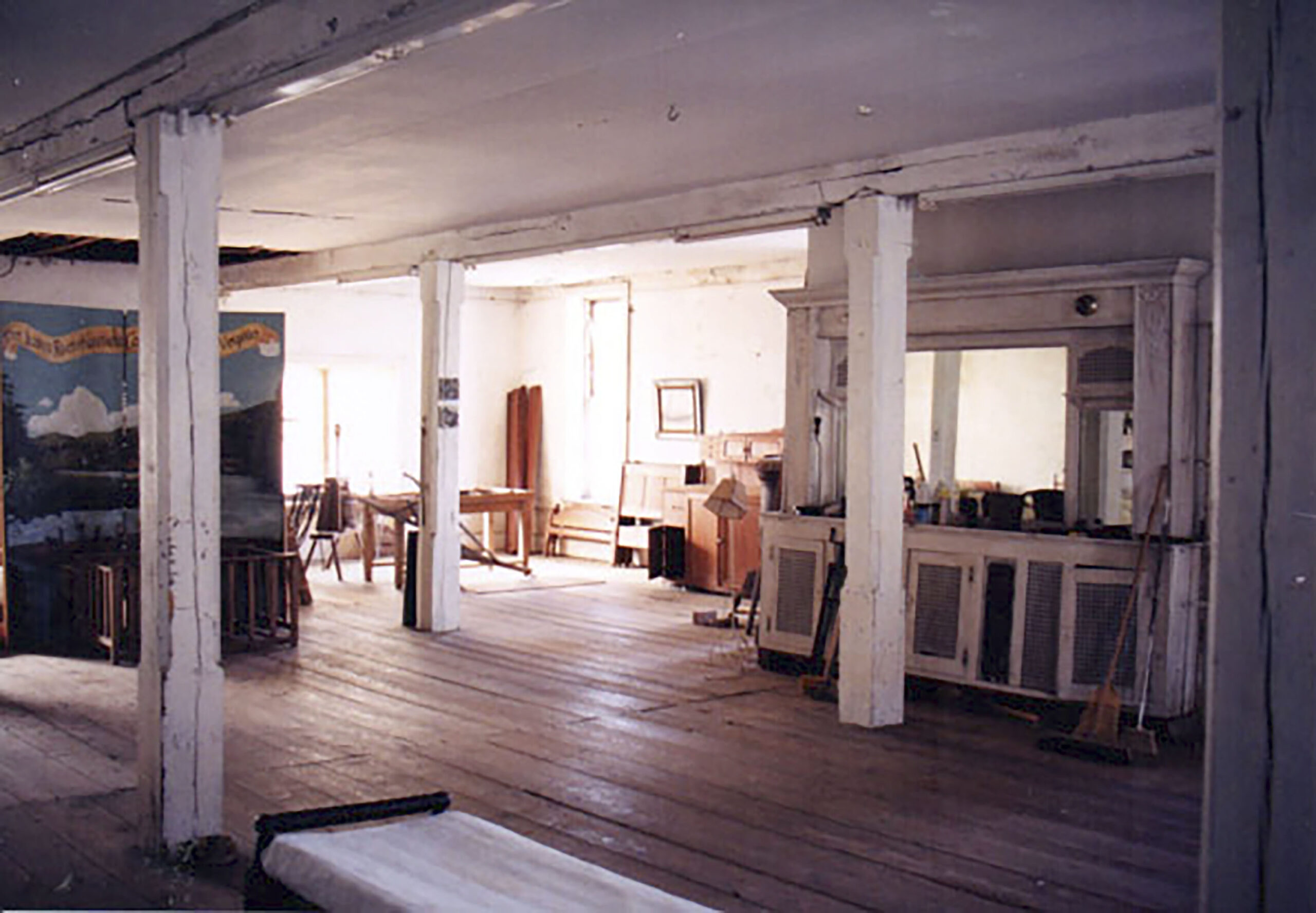
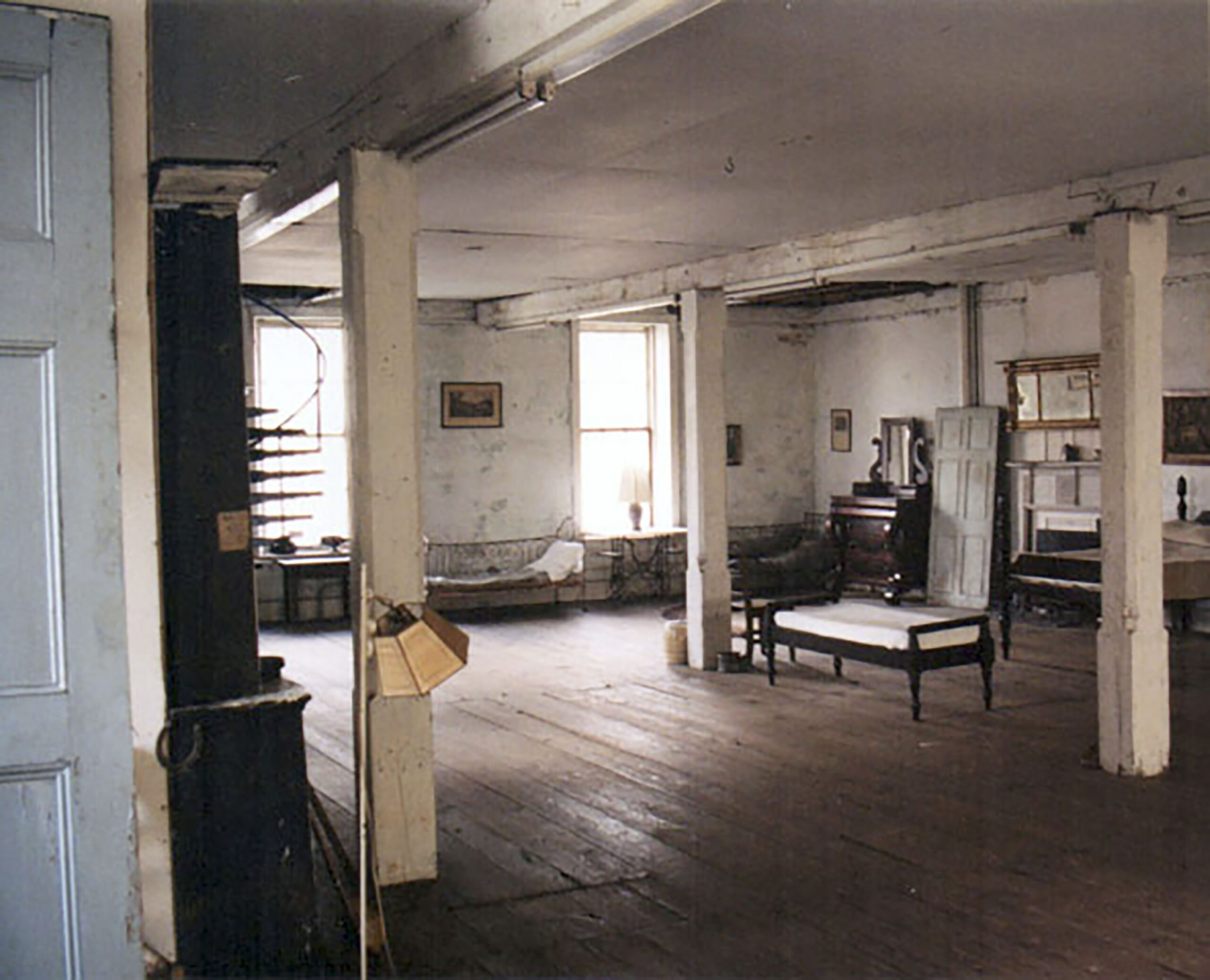
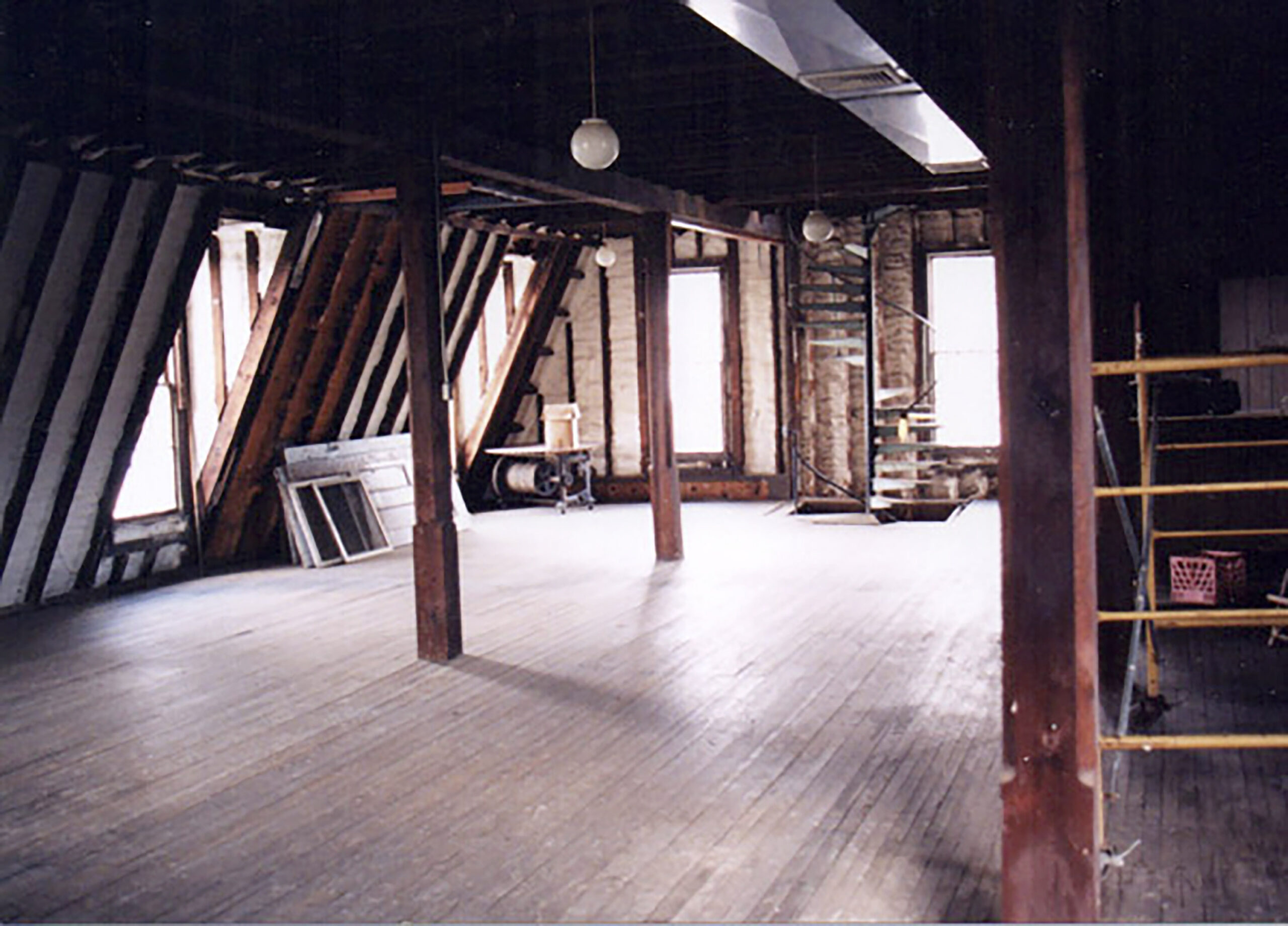
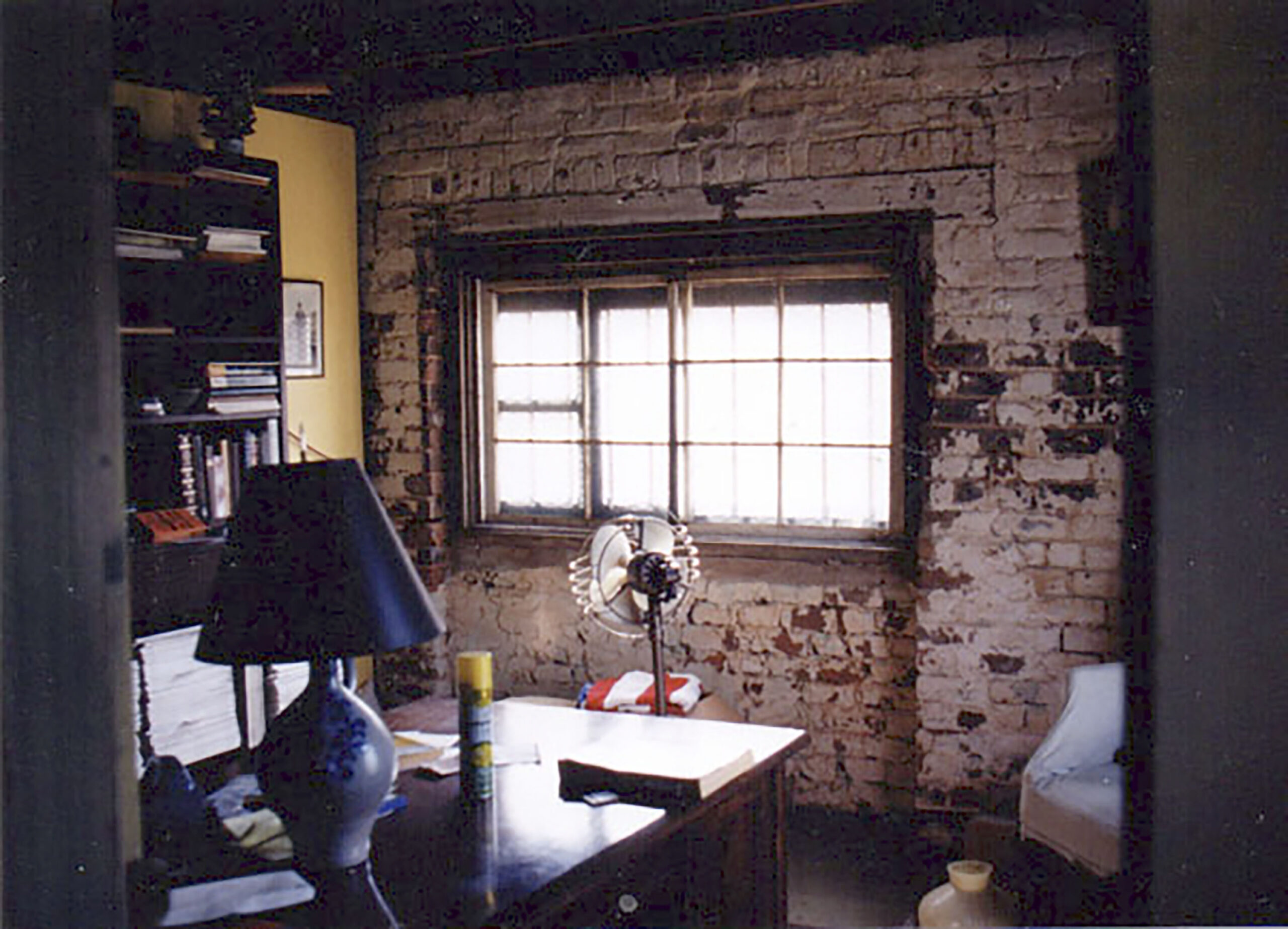
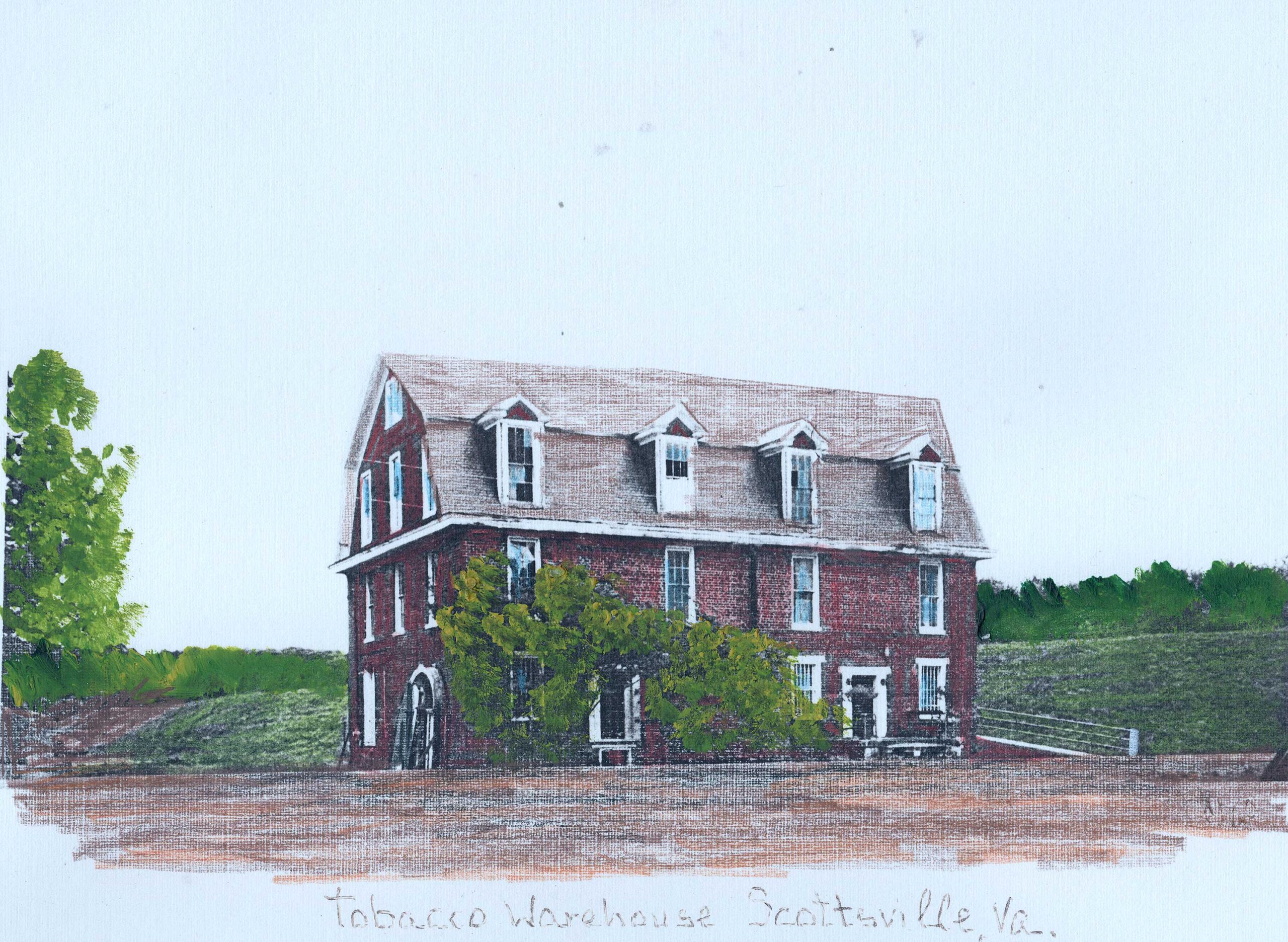
Built around 1834-1844, the Canal Warehouse is a large, gambrel-roofed building, located along the former James River & Kanawha Canal bank in Scottsville. While river and canal traffic flourished, the warehouse was full of tobacco, grain, and other produce waiting to be shipped to Richmond markets.
Canal Warehouse as it appeared circa 1830
Scottsville was an important shipping point on the canal, and many townsfolk were employed by the James River & Kanawha Canal Company. The Company’s stables were located at the corner of Valley and Main Street, and hotels and boarding houses sprang up along Valley and Main Streets to house the wagoners rolling into town with loads of wheat from the Shenandoah. After processing the wheat to flour at a local mill, the barrels of flour were shipped onward to Richmond on the canal. According to President Joseph E. Cabell’s 6th Annual JR & KC Report, “On the 18th of November 1840, a freight boat belonging to Messers Shepperson & Co. of Scottsville arrived in Richmond with a cargo of 300 barrels of flour from the town of Scottsville.”
After emptying their wagons at the Canal warehouse, the same wagoners loaded up manufactured products, shipped by canal from Richmond to Scottsville, and headed back to their Shenandoah homes via the Staunton Turnpike. According to John Hammond Moore in Albemarle 1727-1976, “In 1827, the Staunton or Rockfish Gap turnpike from Staunton across Afton’s Gap to North Garden and Scottsville was completed.
With the opening of the James River and Kanawha Canal in 1840, land and water traffic through Scottsville prospered. In 1841, $30,000 was collected on freight shipped from Scottsville to Richmond. Most of this passed over the turnpike, 43 1/2 miles, from Staunton. A traveler reported in May 1845 at least fifty heavy wagons on the road, and one week in October 1845, some 1400 barrels of flour were inspected at Scottsville, while much more moved to Richmond uninspected. In 1847, the Rockfish Gap Turnpike office moved from Staunton to Scottsville. In 1850, some 70 mountain wagons were counted in town.”
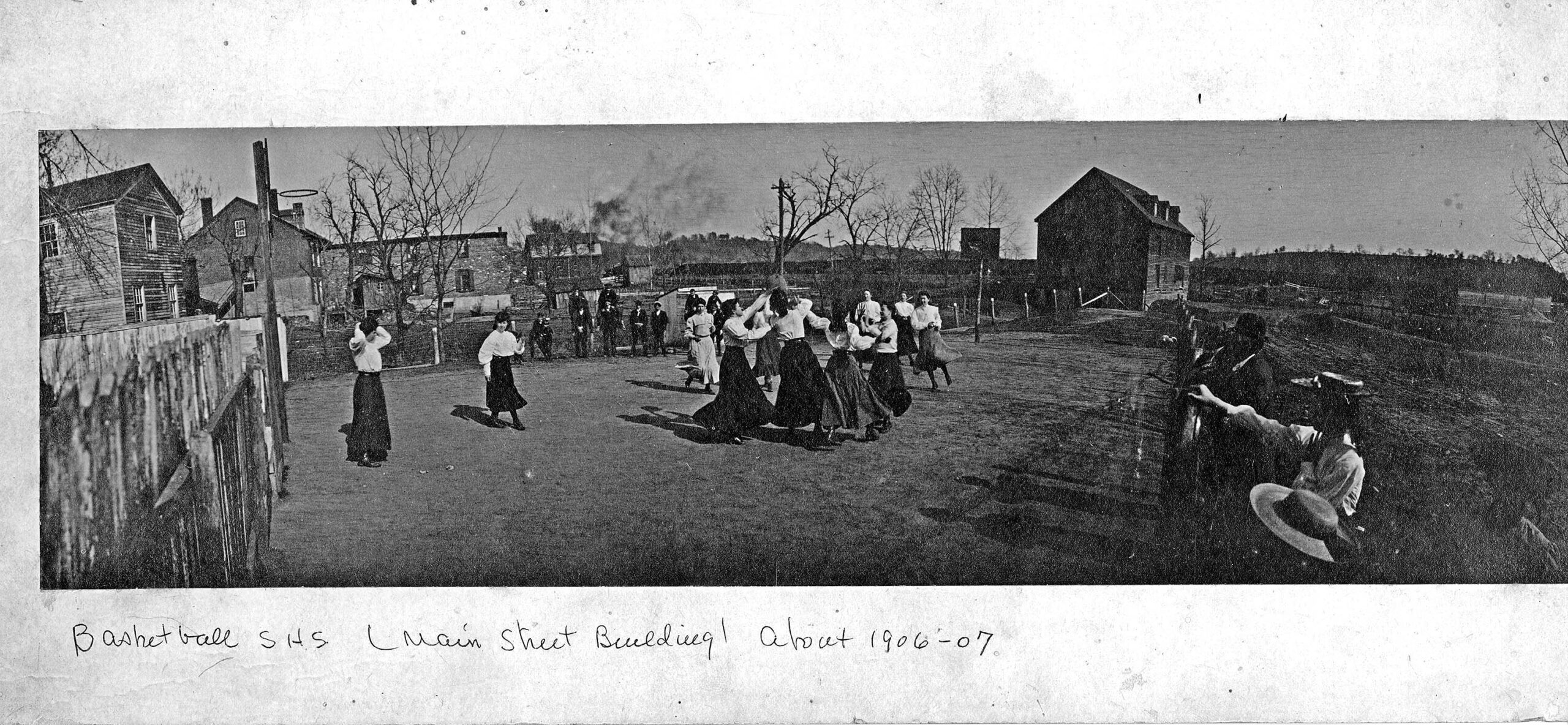
Scottsville High School Girl’s Basketball with Canal Warehouse in background in 1906-07
“The canal brought substantial prosperity to the southern end of Albemarle. A petition seeking a branch bank (Jan. 14, 1842) estimated the Scottsville community had some 1000 souls, together with 21 stores, ’24 mechanics’ shops of various kinds, 3 taverns, a tobacco factory, and 4 churches. Canal transport eastward was conducted by 9 freight boats and 2 packets. Produce and freight valued at over $1 million was being shipped annually.”
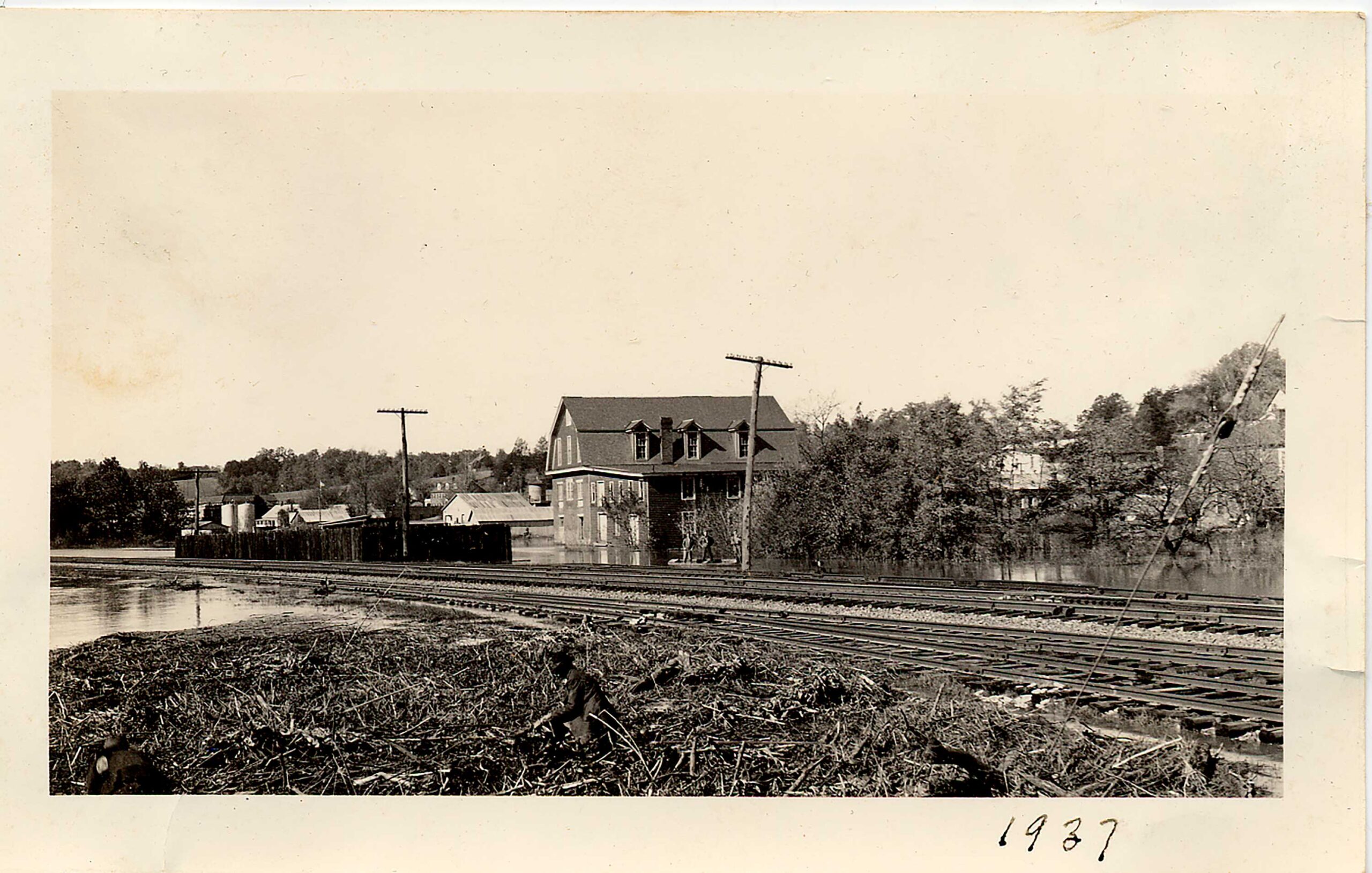
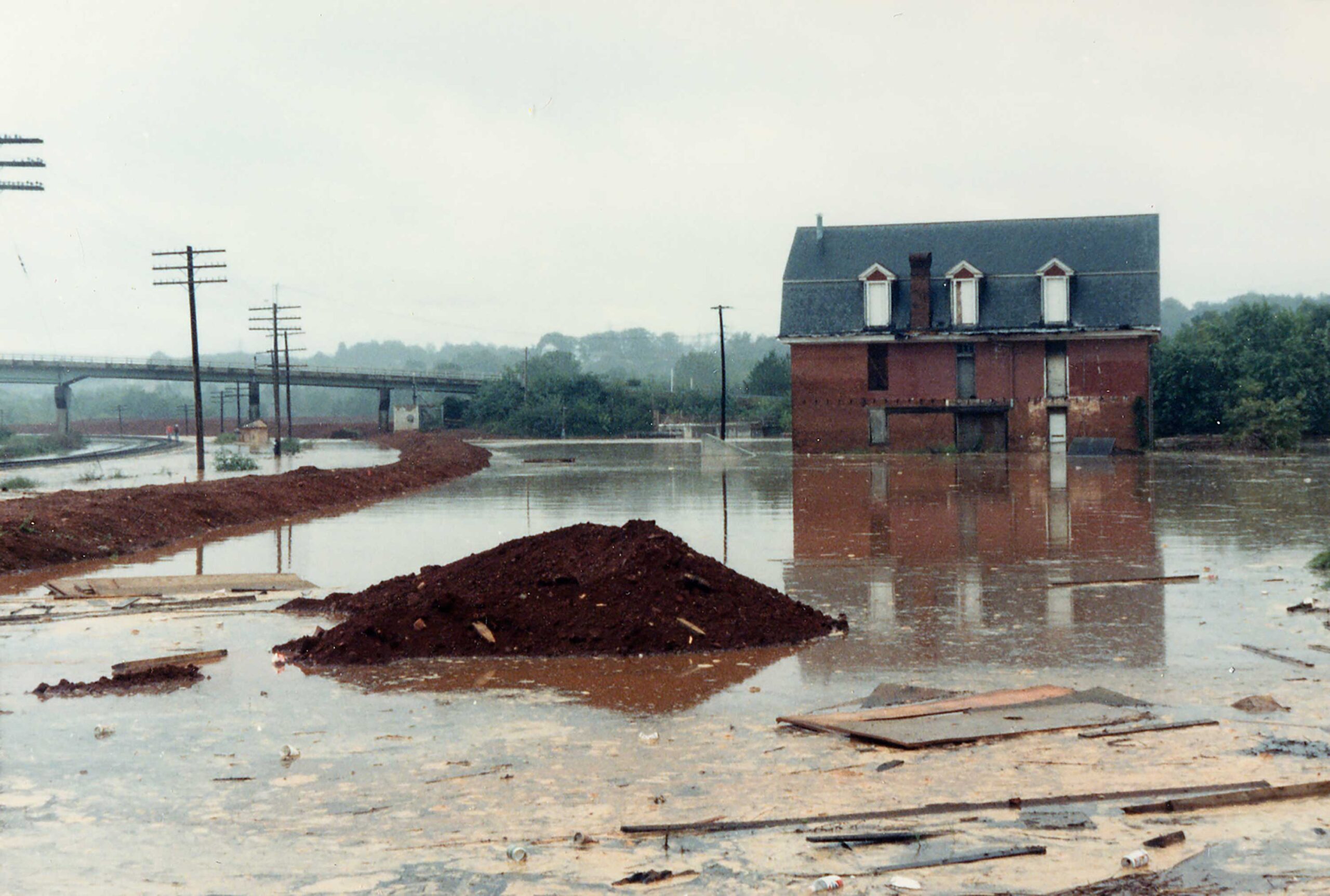
During the flood of 1937
Scottsville used this building on South Street for many different purposes after the canal’s demise in 1880.
During the 1940’s, the old Canal Warehouse even served as a much-loved social center for Scottsville as described in the following article by Callie Bowers.
– • 0 • –
Old Canal Warehouse Memories by Callie Bowers
In the 1940s, Scottsville once again became the social and business center for southern Albemarle, northern Nelson, and Buckingham counties. Not since the heyday of the canal era had there been such prosperity. Everyone who watched “The Waltons” knows that The Dew Drop Inn in Scottsville was the place to be! Certainly, this was an exciting time. Coming out of a childhood lived during the depression, the townsfolk embraced the growing prosperity generated by World War II. In 1944, The Canal Warehouse, also known by then as The Farmer’s Exchange, was bought by the Scottsville Fire Department from C.R. and Clara Dorrier who had owned it for seventeen years.
Townsfolk who lived during this era still smile wistfully when telling about the dances that had this Scottsville landmark rocking. It was during this era that the firemen and the Lions Club made The Canal Warehouse their home. The firemen sponsored dances every Friday night and a big formal New Year’s Ball.
One year, Reeve Nicholas booked two bands by mistake but was saved from embarrassment when a huge snowstorm kept one of the bands from coming. The band that did show up was so bad the firemen and their guests finally ended up making their own music. They could do this most readily since the members of the Scottsville Orchestra — the usual dance musicians — were there, though they had planned on dancing rather than playing for a change. The group was normally made up of Ruth Kent Pitts on the piano, John Henry Phillips on drums, Jack Miller on saxophone, Wiley “Happy” Anderson on banjo, and Curtis “Sticks” Conrad on cornet. Sometimes Ed Evans from Fluvanna would play the sax, and sometimes Harold Parr would give it an old “toot toot” as well.
Sis Coleman recalls going up to Dr. Moody’s house on the hill to make sandwiches to be sold at the dances. Mattie Leigh Golladay Willke made hers at home. There was a huge pot-bellied stove that kept the place warm. Among the songs the orchestra played were such favorites as “Sentimental Journey,” “Tangerine,” “Stars Fell on Alabama,” “The Nearness of You,” “Harbor Lights,” “Stardust,” and “Good Night Irene.”
Wonder which song they were playing in 1945 when Rudy Johnson spotted Frank Shumaker (home on leave from the Navy) across the room and fell completely and forever in love? They were married the next year. Wonder who else was there that night? Perhaps G.B. Cleveland, Sis and Tom Coleman, Milton and Rosemae Cohen, “Chick” and Shirley Dorrier, “Dukes” and Jimmy Johnson, Bob and Vernell Coleman, Reeve and Ampy Nicholas, Rosemary and Leslie Harrison, Austin and Christine Easton, Evelyn and Doug White, Ambrose Payne, Mary Pearl Turner Cook, and Arbutus and Raymon Thacker? All were said to have been regular or occasional attendees.
The Old Warehouse was the setting for the Firemen’s Bazaars as well. The Firemen’s Ladies Auxiliary had bake sales and helped out. Mattie Leigh helped buy the prizes for the bingo games that went on continually on the second floor. Sis Coleman had a beautiful punch bowl she won. Bobby Spencer recalls the huge table of prizes shining under the lights.
I remember the games, rather like midway games, on the first floor. My favorites were taking a chance on the duck that was bobbing in an actual trough of water. One paid a dime, chose a duck and got a prize according to the number on the bottom. Throwing the hoop over an upright was a bit more chancy. Sometimes it just fell off the side. The better prizes were accorded to the uprights farthest to the back. How I wanted a cupie doll or a stuffed animal! I can still hear the spinning of the roulette wheel, the loud popping sound from the air guns at the shooting gallery, the excited rumble of voices. I can almost smell the popcorn!
– • 0 • –
Today, the Canal Warehouse is used only for storage. Built before 1844, time, fires, floods, and vandalism have taken their toll.
During the flood of 1985
As you drive by, stop awhile and take a look at the beautiful lines and details, the fine workmanship, and the unusual Gambrel roof. Imagine the good times, the laughter and joy, and the civic pride this grand old building once afforded the town. What will the future hold for this treasured historic structure?
Following are some photos of the Canal Warehouse and its interior that were taken in the 1990’s: